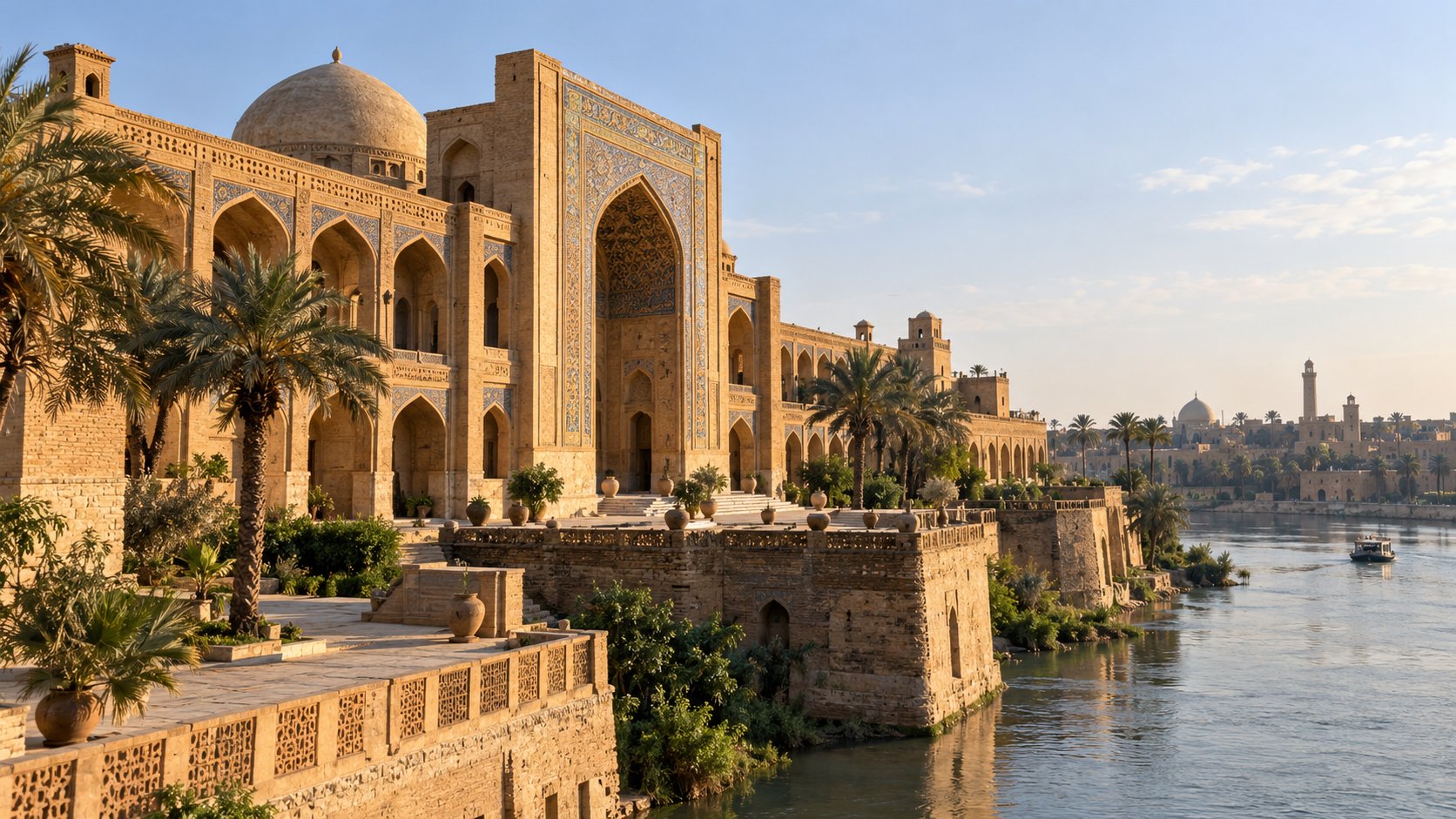
Standing near the eastern bank of the Tigris River in Baghdad’s Al-Rusafa district, the Al-Abbasid Palace is one of the few surviving monuments from the late Abbasid Caliphate, renowned for its intricate geometric brickwork and soaring iwans.
Al-Abbasid Palace in Baghdad
Standing near the eastern bank of the Tigris River in Baghdad’s Al-Rusafa district, the Al-Abbasid Palace (al-Qasr al-Abbasi) is one of the few surviving monuments from the late Abbasid Caliphate. Built of baked brick and carved terracotta, this two-story building offers visitors direct contact with Baghdad's architectural heritage before the Mongol sack of 1258.
Today, the complex forms a key anchor of Iraq's UNESCO World Heritage Tentative List submission for the historic riverfront of Rusafa. Whether studied as an imperial palace of Caliph al-Nasir li-Din Allah or as an elite madrasa, the building features intricate geometric brickwork, soaring vaulted iwans, and honeycomb muqarnas vaulting.
Historical Origins and the Scholarly Debate
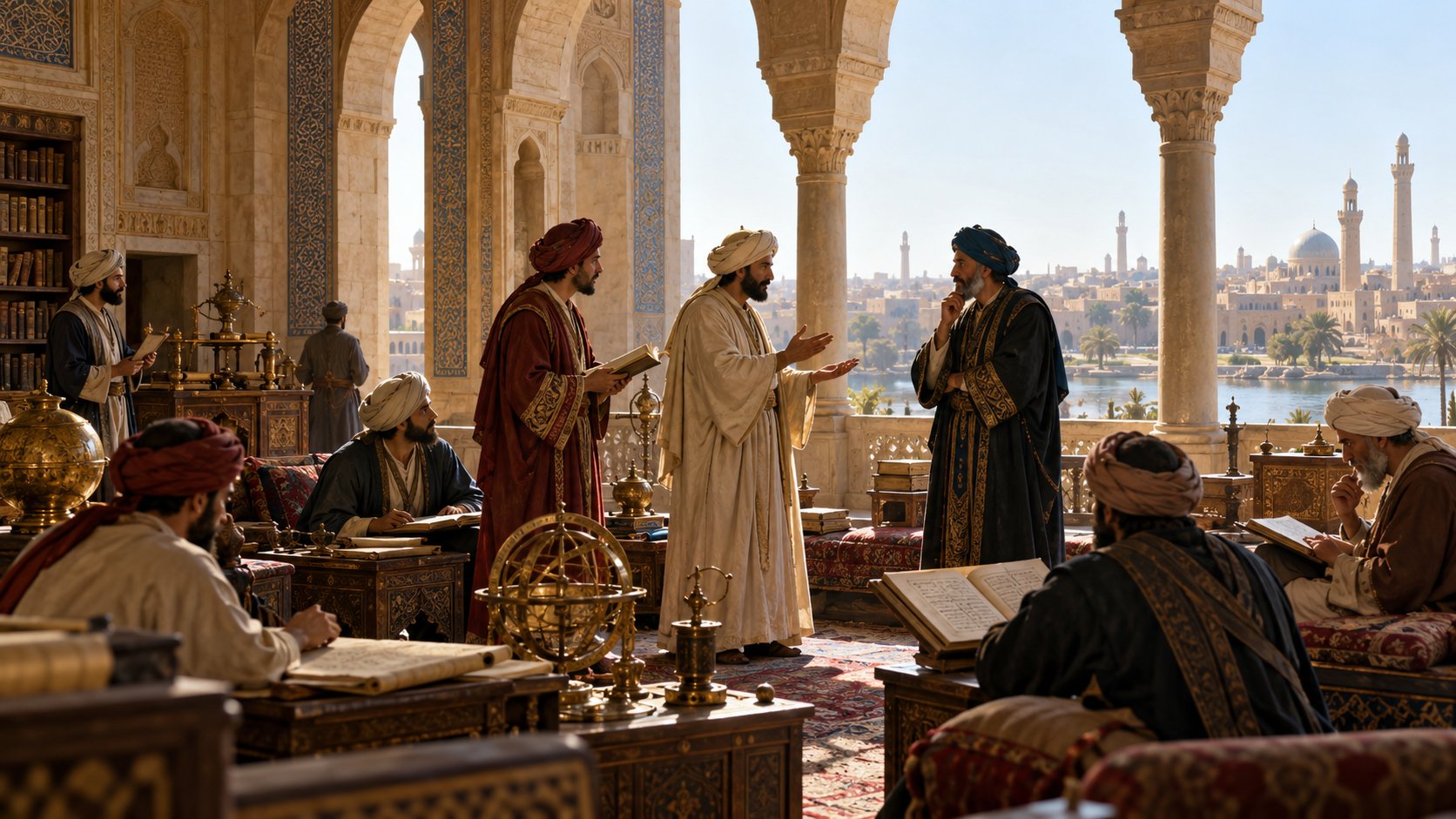
The building dates to the late 12th or early 13th century, during the reign of Caliph Abu al-Abbas Ahmad al-Nasir li-Din Allah (reigned 1180–1225 CE) or his successor Caliph al-Mustansir. During this period, Baghdad saw sustained urban and architectural investment to reinforce caliphal authority and scholarly patronage.
Historians and archaeologists continue to debate the building's original purpose:
- The Caliphal Palace Identification: Iraqi historians Mustafa Jawad and Ya'qub Sarkis identified the complex as a riverside palace built under Caliph al-Nasir between 1180 and 1184 CE. This view aligns with accounts from Andalusian traveler Ibn Jubayr, who visited Baghdad in 1184 and described watching Caliph al-Nasir disembark from royal rivercraft at the quay of his waterfront palace. The complex stood next to the former citadel and eastern defenses of medieval Baghdad, matching its function as a seat for receiving state visitors.
- The Sharabiyya Madrasa Identification: Other architectural historians point out that the building's layout mirrors the nearby Mustansiriyya Madrasa. Two tiers of residential cells flank a central courtyard, alongside a large hall organized as a musalla (prayer room) and indirect entrance corridors. These features led scholars to propose it was the Sharabiyya Madrasa, an institution founded for Islamic jurisprudence and theology.
Whether built as a residence or an academy, the structure is Baghdad's only surviving monumental building from the late Abbasid era.
Architectural Highlights
The Abbasid Palace reflects late Mesopotamian Islamic architecture, marked by Seljuk structural traditions that turned plain baked brick into ornate surface reliefs.
The Monumental Gate and Indirect Entrance (Mabain)
The western entrance facing the Tigris features a tall arched portal framed by carved brick bands. Like many medieval public buildings in Iraq, the entrance leads into an indirect vestibule known as a mabain ("that which is between"). This bent-axis corridor guarded privacy by cutting off direct sightlines from the street into the central courtyard.
The Central Courtyard and Grand Iwan
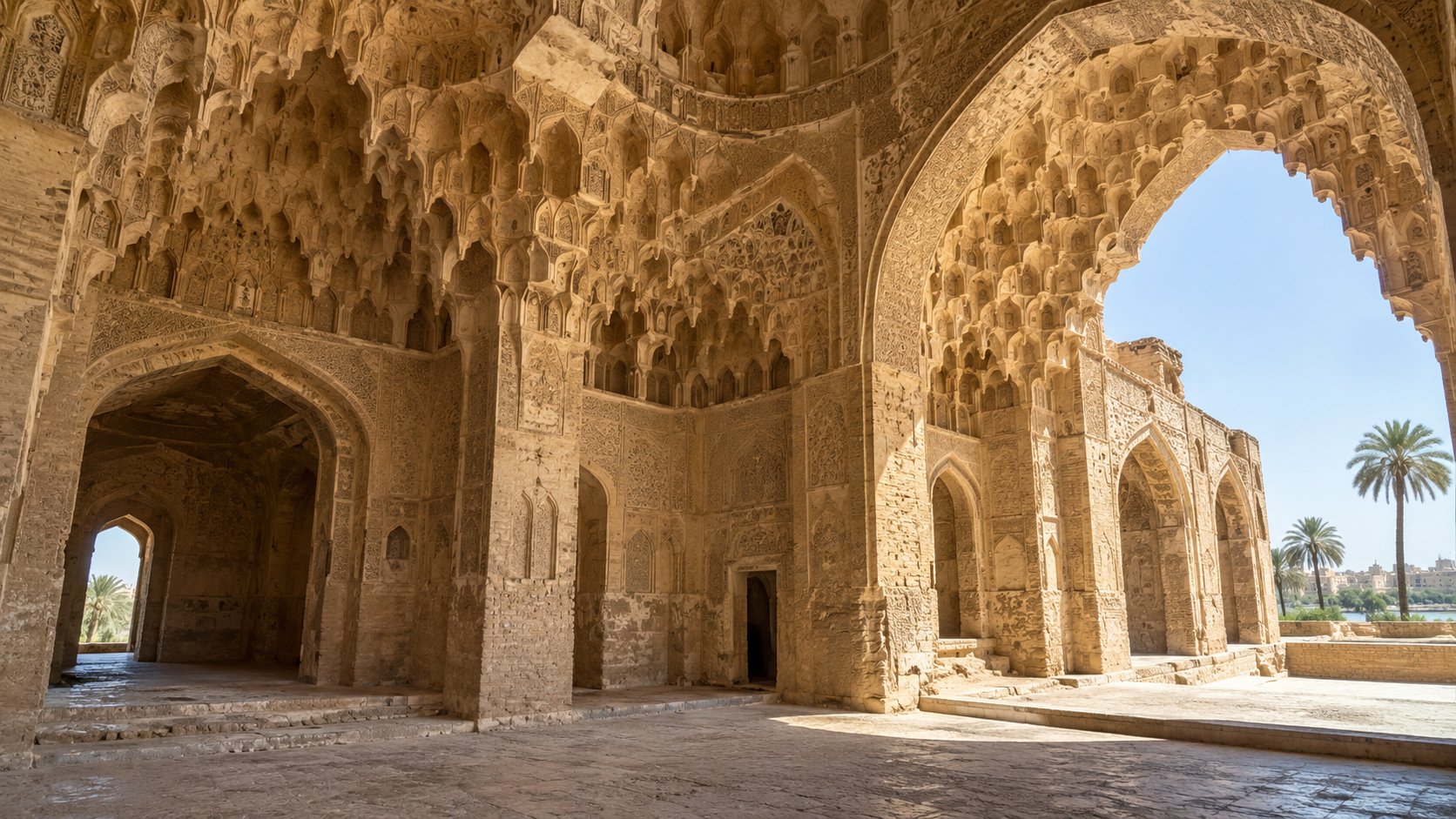
Past the vestibule lies an open rectangular courtyard framed by two-story arcades. The dominant feature is the eastern iwan—a large, barrel-vaulted hall open to the courtyard. Its archway carries geometric arabesques cut into the brickwork, achieving deep texture and shadow without imported stone or glazed tile.
Muqarnas Vaulting and Perimeter Chambers
Both levels of the courtyard open onto covered galleries with muqarnas (corbeled stalactite vaulting). Behind these galleries sit dozens of small vaulted rooms. During periods of educational use, these cells housed students and scholars; during administrative use, they served as offices and guest chambers.
Modern Preservation and Rediscovery
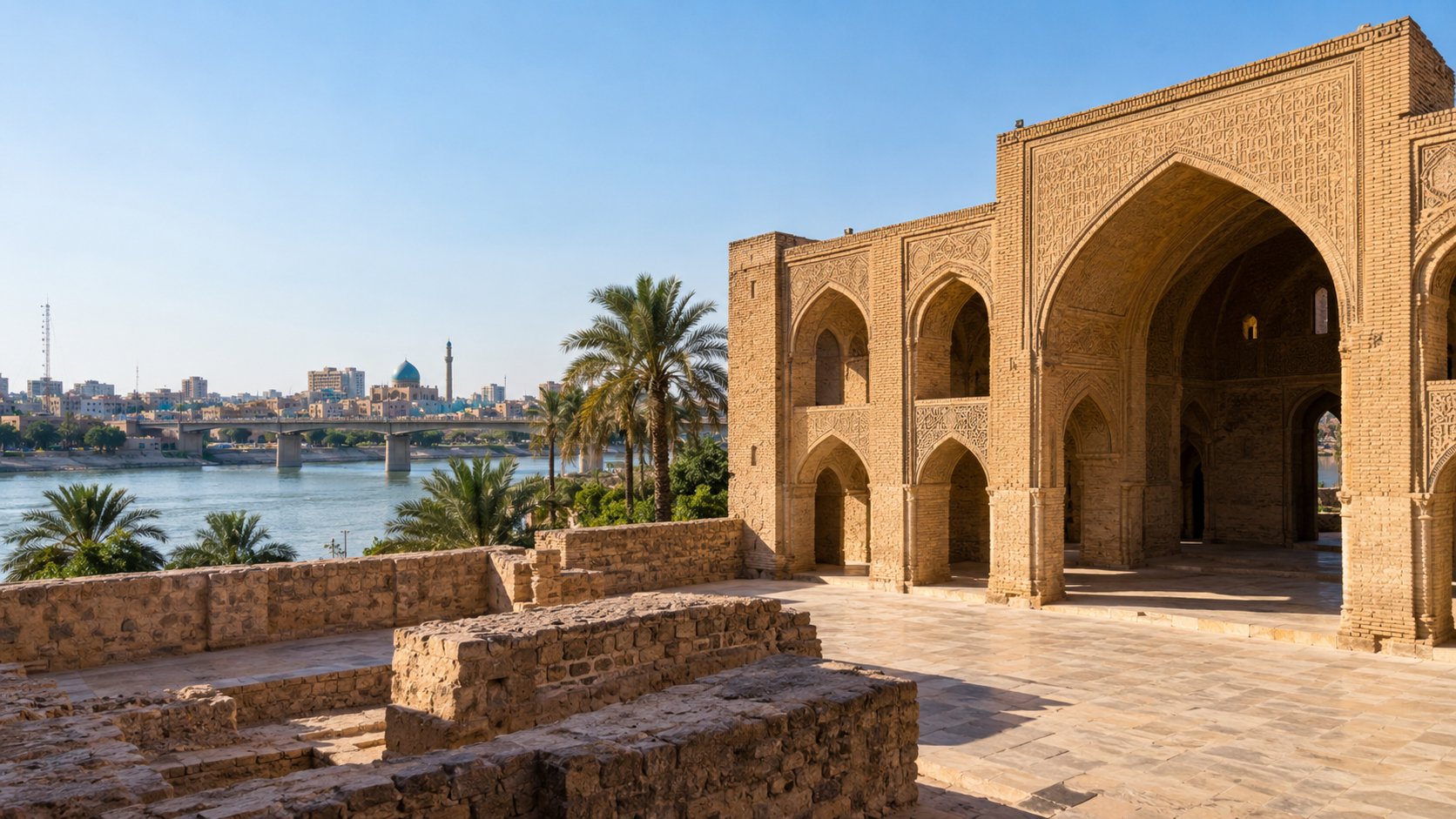
By the early 20th century, recurring Tigris floods, neglect, and urban development had reduced parts of the palace to ruins. German archaeologist Ernst Herzfeld surveyed and documented the structure in the early 1900s, noting it in field records as Iwan al-Qal'ah (Iwan of the Citadel).
In 1933, the Iraqi Directorate of Antiquities began systematic excavations and restoration work that continued across several phases through the 1970s. Teams stabilized the grand iwan, rebuilt missing sections of the courtyard arcades, and restored the entrance vestibule. The Ministry of Culture has since used the restored courtyards for cultural exhibitions, traditional maqam recitals, and scholarly gatherings.
Visitor Guide: Access, Hours, and Practical Information
The Abbasid Palace welcomes independent travelers, guided groups, and architecture researchers in central Baghdad.
- Location: Eastern bank of the Tigris River in the Al-Maidan quarter, northern Al-Rusafa, Baghdad. It sits a short walk north of Al-Mutanabbi Street, near Souq al-Saray and the Ottoman-era Qishla clock tower.
- Opening Hours: Open daily from 08:00 to 13:00, including Friday mornings.
- Admission: Entry is 3,000 IQD (about $2.30 USD) at the gate. Keep small Iraqi dinar cash notes ready.
- Dress Code & Etiquette: Dress conservatively, keeping shoulders and knees covered. Handheld photography with smartphones or standard cameras is permitted; tripods or commercial gear require permission from staff at the door.
- Best Time to Visit: Go between 08:30 and 10:30 on Friday morning. That timing pairs a quiet morning inside the palace courtyard with the lively book market, street vendors, and historic tea houses along Al-Mutanabbi Street.
Sources
- UNESCO World Heritage Centre: "Historical Features of the Tigris River in Baghdad Rusafa, which extends from the school Al-Mustansiriya to the Abbasid Palace." https://whc.unesco.org/en/tentativelists/5880/ (Accessed: May 2024 / tentative listing records).
- ICESCO Heritage Portal: "The Abbasid Palace." https://iwh.icesco.org/the-abbasid-palace/ (Accessed: May 2024).
- Archiqoo Cultural Heritage Database: "Abbasid Palace, Baghdad." https://archiqoo.com/locations/abbasid_palace.php (Accessed: May 2024).
- Islamic Architecture Portal (Archnet Survey Records): "Abbasid Palace, Baghdad." https://islamic-architecture.info/WA-IQ/WA-IQ-007.htm (Accessed: May 2024).
- Encyclopaedia Britannica: "ʿAbbāsid Palace, Baghdad, Iraq." https://www.britannica.com/place/Abbasid-Palace (Accessed: May 2024).
❓Frequently Asked Questions
Here are answers to frequently asked questions about the content above
The Al-Abbasid Palace is located on the eastern bank of the Tigris River in the Al-Maidan quarter of the Al-Rusafa district in central Baghdad, just north of historic Al-Mutanabbi Street.
The palace dates to the late 12th or early 13th century (around 1180–1225 CE) and is traditionally attributed to the reign of Abbasid Caliph Al-Nasir li-Din Allah.
Scholarly opinion remains divided. Historical records by traveler Ibn Jubayr describe Caliph al-Nasir's riverside palace on this site, while the interior two-story layout of student cells and prayer spaces closely mirrors medieval theological madrasas like the Mustansiriyya.
The complex is generally open daily from 8:00 AM to 1:00 PM (including Fridays). General admission tickets are priced at approximately 3,000 Iraqi Dinars (IQD).
The building is renowned for its elaborate Seljuk-style carved brick arabesques, its soaring barrel-vaulted eastern iwan, intricate muqarnas stalactite vaulting along the courtyard galleries, and an indirect 'mabain' entrance corridor designed for interior privacy.
The Abbasid Palace is inscribed on Iraq's UNESCO World Heritage Tentative List as part of the 'Historical Features of the Tigris River in Baghdad Rusafa' cultural landscape nominated in 2014.