Dropping roughly twelve meters into a mountain gorge along the historic Hamilton Road, Gali Ali Beg is the most recognized waterfall in Iraq. Here is practical guidance on viewing platforms, seasonal water flow, drought conditions, and verified road access from Erbil.
Carved through limestone cliffs between Mount Korek and Mount Bradost, Gali Ali Beg waterfall and gorge is one of the most prominent natural landmarks in northern Iraq. The site sits roughly 106 to 130 kilometers northeast of Erbil within the Soran district, near the town of Khalifan, at an elevation of approximately 800 meters above sea level, as recorded by Arabic Wikipedia. For generations of travelers, the waterfall has been an emblem of the Kurdish north, familiar even to those who have never visited because its cascading water appeared on the classic five-dinar Swiss banknote and remains printed on the face of the modern 5,000 Iraqi dinar note, according to Wikipedia Iraqi dinar records.
The waterfall marks the meeting point of three mountain waterways, where waters from the Rawanduz, Sidakan, and Khalifan valleys converge, as noted by the KDP Foreign Relations Office. The gorge itself cuts a twelve-kilometer trench through the folded limestone of the Zagros Mountains. While concrete pavilions, tiered restaurants, and souvenir stalls crowd the base of the falls, the sheer limestone walls rise sharply above them.
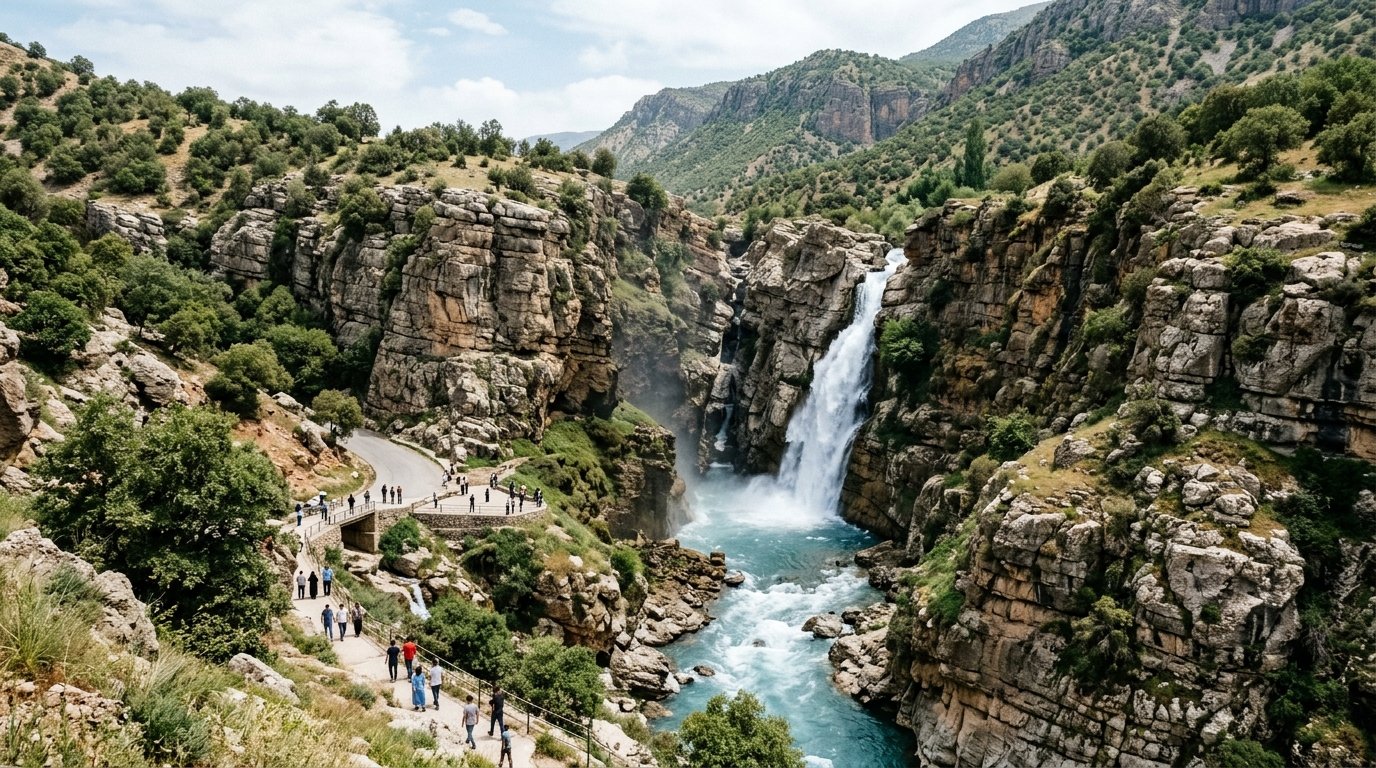
The canyon setting and water dynamics
The primary waterfall drops roughly twelve meters down a pale limestone cliff, fanning out as it plunges into a broad river basin. According to research from Soran University geologist Professor Sardar Balaky, published by the KDP Foreign Relations Office, the rock formations of the gorge date back roughly 25 million years to the Miocene epoch, created by the tectonic convergence of the Arabian and Eurasian plates. The layered gorge walls consist primarily of dolomite, limestone, and marlstone, while the massive spine of neighboring Mount Korek dates back even further to the Jurassic period.
The river channel below the main drop continues through the gorge toward the Greater Zab river system. Smaller seasonal springs emerge along the canyon floor during wet months, creating side cascades that spill over algae-covered rock faces. Modern infrastructure lines the immediate riverbank. Visitors walk along wide paved concourses, cross footbridges positioned directly opposite the spray zone, and rent pedal boats in the deeper sections of the pool when water levels permit.
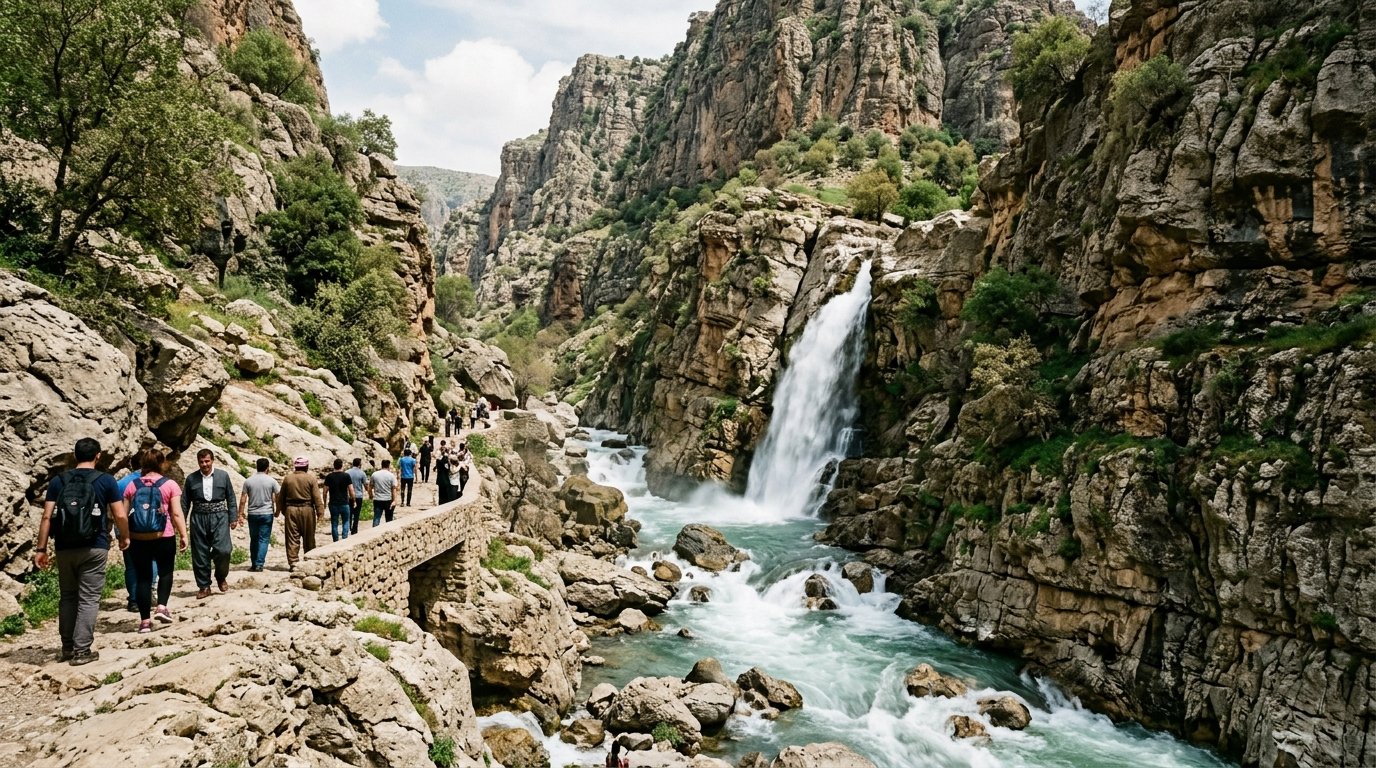
Historical origins and the Hamilton Road
The name of the canyon carries deep regional significance, linked to two conflicting local histories. According to the KDP Foreign Relations Office, one tradition attributes the name to a ruler of the historic Soran Emirate, which controlled the region from capitals in Soran, Harir, and Rawanduz until the 1830s. A second account documented by Wikipedia Geli Ali Beg entry records that the gorge was named in memory of Mir Ali Beg, a Yazidi prince of Sheikhan executed in the valley in late 1833 by Prince Muhammad of Rawanduz during Ottoman-era military campaigns.
The modern route through the gorge follows the Hamilton Road, a mountain highway engineered between 1928 and 1932 by New Zealand civil engineer Archibald Milne Hamilton, as detailed by the Wikipedia Hamilton Road record. The road carved a passage through formerly impenetrable cliffs to connect Erbil with the Iranian frontier near modern Piranshahr. Hamilton recounted the difficulty of blasting rock shelves through the Gali Ali Beg chasm in his 1937 memoir, Road through Kurdistan. Today, Route 3 follows this corridor, letting vehicles drive directly past the entrance to the falls.
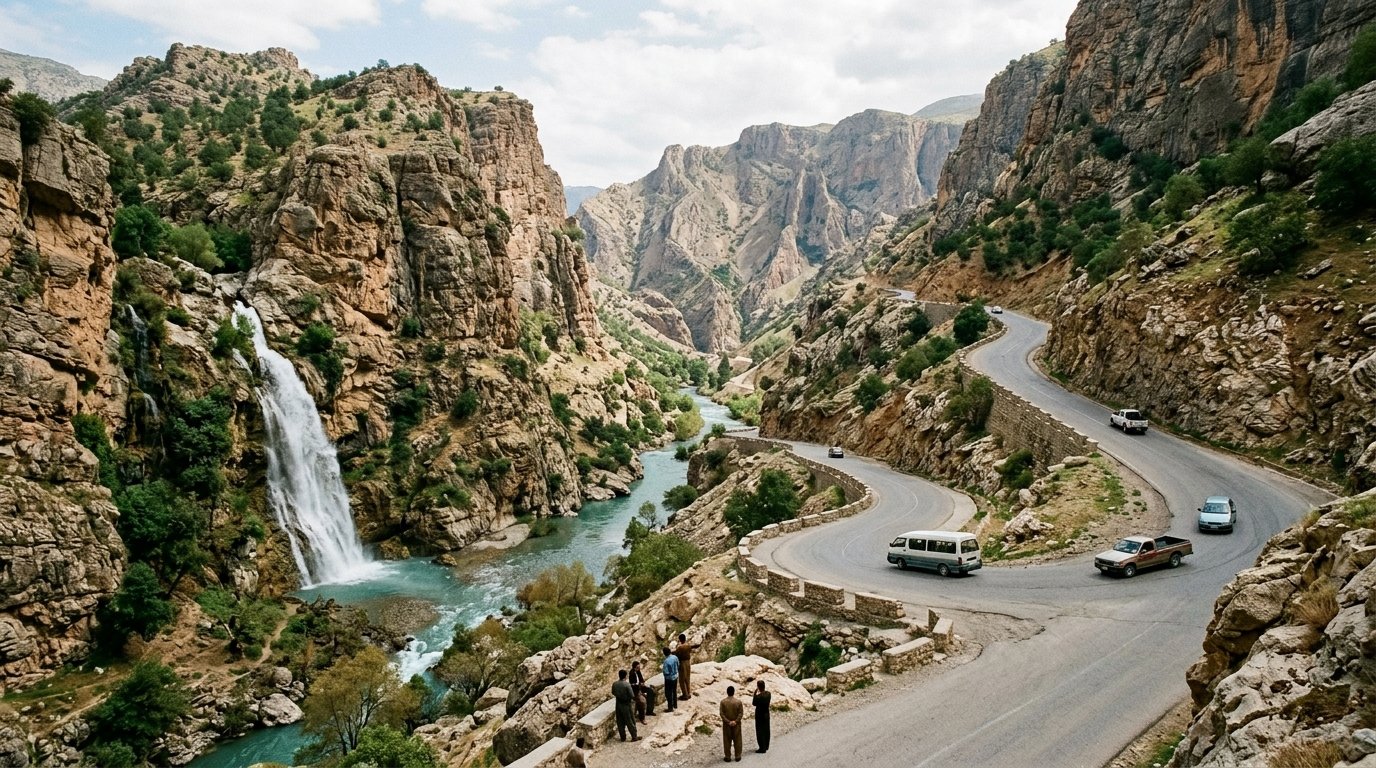
Seasonal flow and drought conditions
Water conditions at Gali Ali Beg vary substantially across the year.
Spring, from April through late May, brings the highest flow. Melting snow from the peaks of the High Zagros feeds mountain tributaries, sending torrents of water over the limestone drop, as reported by Shafaq News. Heavy spray drifts across the concrete viewing platforms, and daytime temperatures generally hover between 20°C and 26°C.
Summer, from June through August, is the busiest season. While low-lying plains around Erbil and Baghdad endure temperatures exceeding 45°C, the canyon floor at Gali Ali Beg stays cooler, typically reaching 31°C to 35°C during the heat of the day, according to the Wikipedia Khalifan overview. Families from central and southern provinces fill the shaded seating areas to escape the heat.
However, water volume drops significantly during dry periods. Because Gali Ali Beg relies on upstream springs and mountain rainfall, prolonged dry spells shrink the flow. During severe regional droughts, such as the drought documented in June 2025 by Shafaq News environmental reporting, natural inflows dropped to historical lows, causing the main waterfall to dry up temporarily before seasonal rains returned. Upstream water diversion and reduced winter snowfall across the Zagros make late summer water volume unpredictable. Travelers visiting between late July and September should expect thinner cascades than those shown in spring photographs.
Autumn brings crisp mountain air and golden foliage along the riverside walnut and poplar groves, though water volume remains low until late autumn rains begin. Winter brings freezing temperatures, with thermometer readings occasionally dipping to minus 10°C, and snow dusting the upper ridges of Mount Korek.
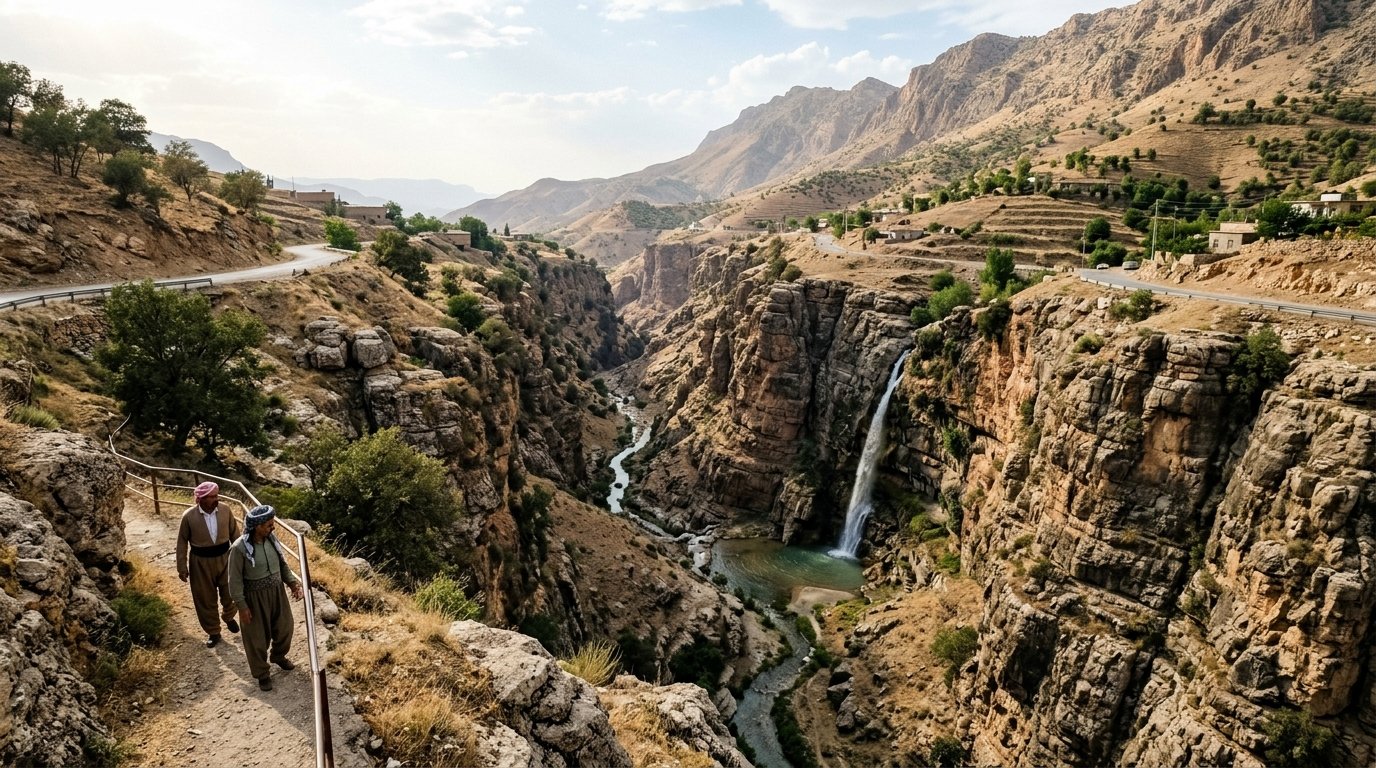
Viewpoint layout and visitor facilities
The site functions as a fully developed tourist hub rather than an untouched wilderness area. Over recent years, regional authorities have invested in formal parking areas, access roads, and public facilities, according to Erbil Tourism Authority statements reported by Shafaq News.
- Main viewing terrace. A broad concrete concourse directly facing the waterfall provides vantage points for photography. Guardrails line the platform, allowing visitors to stand within meters of the falling water.
- Riverside dining platforms. Open-air cafes and restaurants line the riverbanks. Operators set out low plastic tables, carpets, and wooden gazebos where patrons drink spiced black tea and order grilled kebabs, roasted carp, or traditional Kurdish bread. Meals generally start around 5,000 IQD per person, though travelers should confirm prices before sitting down.
- Pedal boats. During the spring and early summer when the basin maintains adequate depth, operators hire out pedal boats, offering views of the falls from the water.
- Hiking spurs and caves. The limestone cliffs flanking the waterfall have shallow natural caverns and narrow dirt trails leading up the gorge sides. These paths require sturdy shoes with reliable grip, as the limestone rocks become slick from mist and spray.
Commercial infrastructure, including brightly colored signage and concrete structures, has altered the immediate landscape, as observed in field reports by Live The Life Expeditions. The site is heavily commercialized, though the high canyon walls still frame the valley.
How to get there from Erbil
Gali Ali Beg is located along the primary highway corridor linking Erbil to Soran and the Iranian frontier.
- Driving by car or private hire. From central Erbil, take Route 3 northeast through Shaqlawa and the Harir plain toward Khalifan. The total drive covers roughly 106 kilometers and takes between 1.5 and 2 hours depending on traffic. The road is paved throughout, winding through scenic mountain valleys with multiple passing lanes.
- Shared transport. Travelers using public transit can take a shared taxi from the Soran Garage near Family Mall in Erbil to Soran, costing between 3,000 and 10,000 IQD per seat, as documented by Wikivoyage Rawanduz guide and Shafaq News. From Soran or Khalifan, local taxis reach the waterfall entrance for roughly 10,000 to 15,000 IQD.
- Fees and parking. General admission to the natural area is free, though travelers may encounter modest municipal access fees around 1,000 IQD during certain seasons. Dedicated vehicle parking lots charge between 2,000 and 5,000 IQD per car.
- Checkpoints. Foreign travelers must pass regional Asayish checkpoints along Route 3. Always carry your original passport with a valid Iraqi visa or Kurdistan Region entry stamp. Security officials routinely conduct quick, courteous document checks.
Nearby stops along the gorge route
A trip to Gali Ali Beg fits naturally into a broader day trip exploring the Soran and Rawanduz district.
- Rawanduz Canyon. Continuing several kilometers past the waterfall leads to Rawanduz Canyon, one of the deepest ravines in the Middle East. High clifftop lookouts offer views of sheer rock walls and the Hamilton Road winding far below.
- Bekhal Waterfall. Situated roughly ten kilometers from Rawanduz, Bekhal has mountain springs that cascade across wide, terraced limestone boulders, as noted by Wikipedia Bekhal documentation. Shaded seating areas make it another favored summer stop.
- Mount Korek cable car. Located near Bekhal, a four-kilometer cable car line lifts visitors up the slopes of Mount Korek to the Pank Resort and upper mountain plateau, overlooking the Zagros range, as reported by The Guardian.
- Shanidar Cave. Further north toward Bradost, this world-famous archaeological cave yielded Neanderthal skeletal remains and is accessible via a paved mountain detour.
Safety advice and practical visitor notes
Visiting Gali Ali Beg requires basic caution regarding terrain, timing, and local customs.
- Footwear and slippery stone. Constant water spray keeps rock steps, concrete ramps, and riverside walkways wet. Algae builds up quickly on the limestone surfaces. Wear shoes with deep rubber treads, and take extra care when stepping close to the river's edge.
- Crowds on weekends and holidays. Friday is the peak leisure day in Iraqi Kurdistan. Hundreds of family groups arrive with picnic gear, causing heavy traffic on Route 3 and crowded parking areas. Visit on a weekday morning for a quieter atmosphere and open photo angles.
- Confirm meal costs. While most vendors and teahouses operate honestly, roadside restaurants occasionally charge inflated prices to foreign visitors when printed menus are absent, as noted by Live The Life Expeditions. Inquire about the price of grilled items and tea before ordering.
- Environmental responsibility. High visitor density has placed stress on the river ecosystem. Use designated trash receptacles and avoid leaving plastic bottles or food waste along the riverbanks.
Sources
- Shafaq News — Visit Kurdistan: Where rivers roar at Gali Ali Beg — Accessed September 2026
- Shafaq News — Iraq's water crisis deepens: Kurdistan's iconic waterfall dries up — Accessed September 2026
- KDP Foreign Relations Office — The story of Kurdistan's famous waterfall, Gali Ali Bag — Accessed September 2026
- Live The Life Expeditions — GALI ALI BEG — Accessed September 2026
- The Guardian — All the fun of the fair, it must be Iraq — Accessed September 2026
- Wikipedia — Geli Ali Beg Waterfall — Accessed September 2026
- Arabic Wikipedia — شلال كلي علي بك — Accessed September 2026
- Wikipedia — A. M. Hamilton — Accessed September 2026
- Wikipedia — Khalifan, Iraq — Accessed September 2026
- Wikivoyage — Rawanduz — Accessed September 2026
- Wikipedia — Bekhal Waterfall — Accessed September 2026
- Wikipedia — Iraqi dinar — Accessed September 2026
❓Frequently Asked Questions
Here are answers to frequently asked questions about the content above
Gali Ali Beg waterfall is located in the Soran district of Erbil Governorate in Iraqi Kurdistan, approximately 106 to 130 kilometers northeast of Erbil city, along the historic Hamilton Road near Khalifan.
The waterfall flows with the greatest volume during spring, from April through late May, when snowmelt from the Zagros Mountains feeds upstream tributaries. Late summer can see significantly reduced flow during regional dry spells.
Access to the general waterfall area is free or requires a nominal municipal fee around 1,000 IQD. Vehicle parking at the site typically costs between 2,000 and 5,000 IQD.
Travelers can drive northeast along paved Route 3 through Shaqlawa and Harir, taking roughly 1.5 to 2 hours. Shared taxis run regularly from Erbil's Soran Garage to Soran, where local taxis provide quick connecting rides to the falls.
Beyond its natural beauty, Gali Ali Beg is a cultural icon recognized across Iraq for appearing on the historic five dinar Swiss banknote and the modern 5,000 Iraqi dinar banknote.
Nearby sights in the Soran and Rawanduz district include the sheer cliffs of Rawanduz Canyon, the spring cascades of Bekhal Waterfall, the Mount Korek cable car, and the historic Shanidar Cave.