Lalish Temple is the holiest sanctuary of the Yazidi faith, nestled in a mountain valley in Nineveh with ancient conical spires and deep spiritual traditions.
Lalish Temple
Set in a forested mountain valley roughly 60 kilometers north of Mosul and 45 kilometers southeast of Dohuk, Lalish Temple (Lalişa Nûranî) is the holiest sanctuary of the Yazidi faith. Located between Mount Hizrat, Mount Misat, and Mount Arafat at an altitude of approximately 861 meters, this secluded site in northern Iraq is the spiritual center of Yazidism—the qibla toward which believers turn in daily prayer and the pilgrimage destination every Yazidi strives to visit at least once.
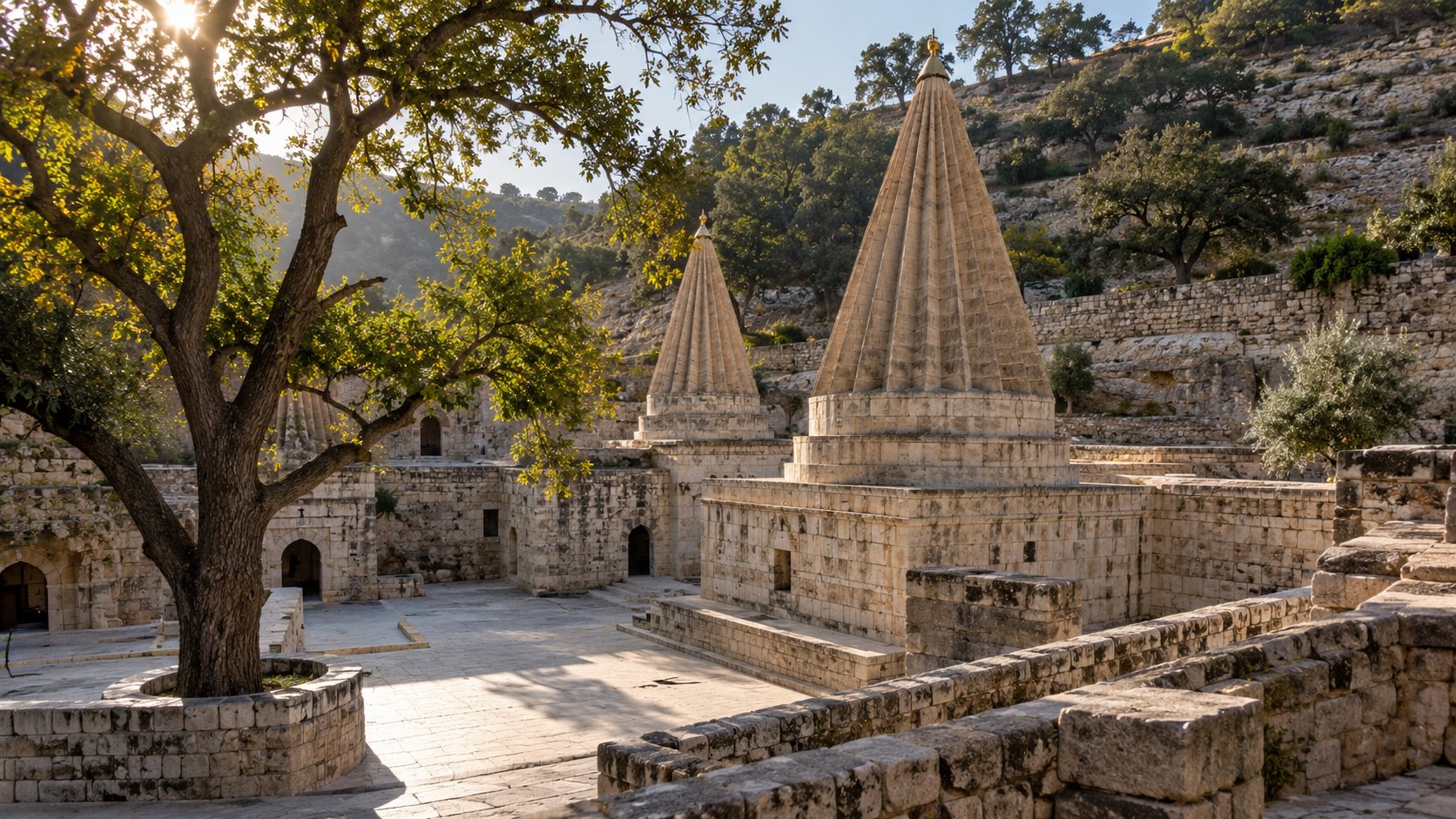
With its ribbed conical spires, sacred baptismal springs, stone courtyards, and deep Sufi-influenced history, Lalish preserves the practices of an ancient monotheistic faith that has endured centuries of persecution.
The Spiritual Heart of the Yazidi Faith
In Yazidism (Êzidîtî), believers worship a single creator God (Xwedê), who placed the care of the world in the hands of seven divine beings (Heft Sirr) led by Tawûsî Melek (the Peacock Angel). In Yazidi cosmogony, Lalish marks where the earth first solidified from primeval water and where divine presence first touched the physical world.
The sanctuary took its current religious and architectural form through the teachings of Sheikh ‘Adî ibn Musafir (ca. 1073–1162 CE), a mystic and reformer who retreated to the valley. Sheikh ‘Adî is venerated as an earthly manifestation of Tawûsî Melek, and his tomb is the primary focus of prayer at Lalish. Grouped around his shrine are the mausoleums of early disciples and lineage leaders, including Sheikh Hesen and Sheikh Shems.
Yazidis from the Nineveh Plains, Sinjar (Shingal), and the worldwide diaspora travel to Lalish to pray, celebrate seasonal festivals, baptize children, and seek counsel. In August 2014, when ISIS attacked Yazidi communities across Sinjar, Lalish served as a refuge for thousands of fleeing families who found shelter and security within its stone courtyards.
Architectural Features: Conical Spires and Sacred Spaces
The skyline of Lalish is defined by its stone terraces, fig and mulberry groves, and distinctive fluted conical domes (qubbas). These multi-faceted spires rest on polygonal drums and represent the sun's rays descending to earth, reflecting the central role of light in Yazidi theology.
Key landmarks across the sanctuary include:
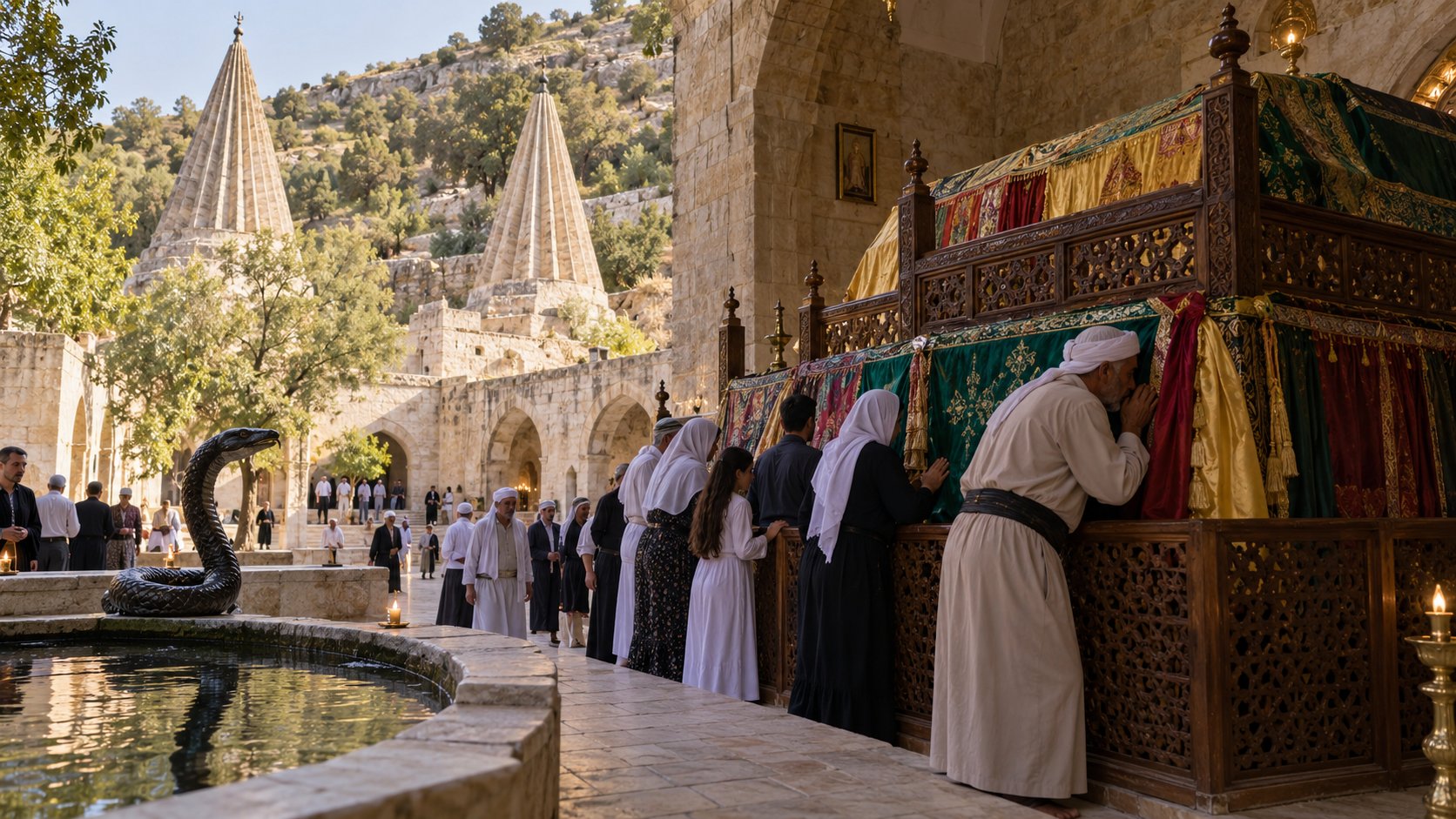
- The Tomb of Sheikh ‘Adî: The central nave holds the catafalque of Sheikh ‘Adî, enclosed behind carved wooden screens and draped in colorful silk cloths. Pilgrims circle the tomb three times counterclockwise, kissing the draperies and reciting quiet prayers.
- The Black Serpent Portal: To the right of the main doorway leading into the sanctuary, an elongated black snake is carved into the stone wall. Darkened with olive oil and soot, the serpent in Yazidi belief represents wisdom and divine protection rather than evil. Visitors touch or kiss the carving before crossing into the inner halls.
- The Wishing Cloths: Inside the dim halls lit by oil lamps, colored silk scarves hang from stone pillars. Worshippers tie a knot while making a silent prayer. Untying a knot tied by an earlier visitor is believed to help grant that person's wish, symbolizing mutual care within the community.
- The Sacred Springs (Kaniya Spî & Zamzam): Lalish contains two venerated water sources. Kaniya Spî (the White Spring), situated southwest of the main shrine beneath its own spire, is used for child baptisms and ritual ablutions. Deep within the central complex's rock chambers flows Zamzam, an underground spring considered equally sacred.
- Olive Oil Presses and Storerooms: Large clay jars and stone vats across the sanctuary hold olive oil pressed on-site from local groves. Caretakers use stone rollers to extract the oil, which fuels hundreds of clay lamps lit each evening along the terraces and niches at dusk.
Visitor Etiquette and Sacred Rules
Lalish is an active sanctuary, not a tourist monument. Yazidis welcome foreign visitors with warmth, provided guests respect the rules that govern the valley:
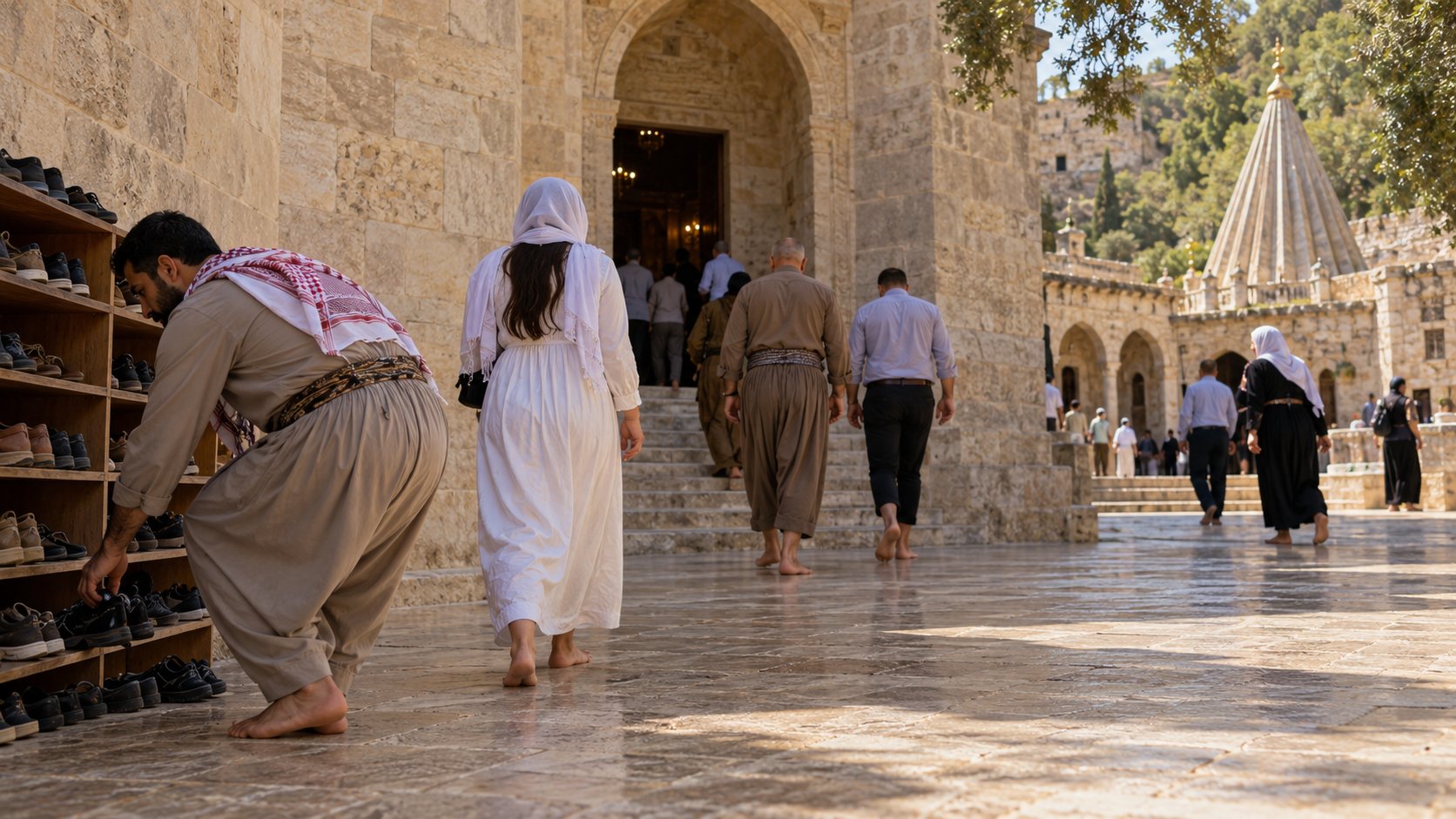
- Walk Barefoot on Sacred Ground: All visitors must remove their footwear upon entering the temple grounds. Outside paths, stone staircases, and interior rooms must be walked barefoot. Thin socks are acceptable if stone floors are cold in winter or hot in summer, but shoes must remain at designated racks or inside your vehicle.
- Never Step on Door Thresholds: In Yazidi belief, the doorsill (çarçêve) is a sacred boundary guarded by holy presences. Step cleanly over every threshold without touching your foot to the sill.
- Dress Modestly: Cover shoulders, upper arms, and knees. Wear loose trousers or long skirts. Avoid shorts, sleeveless shirts, or tight athletic wear.
- Photograph with Care: Open courtyards may be photographed freely, but always ask before photographing individuals, families, or worshippers. Photography inside baptismal sanctuaries like Kaniya Spî is strictly prohibited.
- Maintain Quiet Demeanor: Speak softly and avoid running, loud conversations, or playing recorded music. Treat altars, springs, and centuries-old trees with care.
Festivals and Pilgrimage Calendar
While Lalish remains open throughout the year, the valley fills with worshippers during key religious celebrations:
- Cejna Cem‘îya (The Feast of the Assembly): Held every year between October 6 and 13, this seven-day autumn gathering is the largest festival on the Yazidi calendar. Tens of thousands of pilgrims travel from across Iraq and abroad to hear sacred hymns (qewls), join ritual processions, perform the govend dance, and reconnect with family lines.
- Çarşema Sor (Red Wednesday): The Yazidi New Year falls on the first Wednesday after April 13 (Julian calendar). It celebrates the descent of Tawûsî Melek to bring life and fertility to the earth. Villagers hang red wildflowers above entryways, boil dyed eggs, and light hundreds of small oil wicks along stone ledges at dusk.
Practical Travel Information
- Base Cities: Most travelers visit Lalish on a day trip from Duhok (45 km, about 1 hour by car) or Erbil (140 km, about 2 to 2.5 hours by car).
- Transportation: There is no direct public bus service into the mountain valley. Hire a private taxi for the return journey or book an excursion through an established Kurdistan Region tour agency.
- Checkpoints: Lalish is located in the Sheikhan district of Nineveh, administered under the security oversight of the Kurdistan Regional Government (KRG). Travelers holding an Iraqi Kurdistan entry visa or federal Iraqi visa can typically pass through local checkpoints without extra permits. Bring your passport.
- Visit Duration: Allow 2 to 4 hours to walk the courtyards, visit the inner sanctuary, and explore the surrounding olive and walnut groves.
Sources
- Mesopotamia Heritage, "The Spiritual Centre of Lalish and the Mausoleum of Sheikh Adi", https://www.mesopotamiaheritage.org/en/monuments/le-centre-spirituel-yezidi-de-lalesh-et-le-mausolee-de-cheikh-adi/, accessed March 2025.
- Kurdish History Journal, "Lalish: The Sacred Heart of the Yazidi Faith", https://www.kurdish-history.com/post/lalish, accessed March 2025.
- Visit Kurdistan, "Lalish Travel Guide: Yazidi Holy Site, History & Tips", https://visitkurdistan.com/lalish/, accessed March 2025.
- Wikipedia, "Lalish", https://en.wikipedia.org/wiki/Lalish, accessed March 2025.
❓Frequently Asked Questions
Here are answers to frequently asked questions about the content above
Lalish Temple is situated in a mountain valley in the Sheikhan district of northern Iraq (Nineveh Plains), roughly 60 kilometers north of Mosul and 45 kilometers southeast of Dohuk, within the security perimeter of the Kurdistan Region.
Yazidis revere the entire valley of Lalish as holy ground touched directly by divine presence. To preserve its purity and show humility, all worshippers and visitors must remove their shoes and walk barefoot or in thin socks throughout the sanctuary grounds.
In Yazidi tradition, doorway thresholds represent sacred boundaries inhabited by protective spiritual presences. Stepping on the sill is considered disrespectful, so visitors must carefully step cleanly over every doorsill.
Sheikh Adi ibn Musafir (ca. 1073–1162 CE) was a revered mystic and reformer who shaped the Yazidi faith. He is venerated as an incarnation of the Peacock Angel (Tawûsî Melek), making his mausoleum at Lalish the supreme pilgrimage destination for Yazidis worldwide.
The carved black snake next to the main temple portal is an honored emblem in Yazidi belief, representing wisdom, rebirth, and protection rather than malevolence. Pilgrims reverently touch or kiss the serpent figure before entering the inner halls.
Spring (April–May) and autumn (October–November) offer pleasant weather for walking barefoot on outdoor stone pavements. Visiting during major holy events, like the Feast of the Assembly in early October or Yazidi New Year in April, provides rich cultural insight into traditional rituals.