Shanidar Cave is a major Paleolithic archaeological site on Bradost Mountain in Iraqi Kurdistan. It yielded Neanderthal skeletal remains, evidence of community care, and ongoing excavations uncovering prehistoric life.
Shanidar Cave sits on the southern slopes of Bradost Mountain in the Zagros range, located in the Mergasor district of Erbil Governorate in northern Iraq (Shanidar Cave - Wikipedia). The cave overlooks the valley of the Greater Zab river at an elevation of roughly 640 meters (2,100 feet) above sea level. It is known in paleoanthropology as the location where archaeologist Ralph Solecki uncovered ten Neanderthal skeletons between 1951 and 1960, providing some of the earliest physical evidence for social support, compassion, and deliberate mortuary practices among archaic humans (KurdOff Shanidar Cave Guide).
What Shanidar Cave looks like to visitors
The cavern has a large triangular entrance measuring roughly 25 meters (82 feet) wide and 8 meters (26 feet) high (Shanidar Cave - Wikipedia). Inside, the main chamber extends approximately 40 meters deep and 53 meters across. A paved path and stone stairway lead up the hillside from the road to the entrance platform (VisitKurdistan Guide).
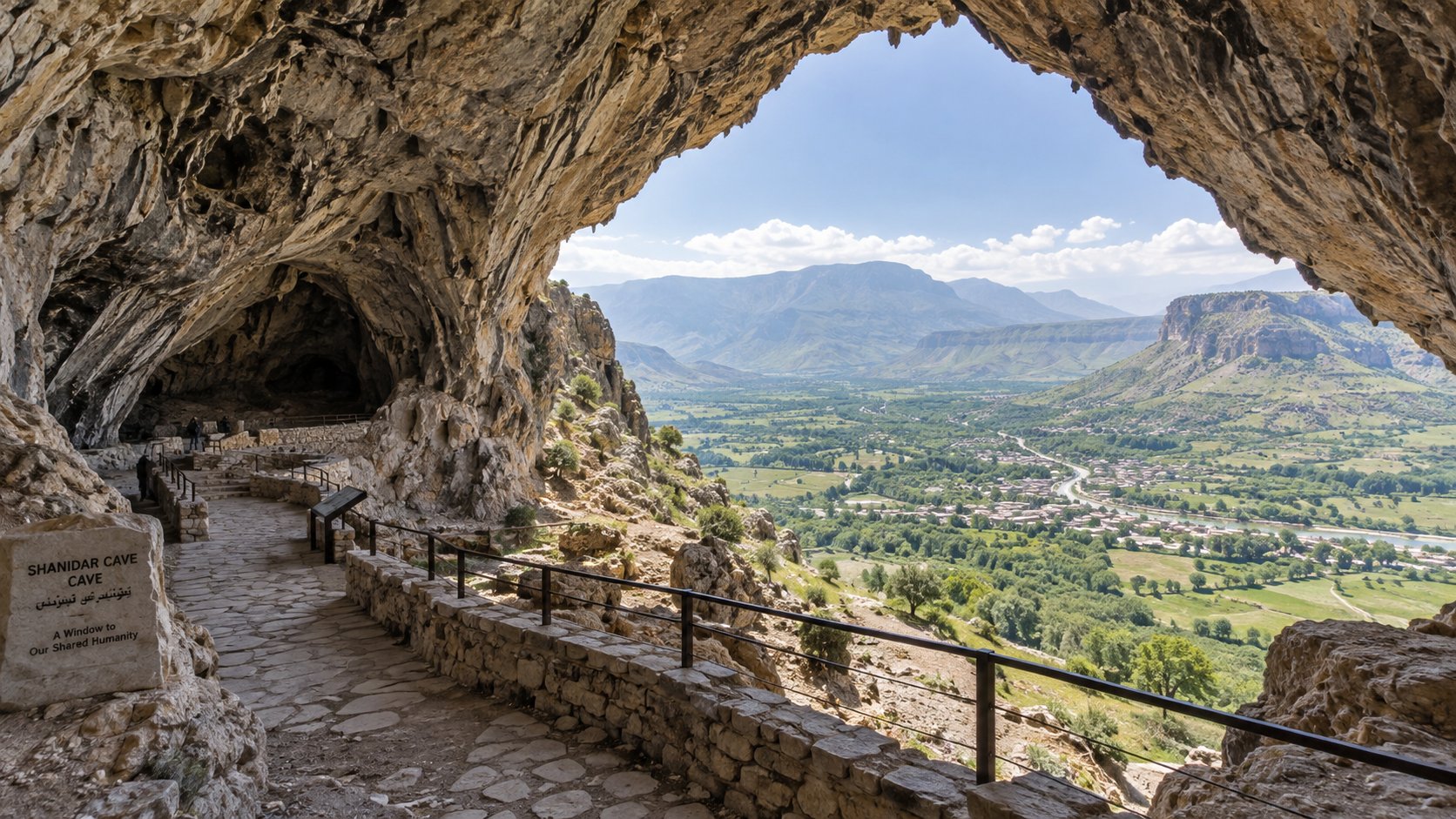
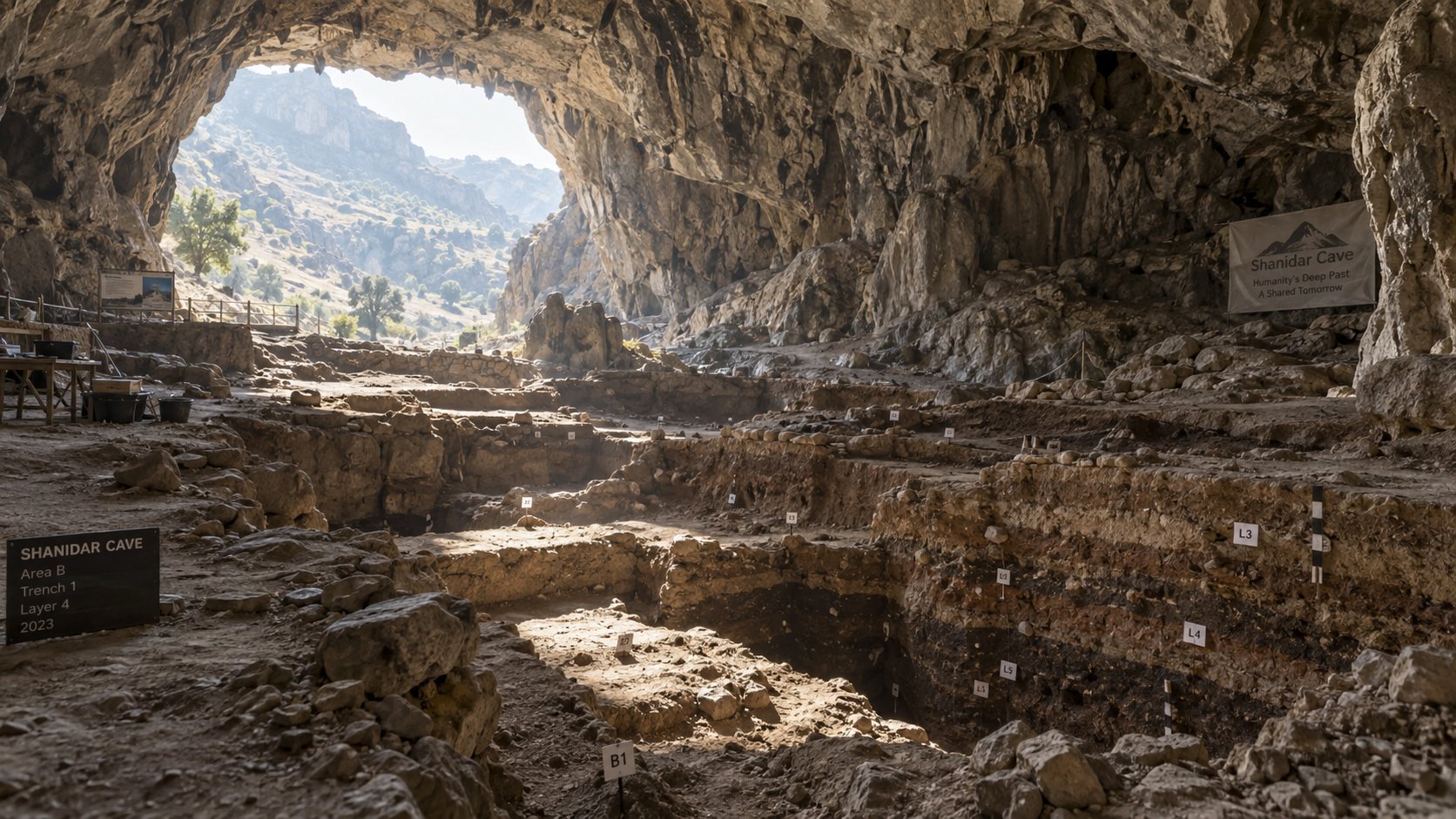
Inside the cave, visitors can walk through the wide opening and observe the deep archaeological trench cut into the limestone floor. The site remains an active field research location rather than a commercialized tourist center (KurdOff Shanidar Cave Guide). Signs at the entrance describe the stratigraphy, while the cave opening looks out over the Bradost ridge and the valley below.
The Neanderthal burials and scientific discoveries
Excavations directed by Ralph Solecki under Columbia University and the Smithsonian Institution revealed layered occupational strata spanning Middle Paleolithic Mousterian deposits, Baradostian, Zarzian, and Proto-Neolithic settlements (Shanidar Cave - Wikipedia, Arabic Wikipedia Shanidar).
The Neanderthal remains, dating between 35,000 and 75,000 years ago, transformed modern understanding of Neanderthal culture:
- Shanidar 1 ("Nandy"): An older adult male between 30 and 45 years of age who suffered a severe blow crushing his left eye socket, profound hearing loss from bone growths in both ear canals, and a withered or amputated right arm (Shanidar Cave - Wikipedia, Arabic Wikipedia Shanidar). His ability to survive for years with debilitating impairments demonstrates sustained communal care and food sharing.
- Shanidar 3: An adult male showing a healed penetrating rib wound, representing one of the oldest recorded instances of projectile trauma in the human fossil record (KurdOff Shanidar Cave Guide, Arabic Wikipedia Shanidar). Shanidar 3 is preserved at the Smithsonian National Museum of Natural History in Washington, D.C.
- Shanidar 4 and the flower burial debate: Discovered in 1960, this skeleton was found surrounded by clusters of pollen from yarrow, cornflower, ragwort, and hollyhock (KurdOff Shanidar Cave Guide). While originally interpreted as deliberate floral offerings, subsequent palynological studies led by Professor Chris Hunt suggest the pollen was introduced naturally by burrowing Persian jirds and solitary bees nesting in the cave soil (ClassiCult Shanidar Z Report, KurdOff Shanidar Cave Guide).
Modern Cambridge excavations and Shanidar Z
In 2015, renewed fieldwork began under Professor Graeme Barker of the University of Cambridge, in partnership with the Kurdistan Directorate of Antiquities (KurdOff Shanidar Cave Guide, ClassiCult Shanidar Z Report). In 2018, the team unearthed Shanidar Z, an articulated upper skeleton and crushed skull of an older female Neanderthal dating to around 75,000 years ago (ClassiCult Shanidar Z Report).
Laboratory conservators led by Dr Emma Pomeroy and Dr Lucia Lopez-Polin reassembled over 200 bone fragments of the skull. This enabled a lifelike 3D facial reconstruction by paleoartists Adrie and Alfons Kennis (ClassiCult Shanidar Z Report). Soil analyses also revealed charred plant residues, showing that Neanderthals processed and cooked wild pulses, nuts, and grasses around the burial cluster (ClassiCult Shanidar Z Report).
Best time to visit
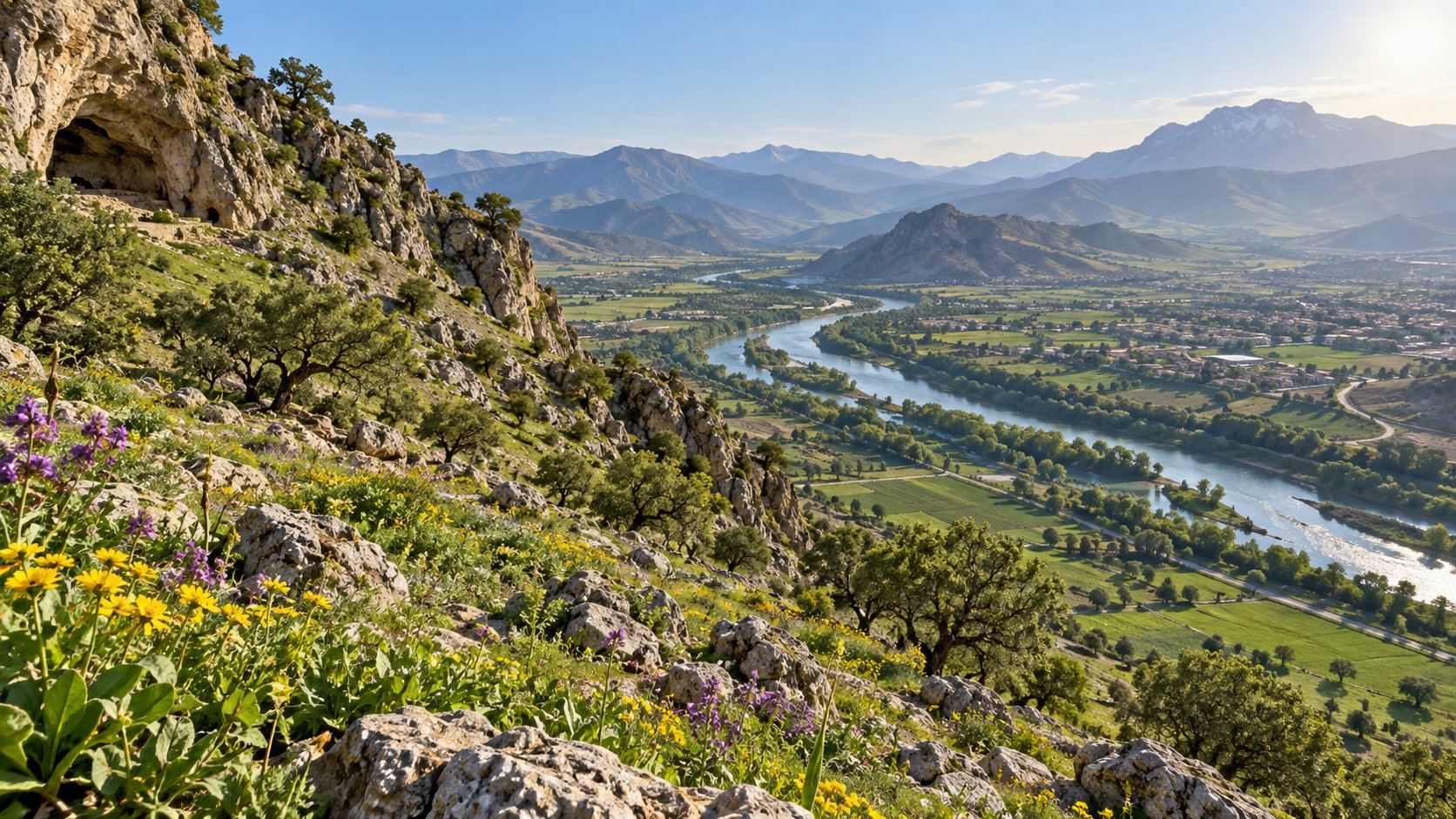
The best seasons to visit Shanidar Cave are spring (March through May) and autumn (September through November) (VisitKurdistan Guide). In spring, the surrounding valleys and mountain slopes are green, and temperatures remain comfortable for walking. Summer temperatures in the lowlands often exceed 40°C (104°F), while winter brings cold winds and occasional snow along Bradost Mountain.
How to get to Shanidar Cave
Shanidar Cave is accessed by road from Erbil, located approximately 140 kilometers (87 miles) to the southwest (VisitKurdistan Guide). The drive takes around 2.5 to 3 hours:
- From Erbil, drive northeast along the Hamilton Road corridor past Shaqlawa and toward Soran, or take the northern route toward Barzan and Mergasor.
- The cave is often combined into a day trip itinerary with Rawanduz Canyon, Gali Ali Beg Waterfall, or hiking around Akre and Amadiya (VisitKurdistan Guide).
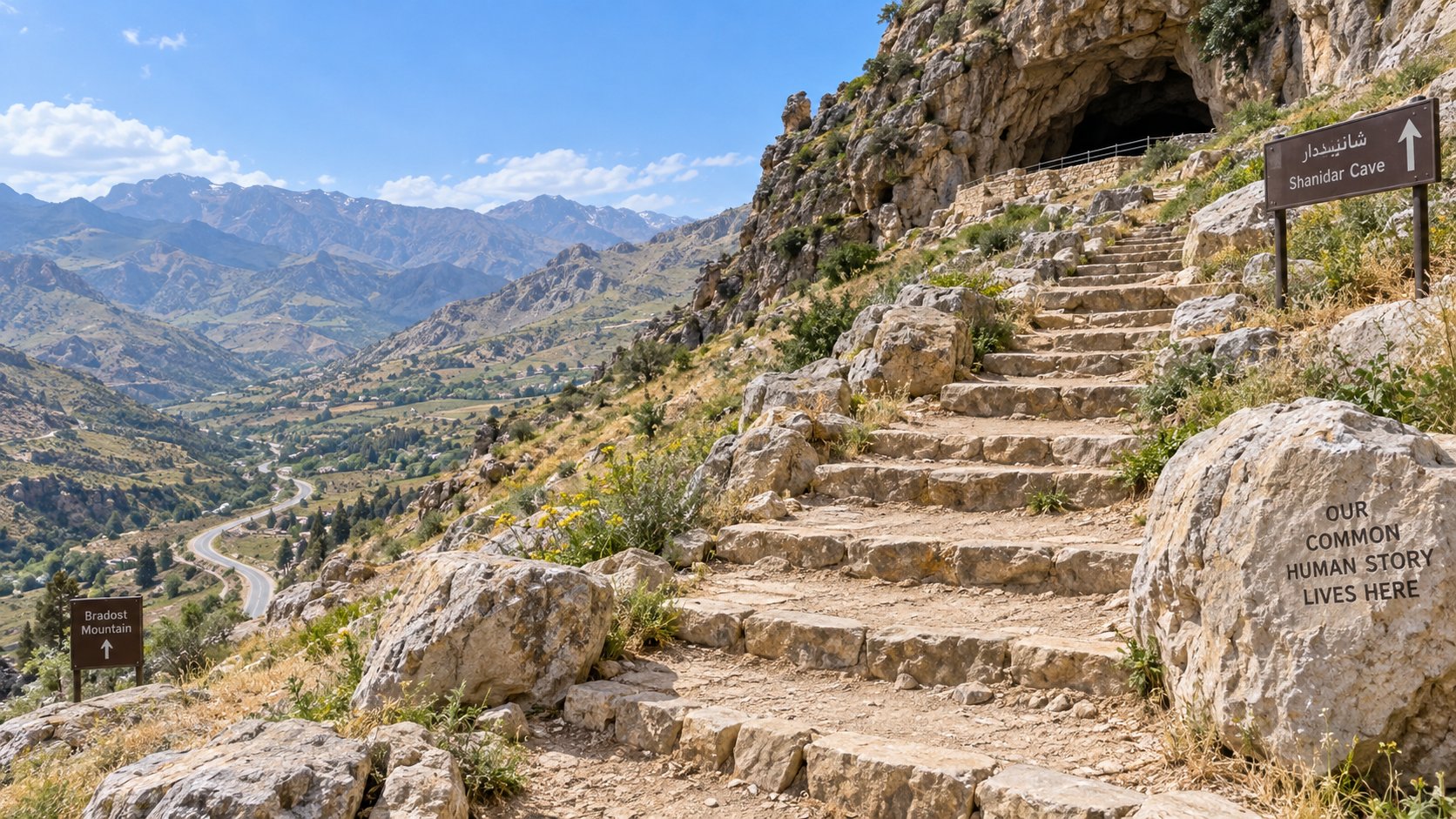
- A paved turnoff leads directly to a designated parking area below the cave hill. From the parking area, visitors climb a maintained stone stairway for 10 to 15 minutes to reach the cave entrance (VisitKurdistan Guide).
Practical visitor advice and safety
- Entry fees and access: There is no formal ticket office or fixed entry fee published by the regional tourism authority, though local caretakers or security personnel may be present (KurdOff Shanidar Cave Guide). It is best to visit during daylight hours.
- Footwear: Wear sturdy walking shoes or hiking boots. The approach steps and cave floor contain loose gravel, smooth limestone, and uneven dirt (VisitKurdistan Guide).
- Site preservation: The archaeological trenches are protected. Visitors must stay on established footpaths, avoid climbing excavation edges, and refrain from touching or collecting sediment and rock samples (VisitKurdistan Guide).
- Checkpoints: Foreign travelers should carry their passports and valid Kurdistan Region visa documentation, as standard security checkpoints operate along regional highways between Erbil, Soran, and Mergasor.
Sources
- Wikipedia — Shanidar Cave — https://en.wikipedia.org/wiki/Shanidar_Cave — Accessed May 25, 2026
- KurdOff — Shanidar Cave, Shanidar Valley (Mergasur): Visitor Guide, Route and Best Time — https://kurdoff.com/travel/attractions/shanidar-cave — Accessed May 25, 2026
- VisitKurdistan.com — Shanidar Cave: Neanderthal Site in Kurdistan — https://visitkurdistan.com/shanidar-cave/ — Accessed May 25, 2026
- ClassiCult — The Face of Shanidar Z, a 75,000-Year-Old Female Neanderthal — https://www.classicult.it/en/the-face-of-shanidar-z-a-75000-year-old-female-neanderthal/ — Accessed May 25, 2026
- Latitude.to — GPS Coordinates of Shanidar Cave, Iraq — https://latitude.to/articles-by-country/iq/iraq/13717/shanidar-cave — Accessed May 25, 2026
- Arabic Wikipedia — كهف شاندر — https://ar.wikipedia.org/wiki/%D9%83%D9%87%D9%81_%D8%B4%D8%A7%D9%86%D8%AF%D8%B1 — Accessed May 25, 2026
❓Frequently Asked Questions
Here are answers to frequently asked questions about the content above
Shanidar Cave is situated on Bradost Mountain overlooking the Greater Zab river in the Mergasor district of Erbil Governorate, in the Kurdistan Region of northern Iraq.
The cave contained the skeletal remains of ten Neanderthals and later Proto-Neolithic burials. Discoveries like Shanidar 1 provided the first clear evidence of social care and support for severely injured group members among Neanderthals.
Pollen clumps found with Shanidar 4 were initially interpreted as flowers placed in a deliberate grave ritual. Recent palynological research indicates the pollen was most likely accumulated naturally by burrowing Persian jirds and solitary nesting bees, though deliberate mortuary placement of the body remains supported.
Shanidar Z is an approximately 75,000-year-old female Neanderthal skeleton unearthed in 2018 by a University of Cambridge team. Her crushed skull was reconstructed from over 200 bone fragments to create a 3D facial likeness, and nearby sediment revealed traces of cooked wild pulses and seeds.
The original Shanidar 3 skeleton is curated and displayed at the Smithsonian National Museum of Natural History in Washington, D.C. Other original remains and associated artifacts are held by the Iraq Museum in Baghdad, Sulaymaniyah Museum, and the Kurdistan Directorate of Antiquities.
Travelers drive roughly 2.5 to 3 hours northeast from Erbil toward Soran or Barzan in Mergasor district. A paved road leads to a parking area below the site, followed by a 10 to 15-minute walk up a stone staircase.