The National Museum of Iraq houses the definitive material record of Mesopotamia across more than 7,000 years of civilization in central Baghdad.
The Baghdad Museum—officially the National Museum of Iraq (Arabic: المتحف العراقي)—is the country's central archaeological repository. Located in Baghdad's Al-Karkh district on Damascus Street, the museum houses the definitive material record of Mesopotamia. Its collections span more than 7,000 years, tracing early agricultural settlements, the development of cuneiform writing, monumental architecture, codified law, and the Islamic Golden Age.
Whether visiting independently or on a guided itinerary, planning around verified opening hours and entrance procedures helps make the most of your visit.
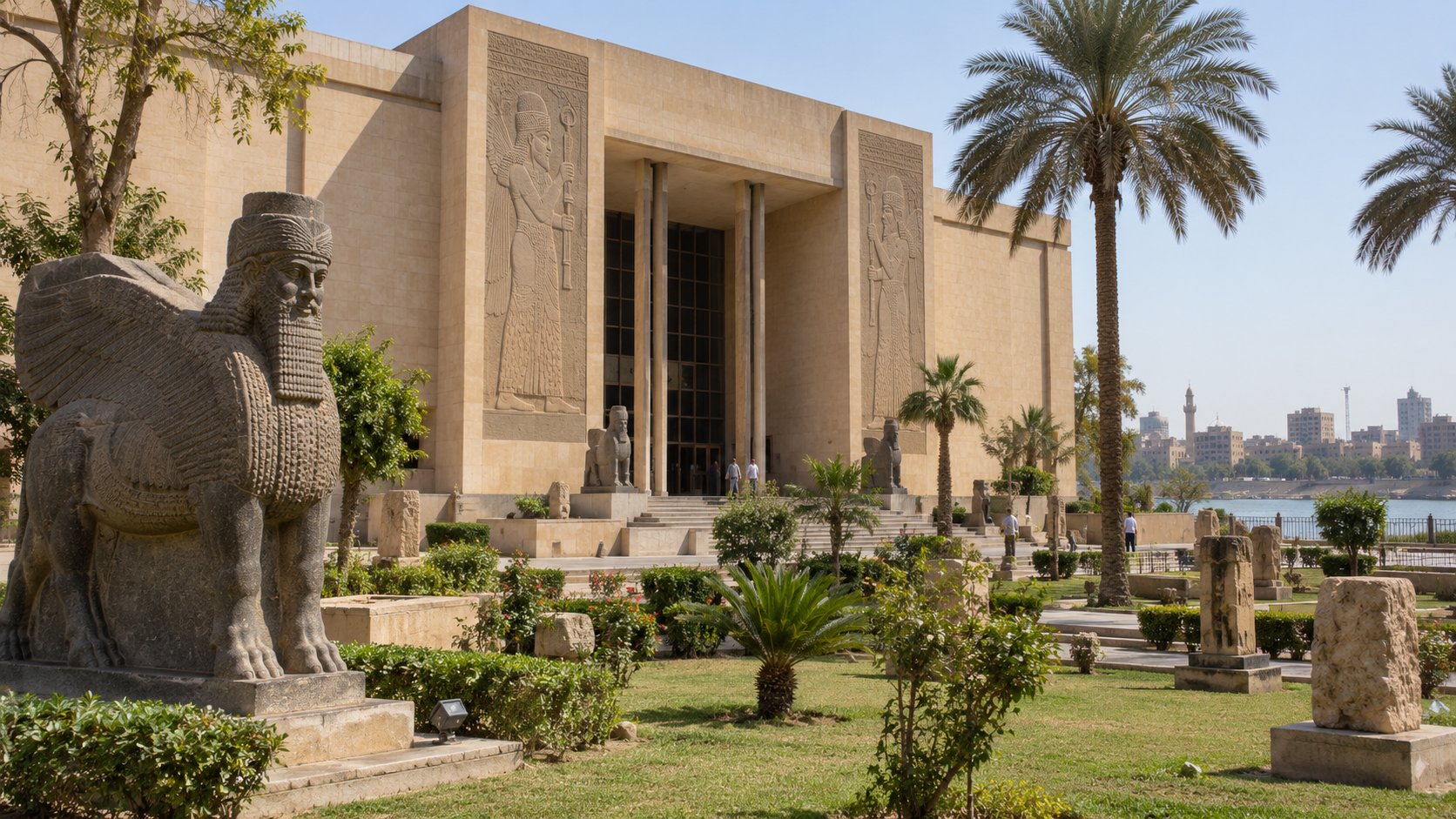
History and Architecture
British archaeologist and diplomat Gertrude Bell founded the collection in 1923, working with King Faisal I to establish the Baghdad Archaeological Museum. Bell aimed to retain excavated antiquities within Iraq rather than losing them entirely to European and North American institutions.
The collection first occupied rooms in the Ottoman-era Qishla complex on the east bank of the Tigris. Rapid excavation finds from Ur, Kish, and Babylon soon outgrew that space, prompting a move to Al-Ma'moun Street in 1926.
By the 1930s, the Directorate General of Antiquities planned a purpose-built facility. Construction began in 1957 in Al-Salihiyyah, designed by German architect Werner March alongside Iraqi engineers. The complex opened in 1966 and expanded in 1986, creating more than 20 galleries around central courtyards using modern brick construction influenced by Mesopotamian styles.
Looting during the 2003 invasion stripped roughly 15,000 artifacts from the museum. Curators, conservators, and international agencies have since recovered more than a third of the stolen pieces, returning core masterworks to display.
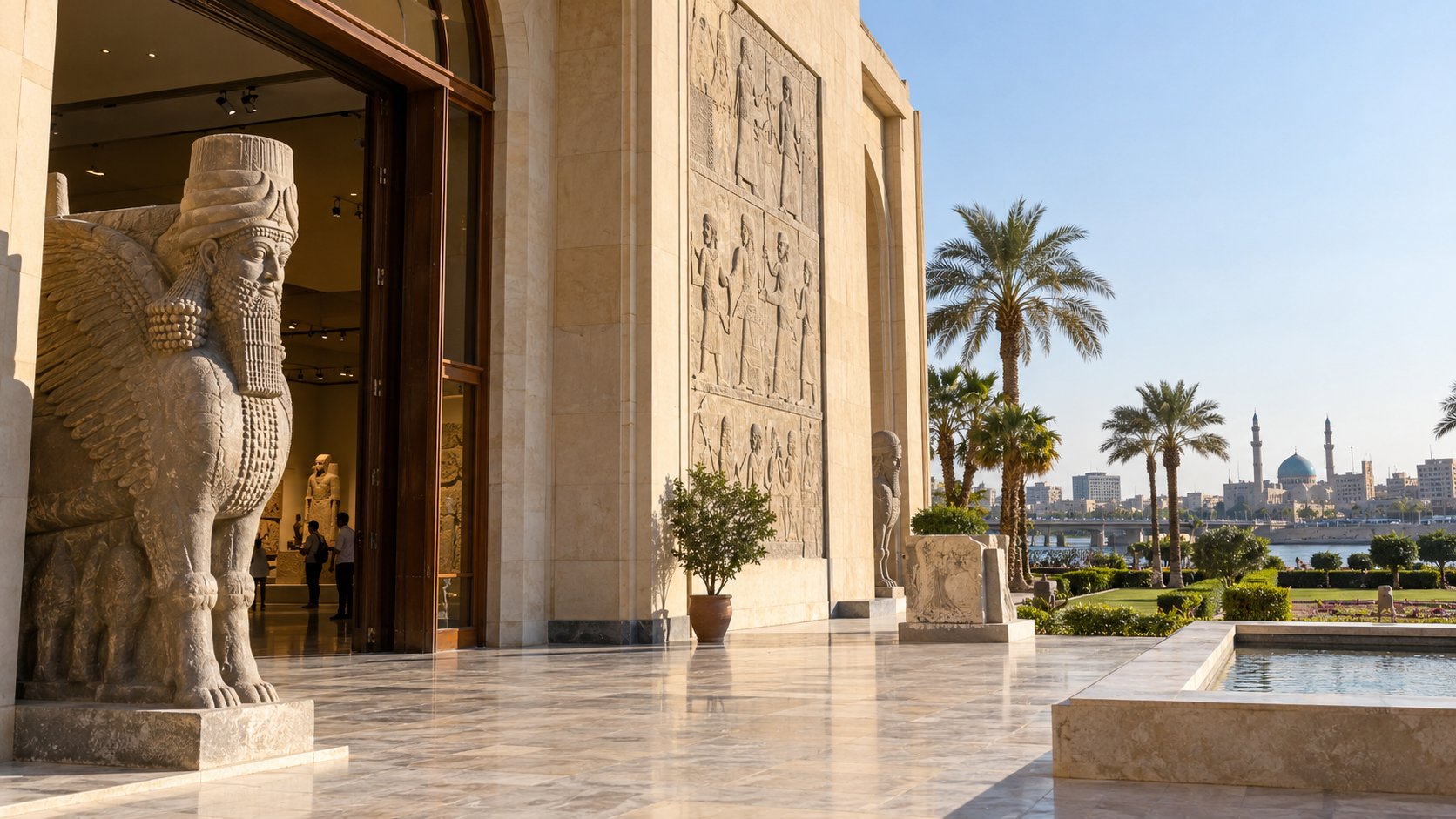
Collections and Gallery Layout
The museum arranges its holdings in chronological order across more than 20 galleries:
- Prehistoric and Neolithic Galleries: Finds from Shanidar Cave, Jarmo, and Tell Hassuna, including early flint and obsidian tools, stone bowls, and Neolithic pottery.
- Sumerian Hall (Uruk and Early Dynastic Periods): Key exhibits include the Mask of Warka (the "Lady of Uruk," c. 3100 BCE), the carved alabaster Warka Vase, proto-cuneiform tablets, and shell-inlay temple panels.
- Akkadian and Ur III Collections: Features the cast-bronze head of an Akkadian king (often associated with Sargon of Akkad or Naram-Sin), diorite statuary of Gudea of Lagash, and inscribed foundation cylinders.
- Babylonian Halls: Inscribed boundary markers (kudurru), glazed brick panels, and cuneiform tablets documenting legal codes, mathematics, and astronomy under Old and Neo-Babylonian rule.
- Assyrian Halls: Colossal stone winged bulls (lamassu) and narrative wall reliefs from royal palaces at Nimrud, Khorsabad, and Nineveh showing campaigns, hunts, and court ceremonies under Ashurnasirpal II and Sennacherib.
- Hatra and Parthian Galleries: Sculptures, limestone carvings, and architectural reliefs from the desert city of Hatra, showing Hellenistic and Roman artistic influence blended with local traditions.
- Islamic Galleries: Abbasid stucco panels, manuscripts, astrolabes, ceramics, and carved woodwork from Baghdad's period as the seat of the Abbasid Caliphate.
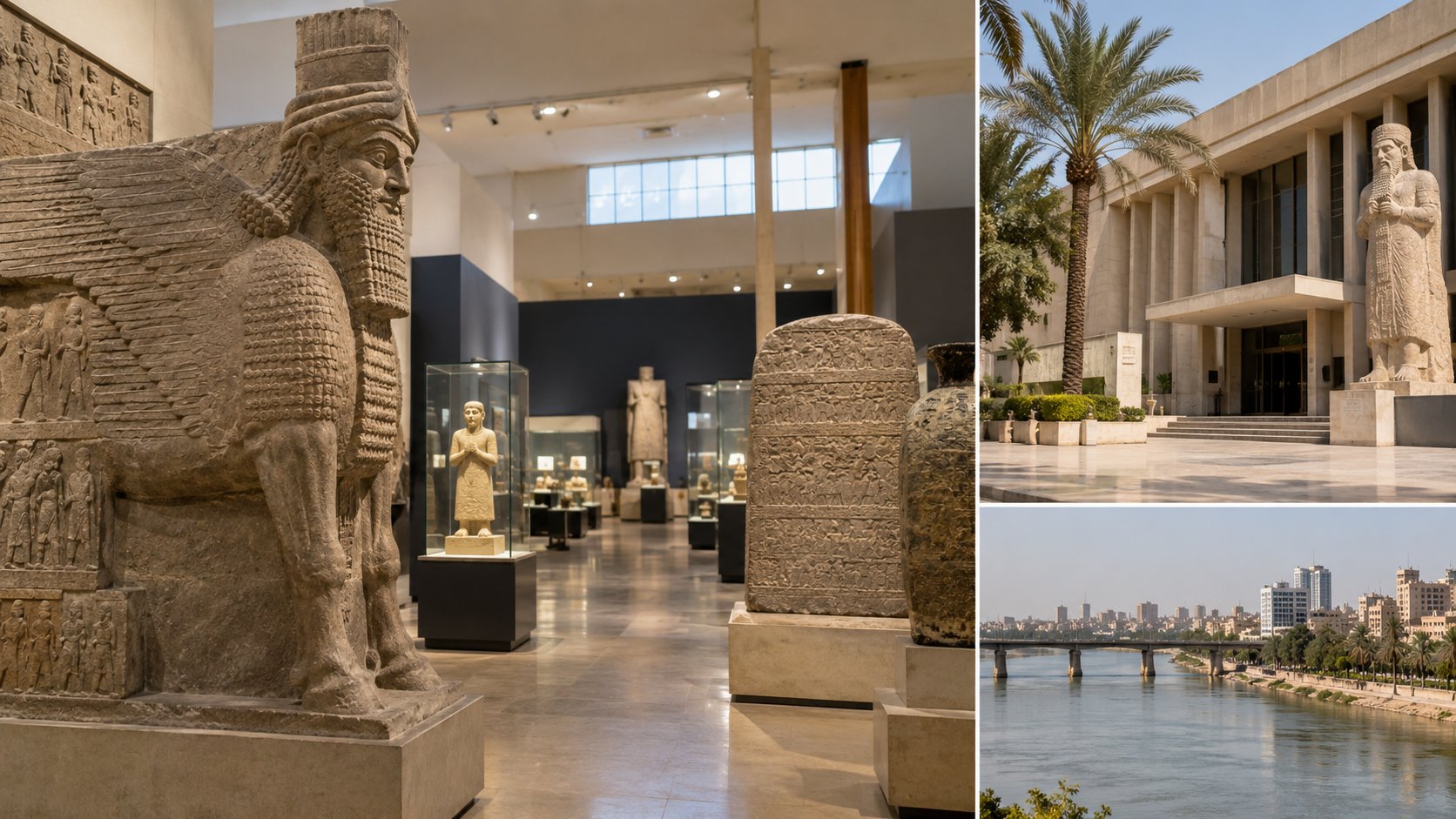
Location and Access
The National Museum of Iraq stands on Damascus Street in the Al-Salihiyyah quarter of Al-Karkh, just west of the Tigris River and close to the Al-Alawi transport junction.
- Coordinates / Area: Damascus Street, Al-Salihiyyah, Al-Karkh, Baghdad.
- Getting There: Taxis arranged through your hotel or rideshare apps like Careem drop off directly at the entrance gate. Guided tours typically handle private transfers.
- Security: Visitors pass through bag scanners and walk-through metal detectors at the outer gate. Keep your original passport or Iraqi national ID with you for security check-in.
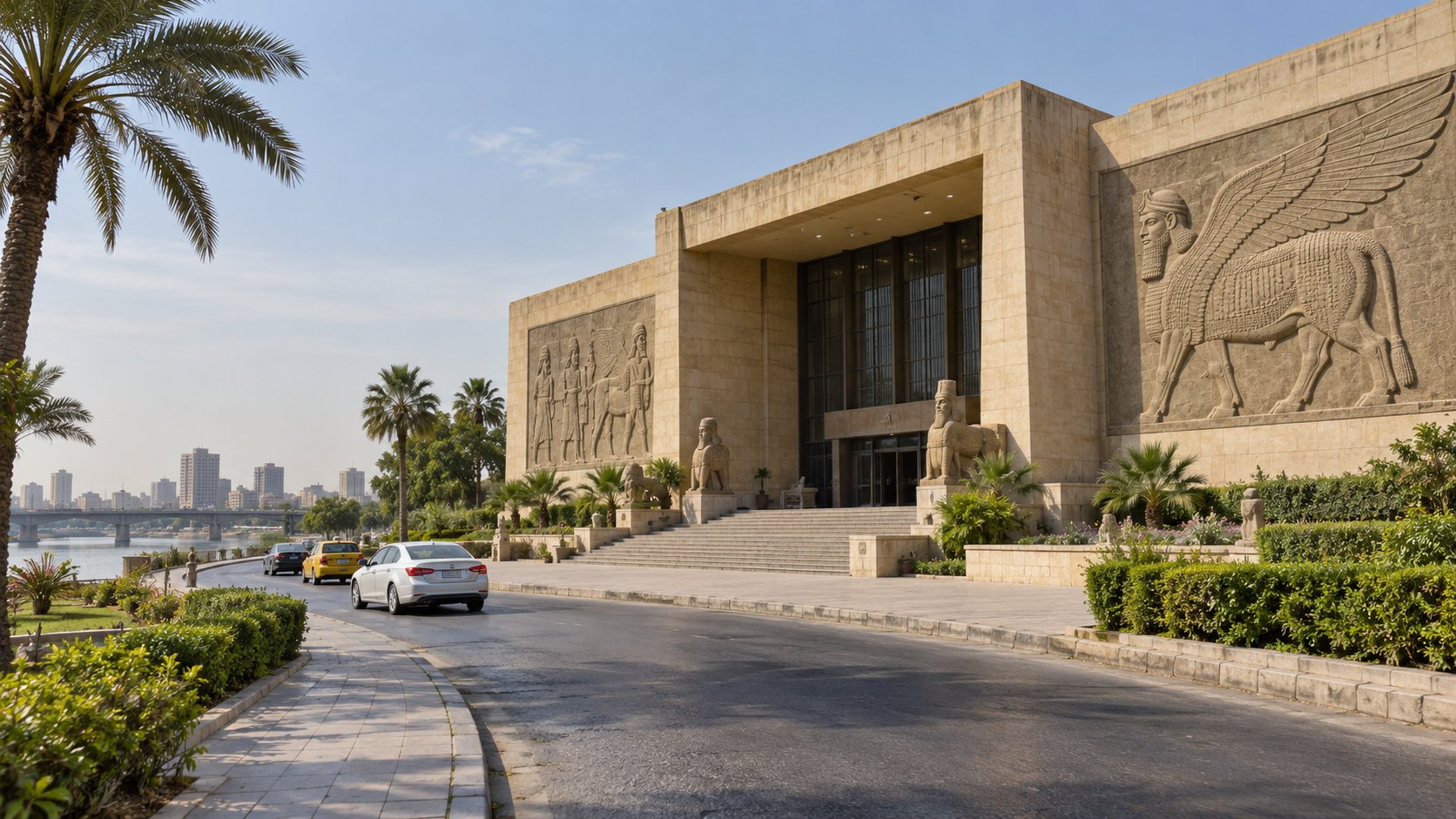
Opening Hours and Visitor Information
Operating hours and access policies are set by the State Board of Antiquities and Heritage (SBAH):
- Days Open: Monday through Friday.
- Closed: Saturdays and Sundays, plus official public holidays.
- Hours:
- Monday – Thursday: 9:00 AM – 1:00 PM (ticket counter closes around 12:15 PM to 12:30 PM).
- Friday: 9:00 AM – 4:00 PM (hours can extend to 5:00 PM seasonally).
- Admission:
- Foreign Visitors: 25,000 IQD per adult.
- Iraqi Nationals: 3,000 IQD per adult.
- Payment: Cash only in Iraqi Dinars (IQD) at the ticket booth. Credit and debit cards are not accepted.
- Photography: Handheld personal photography without flash is allowed in the permanent galleries. Flash, tripods, gimbals, and commercial camera gear require written permits from the Ministry of Culture, Tourism and Antiquities.
- Visitor Facilities: Displays include bilingual labels in Arabic and English. Licensed English-speaking guides are often available on-site near the ticket office or through local agencies. Restrooms and benches are located inside the complex.
Sources
- The Iraq Museum (Official Portal): Welcome & Permanent Collections Overview. https://www.theiraqmuseum.com/ (Accessed: May 2024).
- Visit Iraq Official Tourism Portal: Iraqi Archaeological Museum / Iraq National Museum Visitor Guide. https://www.visitiraq.iq/copy-of-basrah-cultural-museum (Accessed: May 2024).
- Audiala Cultural Guides: National Museum of Iraq, Baghdad: Visitor Guide 2025. https://audiala.com/en/iraq/baghdad/national-museum-of-iraq (Accessed: May 2024).
- UNESCO World Heritage Centre: Iraq Cultural Heritage Protection and The National Museum of Iraq Initiatives. https://whc.unesco.org/en/news/ (Accessed: May 2024).
❓Frequently Asked Questions
Here are answers to frequently asked questions about the content above
The museum is officially known as the National Museum of Iraq (al-Mathaf al-Iraqi). It is located on Damascus Street in the Al-Salihiyyah / Al-Alawi district on the western bank of the Tigris River in central Baghdad.
The museum is typically open Monday through Thursday from 9:00 AM to 1:00 PM, and on Fridays from 9:00 AM to 4:00 PM. It is closed on Saturdays and Sundays, as well as on select official national holidays.
Admission costs 25,000 Iraqi Dinars (IQD) for foreign tourists and 3,000 IQD for Iraqi citizens. Tickets must be paid in cash in Iraqi Dinars at the on-site ticketing booth, as electronic card payments are generally not supported.
Highlights include the 5,000-year-old Mask of Warka (Lady of Uruk), the Sumerian alabaster Warka Vase, monumental Neo-Assyrian winged bull statues (lamassu) from Nimrud and Khorsabad, royal bronze heads from the Akkadian era, and ancient cuneiform legal and literary tablets.
Non-flash personal photography with mobile phones and compact hand-held cameras is permitted inside the main exhibition galleries. Flash photography, tripods, and commercial video recording are strictly prohibited without formal accreditation.
Visitors must present original government identification (an international passport for foreign travelers) at the security gate and pass through metal detector checkpoints and routine bag inspections before entry.