A 13th-century Abbasid universal university on the east bank of the Tigris in Baghdad, famous for its monumental iwans, intricate carved brickwork, and historic four-school jurisprudence curriculum.
The Mustansiriya Madrasah stands on the east bank of the Tigris River in Baghdad, a surviving masterpiece of medieval architecture that outlasted Mongol sackings, imperial conversions, and modern conflicts. Commissioned in 1227 CE (625 AH) by the Abbasid Caliph Abu Ja'far al-Mansur al-Mustansir bi'llah and completed in 1233–1234 CE (631 AH), the monument represents one of the earliest surviving purpose-built universal universities in Islamic civilization. Long before multi-faculty universities became standard across medieval Europe, al-Mustansir gathered the four canonical Sunni schools of jurisprudence under one roof, providing the complex with residences, a teaching hospital, a public pharmacy, an extensive library, and an astronomical water clock.
Located just south of Al-Shuhada Bridge along the historic Rusafa riverbank, the restored brick complex gives visitors an authentic physical record of the late Abbasid Caliphate.
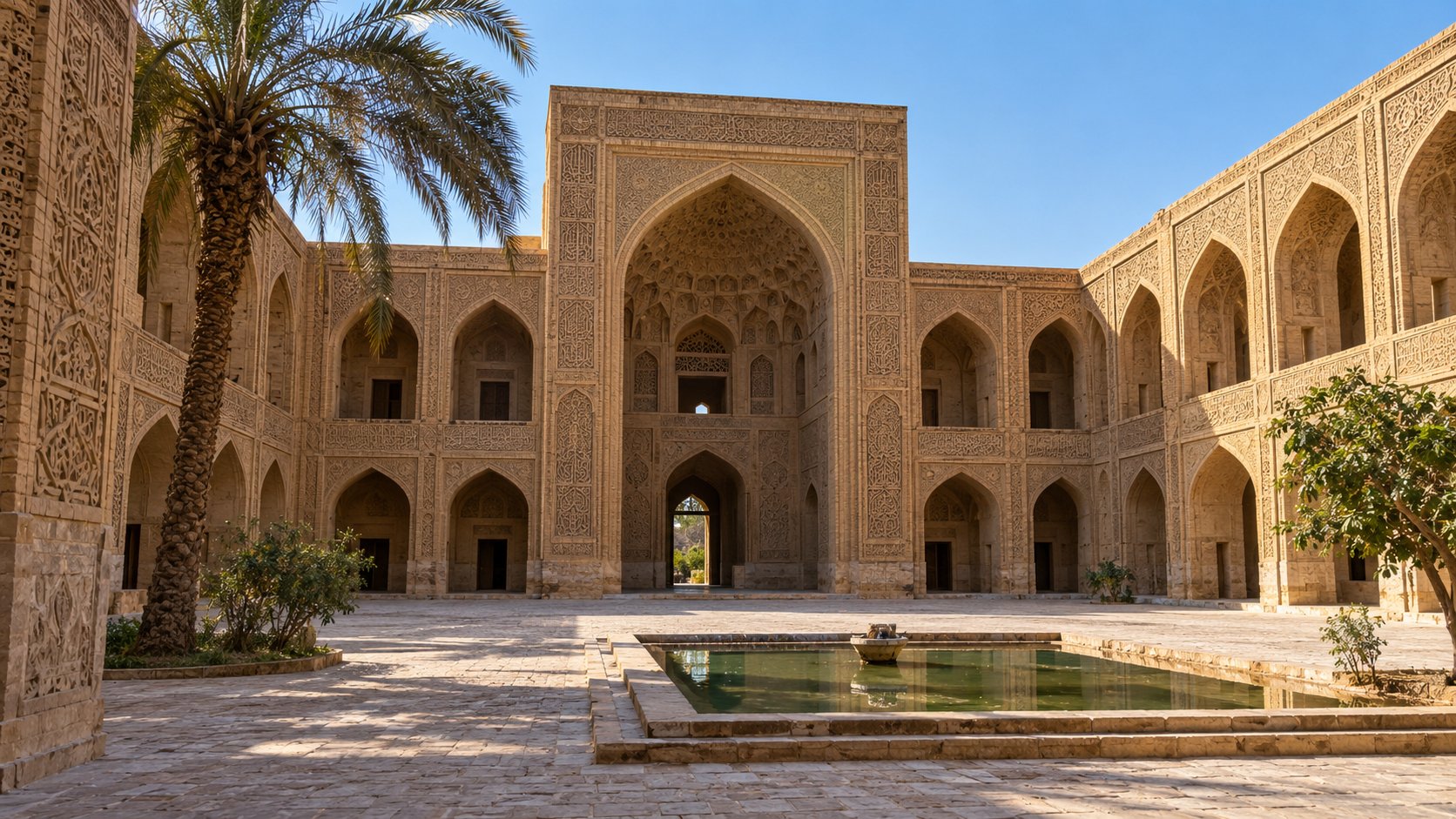
Architecture: Brickwork and Iwans
The architecture of the Mustansiriya Madrasah demonstrates master-level Mesopotamian brick masonry from the late Abbasid era. The complex occupies a rectangular footprint roughly 106 meters long by 50 meters wide, organized around an open central courtyard.
Key architectural features include:
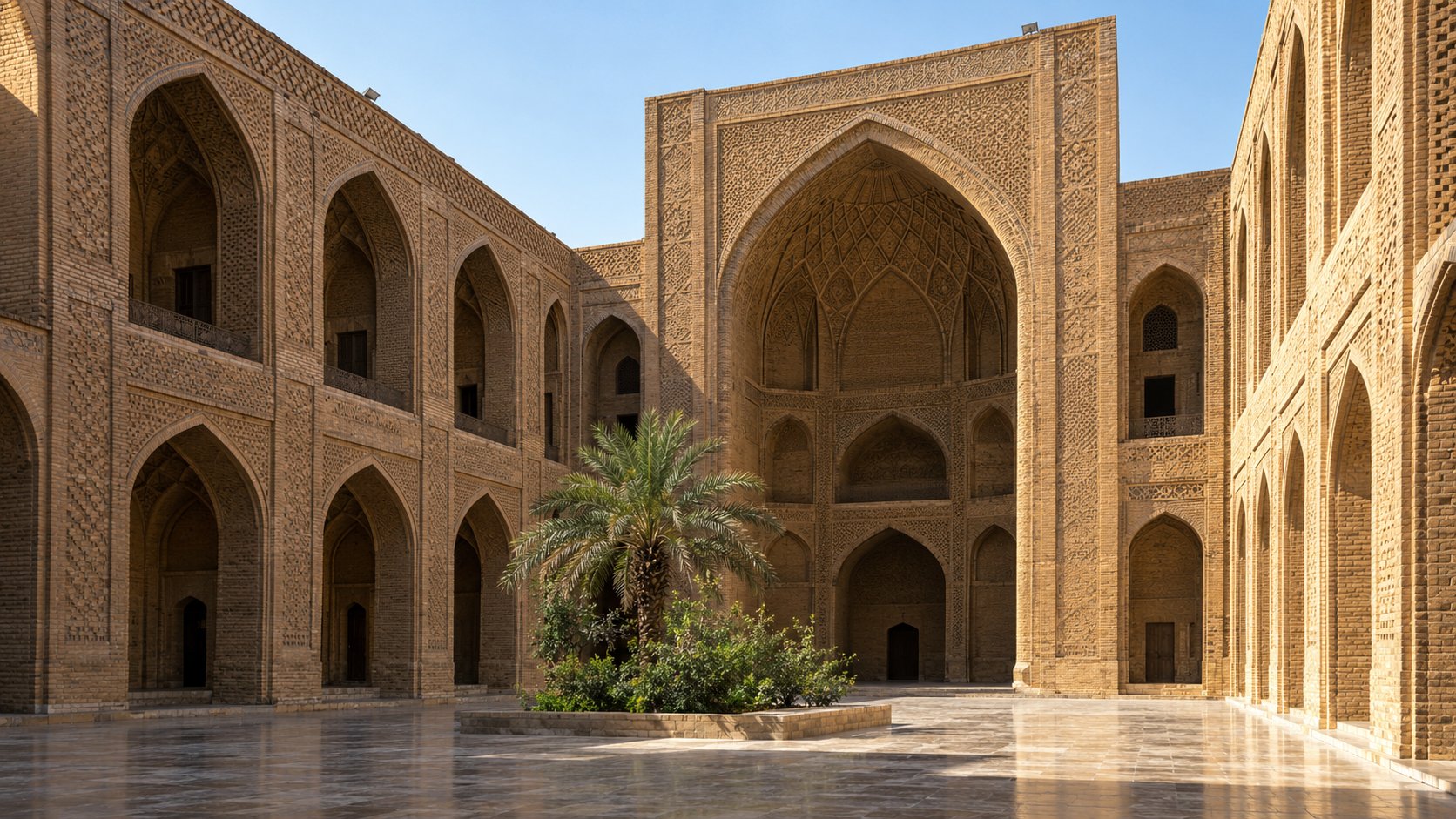
- The Four-Iwan Plan: Departing from the single-hall madrasas of earlier centuries, the layout centers on monumental vaulted halls, or iwans, opening directly onto the courtyard. Two tall two-story iwans frame the shorter southeastern and northwestern sides of the court, serving as central gathering spaces for lectures and assemblies.
- Carved Brick and Terracotta Ornamentation: Rather than relying on the glazed tilework that later dominated Persian architecture, the Mustansiriya highlights decorative brick craftsmanship. Deep-cut terracotta panels, geometric star-and-polygon friezes, interlocking zigzags, and calligraphic bands decorate the portals and courtyard elevations.
- Monumental Portals and Inscription Bands: The main northeastern portal projects outward with a recessed pointed arch framed by three concentric moldings of geometric strapwork. Above the portal, a ten-line foundation inscription carved in Thuluth script records Caliph al-Mustansir’s patronage. Along the river-facing southwestern exterior wall, decorative brick plugs form raised zigzag patterns above an inscription band documenting later restorations.
- Two-Story Arcades and Student Cells: Flanking the primary iwans along both long courtyard walls run two tiers of pointed-arch arcades. These open corridors lead into narrow vaulted student cells (hujarat), designed as individual living quarters and quiet study rooms.
A Universal Center of Medieval Learning
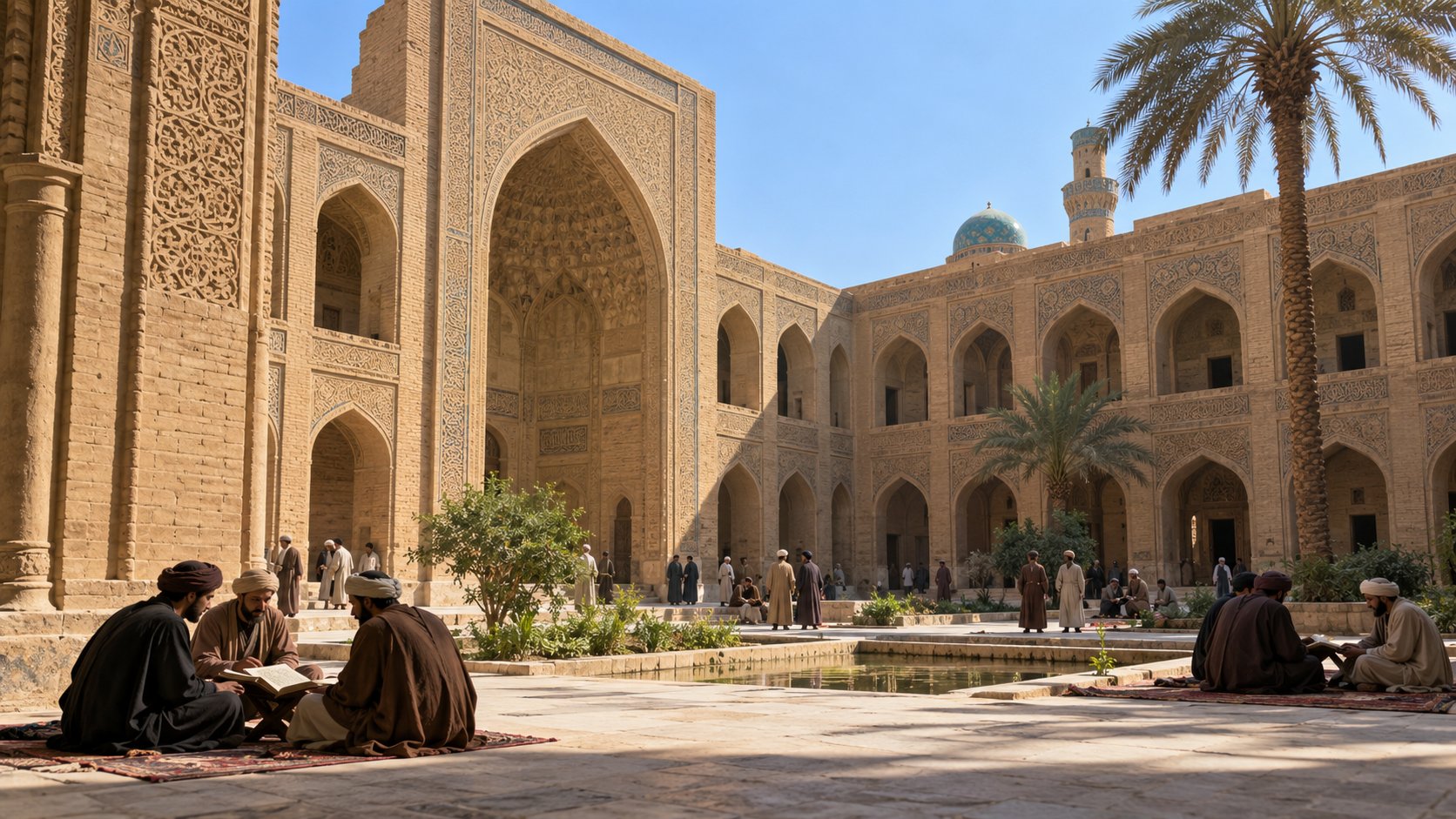
Before the founding of the Mustansiriya, madrasas throughout the Islamic world typically served a single legal school (madhhab). Caliph al-Mustansir reformed this model by establishing an institution that housed all four recognized Sunni legal traditions: Hanafi, Shafi'i, Maliki, and Hanbali.
Each school received dedicated study quarters, professorial chairs, and student cohorts within the four quadrants of the building. The curriculum extended well beyond jurisprudence and Quranic exegesis:
- Dar al-Hadith and Dar al-Qur'an: Specialized divisions held regular recitation and study sessions under senior scholars. The caliph also endowed living provisions for thirty orphans studying the Quran.
- School of Medicine and Teaching Hospital: The madrasah housed a formal medical faculty led by an appointed chief physician, complete with a teaching hospital (bimaristan) and a dispensary. Students received bedside clinical instruction alongside theoretical training.
- Public Welfare and Stipends: Higher learning at the Mustansiriya was completely endowed as a public welfare institution. Students received free lodging, clothing, daily food rations, medical care, and monetary stipends.
- The Grand Library: The madrasah held a library initially endowed by the caliph with approximately 80,000 volumes. Chroniclers noted that the collection grew steadily over following decades, attracting copyists and scholars from across the region.
- The Hydraulic Astronomical Clock: In 1235 CE, engineer Ali ibn Tha'lab al-Sa'ati completed a water-powered clock in the madrasah entrance vestibule. The device marked daytime and nighttime hours by dropping brass spheres and tracked celestial movements, alerting students and faculty to prayer times.
History and Modern Restoration
The school had operated for only twenty-five years when Mongol forces under Hulagu Khan besieged and sacked Baghdad in February 1258, ending the Abbasid Caliphate. While much of the city was destroyed and libraries were thrown into the Tigris, the Mustansiriya's burnt-brick structure survived.
Under Ilkhanid rule, the madrasah was repaired and reopened. Polymath and chronicler Ibn al-Fuwati served as its director and chief librarian in 1281 CE. However, recurring Tigris floods, outbreaks of plague, and Timur’s invasions of Baghdad in 1392 and 1401 disrupted operations and damaged the city's institutions.
During the Ottoman period, the complex served various civic and commercial functions. European traveler Carsten Niebuhr visited Baghdad in the mid-18th century and found local merchants using parts of the building as a caravanserai (khan). In 1865, under Ottoman Sultan Abdülaziz, the building was repaired and repurposed as a central customs warehouse (Gumruk).
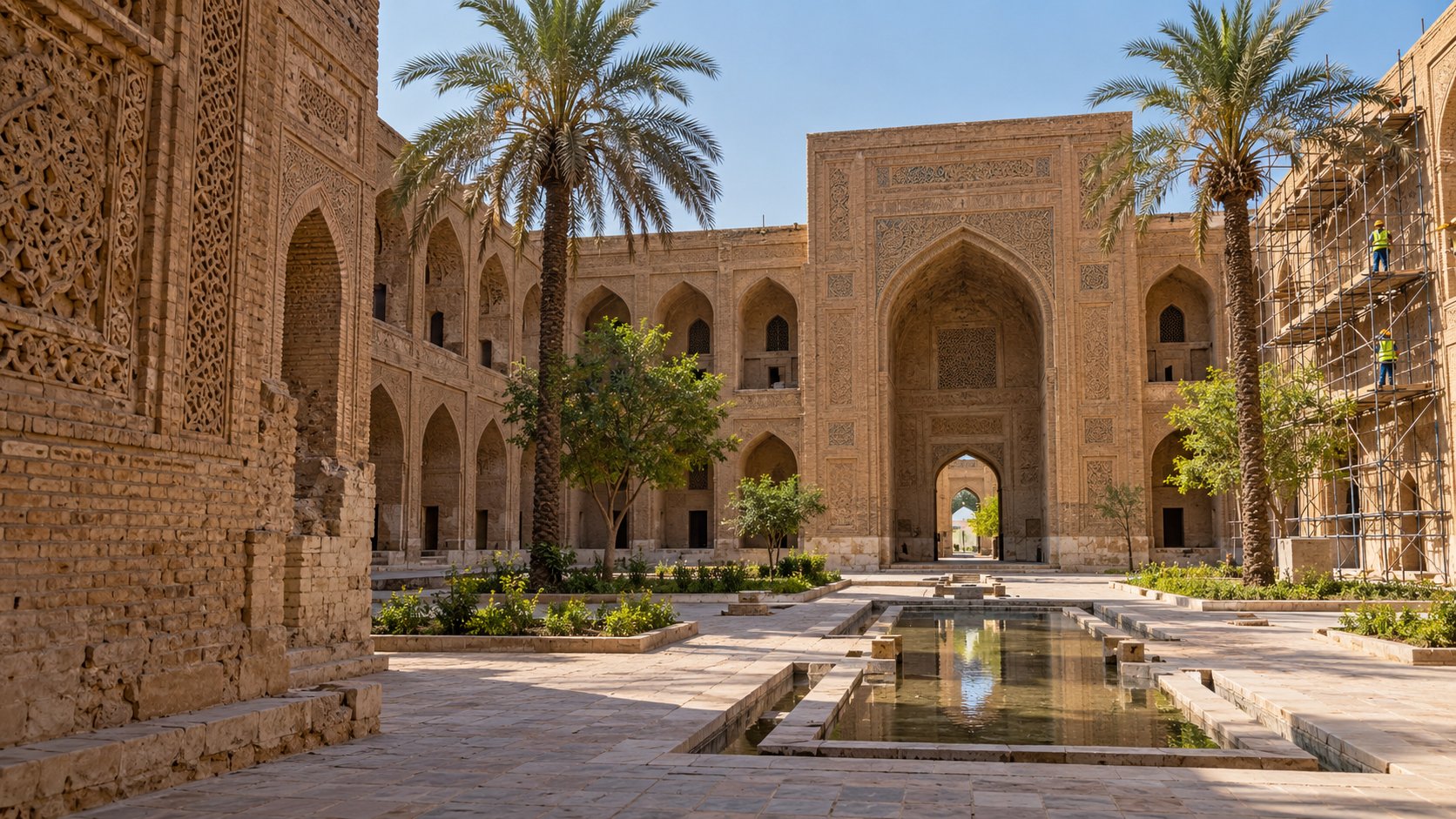
Restoration began in 1945, when the Iraqi Directorate of Antiquities started systematic clearing and conservation work. Commercial stalls built against the exterior walls were removed, brick vaults and carved reliefs were stabilized, and in 1960 the complex reopened to the public as the Museum of Islamic Art. Today, it is managed by the State Board of Antiquities and Heritage (SBAH) and is listed on Iraq’s UNESCO World Heritage Tentative List.
Practical Guide for Visitors
Location and Surroundings
The Mustansiriya Madrasah is located in Baghdad's historic Al-Rusafa district on the east bank of the Tigris River, directly beside Al-Shuhada Bridge. It sits within walking distance of Al-Mutanabbi Street, the Souq al-Saray stationery market, Shabandar Café, and the restored Abbasid Palace (Al-Qasr al-Abbasi).
Planning Your Visit
- Hours: The madrasah is generally open Sunday through Thursday from 8:30 AM to 2:00 PM. It is closed on national holidays and runs reduced hours during Ramadan.
- Admission: Foreign visitors buy entrance tickets at the gate (typically 10,000 to 15,000 IQD). Check opening times locally before visiting, as site work or official visits can temporarily restrict access.
- Visit Length: Set aside 60 to 90 minutes to tour the ground-level arcades, walk the second-story porticoes overlooking the courtyard, and examine the brick relief carvings.
- Photography: Personal photography and phone cameras are permitted throughout the courtyard and arcades. Commercial shoots or tripods require prior permission from site staff.
Sources
- Archnet (Aga Khan Documentation Center): "Madrasa al-Mustansiriyya", architectural survey and building history, https://archnet.org/sites/3836, accessed March 2025.
- UNESCO World Heritage Centre: "Historical Features of the Tigris River in Baghdad Rusafa, which extends from the school Al-Mustansiriya to the Abbasid Palace", Tentative Lists documentation, accessed March 2025.
- Directorate of Antiquities & Heritage of Iraq / Tariq Jawad Al-Janabi: Studies in Medieval Iraqi Architecture, Ministry of Culture and Information, Baghdad, 1982.
- Hansjörg Schmid: Die Madrasa des Kalifen al-Mustansir in Baghdad, Verlag Philipp von Zabern, Mainz am Rhein, 1980.
- Carsten Niebuhr: Reisebeschreibung nach Arabien und andern umliegenden Ländern, historical accounts of Baghdad inscriptions and madrasah reuse, Copenhagen, 1774–1778.
❓Frequently Asked Questions
Here are answers to frequently asked questions about the content above
Founded in 1227 CE by Abbasid Caliph al-Mustansir, it was one of the earliest universal higher education universities in the Islamic world, famously teaching all four major Sunni schools of jurisprudence within a single complex alongside medicine, mathematics, and astronomy.
The complex is located on the east bank of the Tigris River in the Al-Rusafa district of Baghdad, directly downstream of Al-Shuhada Bridge and a short walk from Al-Mutanabbi Street.
Yes, while Hulagu Khan's forces devastated Baghdad in 1258, the sturdy burnt-brick building survived the assault and was later restored and reopened under Ilkhanid rule, continuing to function as an educational center.
The madrasah exemplifies late Abbasid architecture, featuring a four-iwan plan centered on a 106-by-50-meter rectangular courtyard with elaborate geometric burnt-brick relief, terracotta strapwork, and monumental Arabic calligraphic friezes.
Beyond Quranic sciences and the four legal madhabs, the institution housed a dedicated School of Medicine with an attached hospital and pharmacy, as well as chairs for mathematics, grammar, literature, and astronomy.
Yes, the restored complex is open to international visitors and local travelers, generally on weekday mornings and early afternoons, and can easily be paired with visits to nearby Al-Mutanabbi Street and the Abbasid Palace.