Rising forty meters above the Khasa riverbed, the Kirkuk Citadel holds four thousand years of continuous settlement from ancient Arrapha to the Ottoman era. Today, visitors can walk the high archaeological mound to explore surviving Jalayirid domes, multi-faith shrines, and ruined Chaldean cathedrals overlooking central Kirkuk.
Kirkuk Citadel stands in the center of Kirkuk on a steep, four-cornered archaeological tell that rises roughly 40 meters above the surrounding plains. The mound covers roughly 42.5 hectares (170 Iraqi dunams) directly west of the seasonal Khasa River. While most of the dense residential quarters that once packed the plateau were cleared in the late 1990s, the citadel remains the historical anchor of the province, holding four millennia of layered Mesopotamian, Islamic, and Christian architecture.
In April 2021, the Iraqi State Board of Antiquities and Heritage submitted the citadel to the UNESCO World Heritage Tentative List according to UNESCO World Heritage Centre. Today, travelers visiting Kirkuk can climb the citadel ramp to explore its open-air archaeological tell, active historic mosques, medieval mausoleums, and panoramic lookouts over the lower markets.
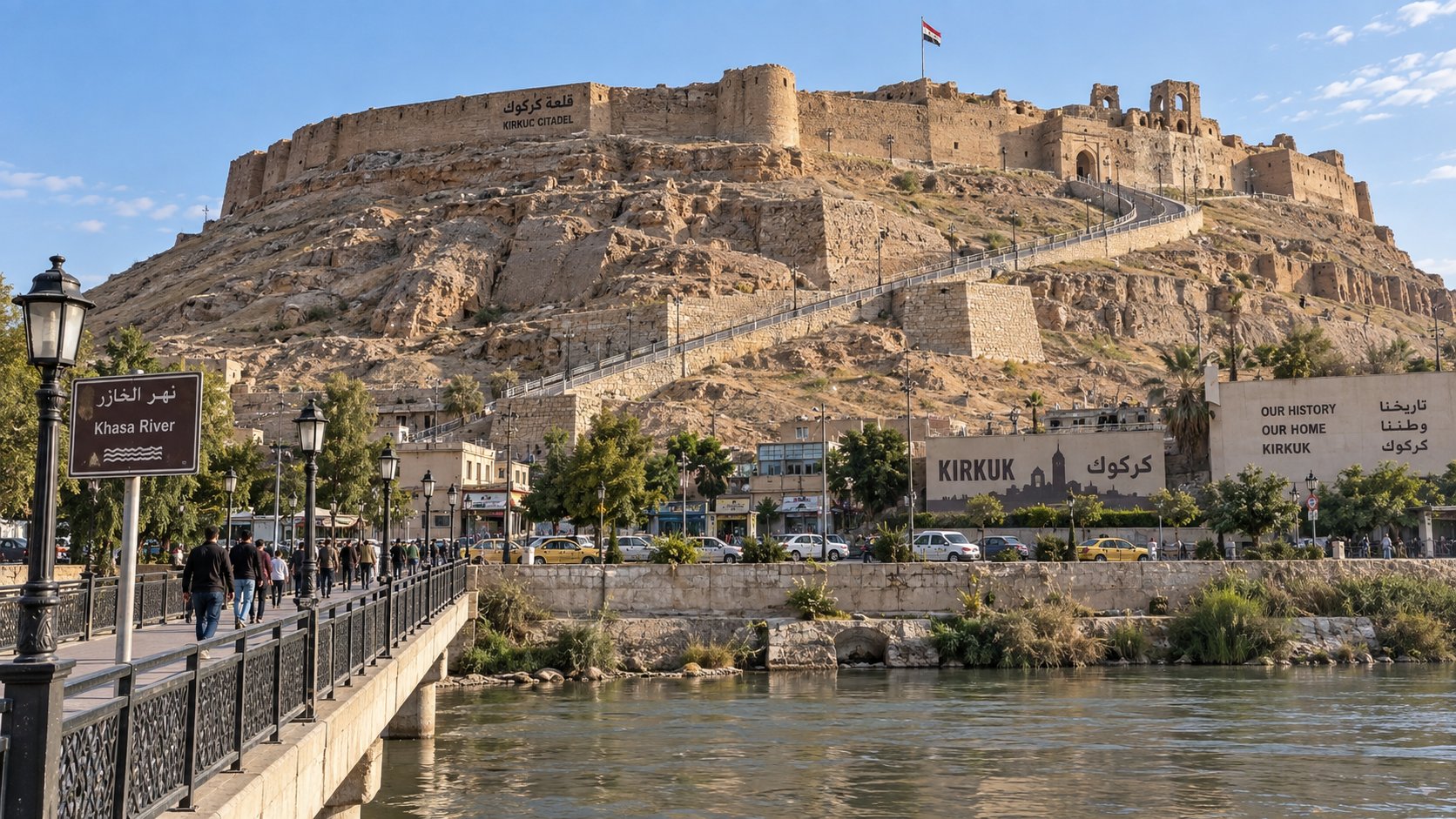
Four Millennia of History on the Tell
Archaeological excavations and surface surveys show that the citadel mound is an ancient artificial tell built up by successive settlements dating back to the third millennium BCE. In 1923, archaeologists discovered 51 cuneiform tablets near the base of the mound that tied the location directly to the ancient Hurrian and Babylonian city of Arrapha, as documented by Oxford University's archaeological heritage survey.
Between 884 and 850 BCE, the Neo-Assyrian King Ashurnasirpal II fortified Arrapha, using the high tell as a forward military bastion and regional administrative center, as noted by The National News. Later, the Seleucid ruler Seleucus I Nicator rebuilt the perimeter ramparts, constructing an enclosure with 72 defensive towers and 72 internal thoroughfares.
The site retained strategic military and trade importance through Parthian, Sassanid, Abbasid, and Jalayirid rule. During the Ottoman era, the citadel formed the fortified residential heart of Kirkuk, divided into three distinct quarters (mahallas):
- Al-Maidan Quarter: The northern residential sector, home to merchant estates and administrative buildings.
- Al-Qal'a Quarter: The central district holding key mosques, religious schools, and the central bazaar.
- Al-Hammam Quarter: The southern residential district named after its public bathhouses.
For centuries, these quarters housed a multi-ethnic community of Turkmens, Chaldean Christians, Kurds, Jews, and Arabs living within a dense urban fabric of narrow alleyways and enclosed courtyards.
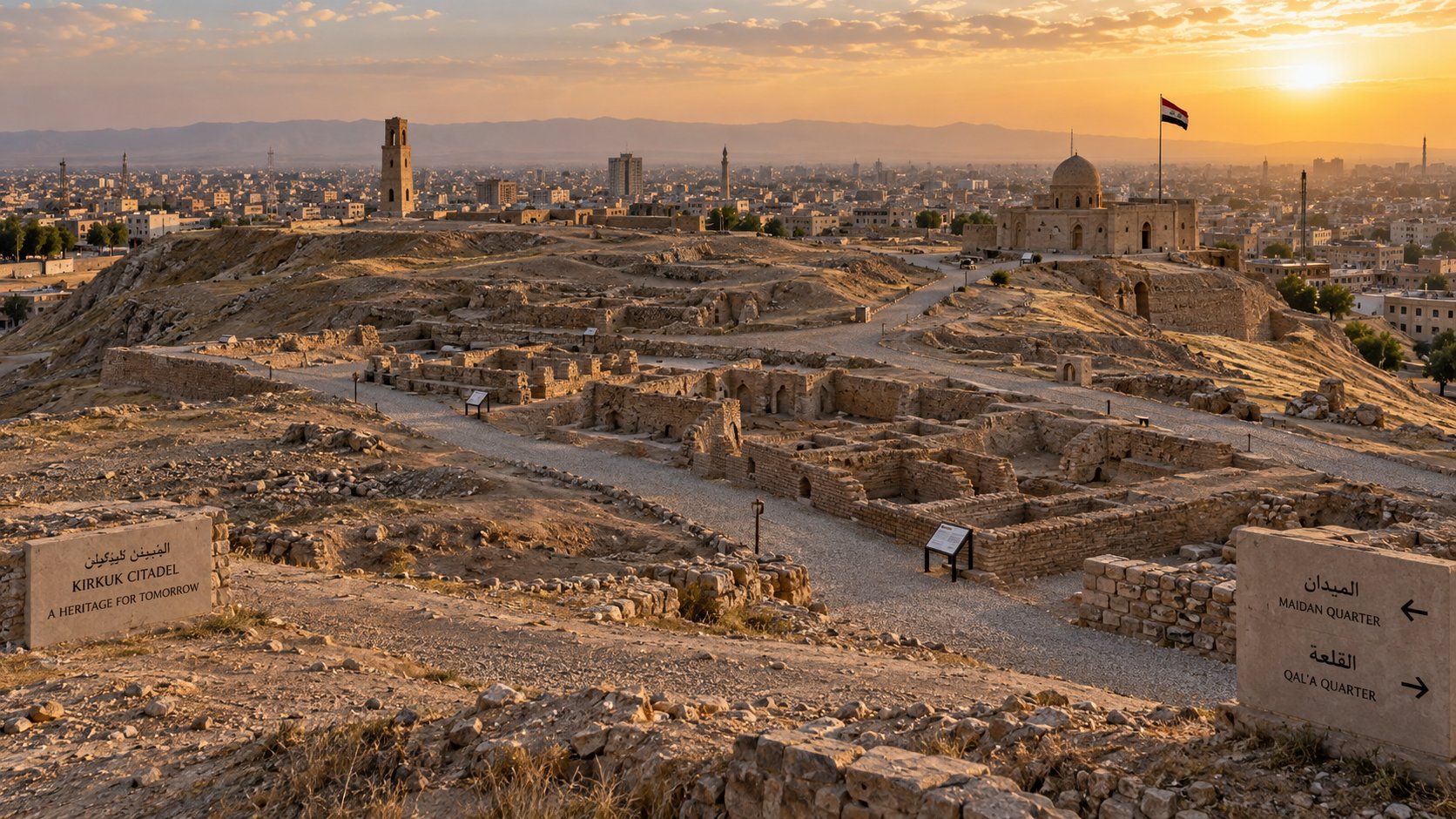
Surviving Monuments and Architecture
Although much of the residential streetscape was lost during the late twentieth century, nine major monuments and several historic residences remain standing across the tell.
Mosque and Shrine of Prophet Daniel (Jami' al-Nabi Danyal)
Located on the southern side of the citadel (35°28'08"N, 44°23'44"E), this complex is the most active and visited religious landmark on the tell according to Al-Sabaah Newspaper. The structure occupies a site with deep interfaith roots. It originated as a synagogue in antiquity, transitioned into a Christian church during the pre-Islamic era, and was converted into a mosque during the Umayyad caliphate.
The current building dates primarily to the fourteenth-century Jalayirid period, featuring a cylindrical brick minaret decorated with geometric patterns and two glazed turquoise domes. Inside the vaulted main prayer hall stand three enclosed shrines attributed by local tradition to the Prophet Daniel and two companion figures, Hananiah and Azariah (known in biblical accounts as Shadrach and Abednego). Immediately behind the mosque lies the oldest cemetery in Kirkuk, containing centuries-old Ottoman headstones and military burials from World War I.
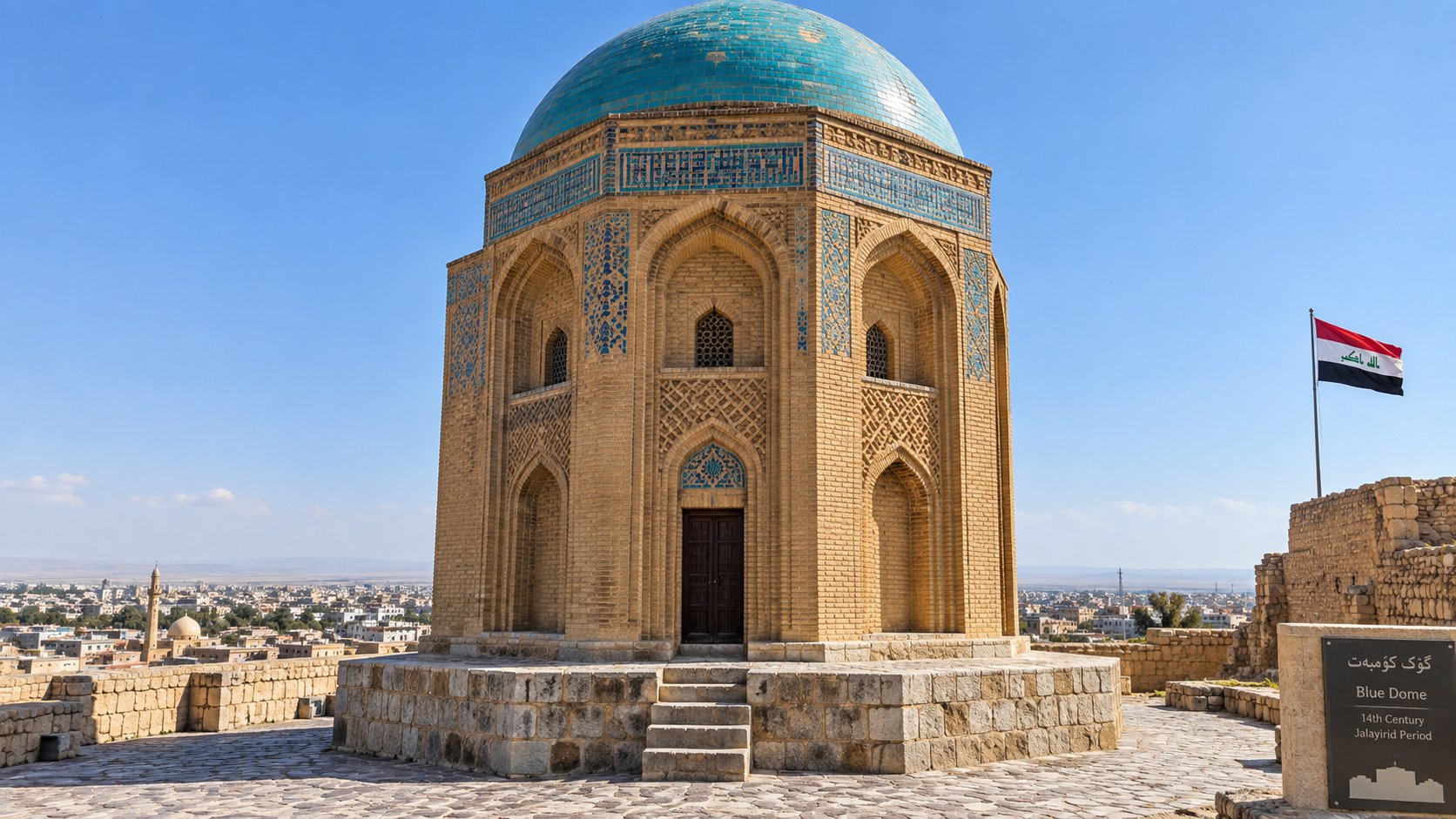
The Blue Dome (Gök Kümbet)
Standing near the northern edge of the citadel (35°28'14"N, 44°23'43"E), the Blue Dome (Gök Kümbet in Turkish, Qubbat al-Zarqa in Arabic) is an octagonal funerary monument built in 1361 CE during the Jalayirid Sultanate. Historical records indicate the tomb was commissioned for Bogdai Khatun, a Mongol-Turkic noblewoman who passed away in the region while traveling toward Mecca.
The mausoleum features a two-story octagonal layout resting on a raised stone base. Its exterior brick walls display detailed decorative recessed niches, glazed terracotta tile fragments, and bands of Arabic and geometric script. The burial crypt lies beneath the main chamber, while the upper structure is crowned by a turquoise dome restored in the early 2000s.
Great Mosque of the Citadel (Ulu Camii)
Also known as the Mosque of the Virgin Mary, the Ulu Camii is the oldest surviving congregational mosque on the mound. It occupies the site of a seventh-century church that was repaired and converted under Abbasid rule, then substantially rebuilt in 1237 CE in Seljuk architectural style. An Ottoman religious school (madrasa) was added to the courtyard in 1657. After structural stabilization works, the mosque officially reopened its doors for regular neighborhood prayers and Ramadan services according to Shafaq News reporting.
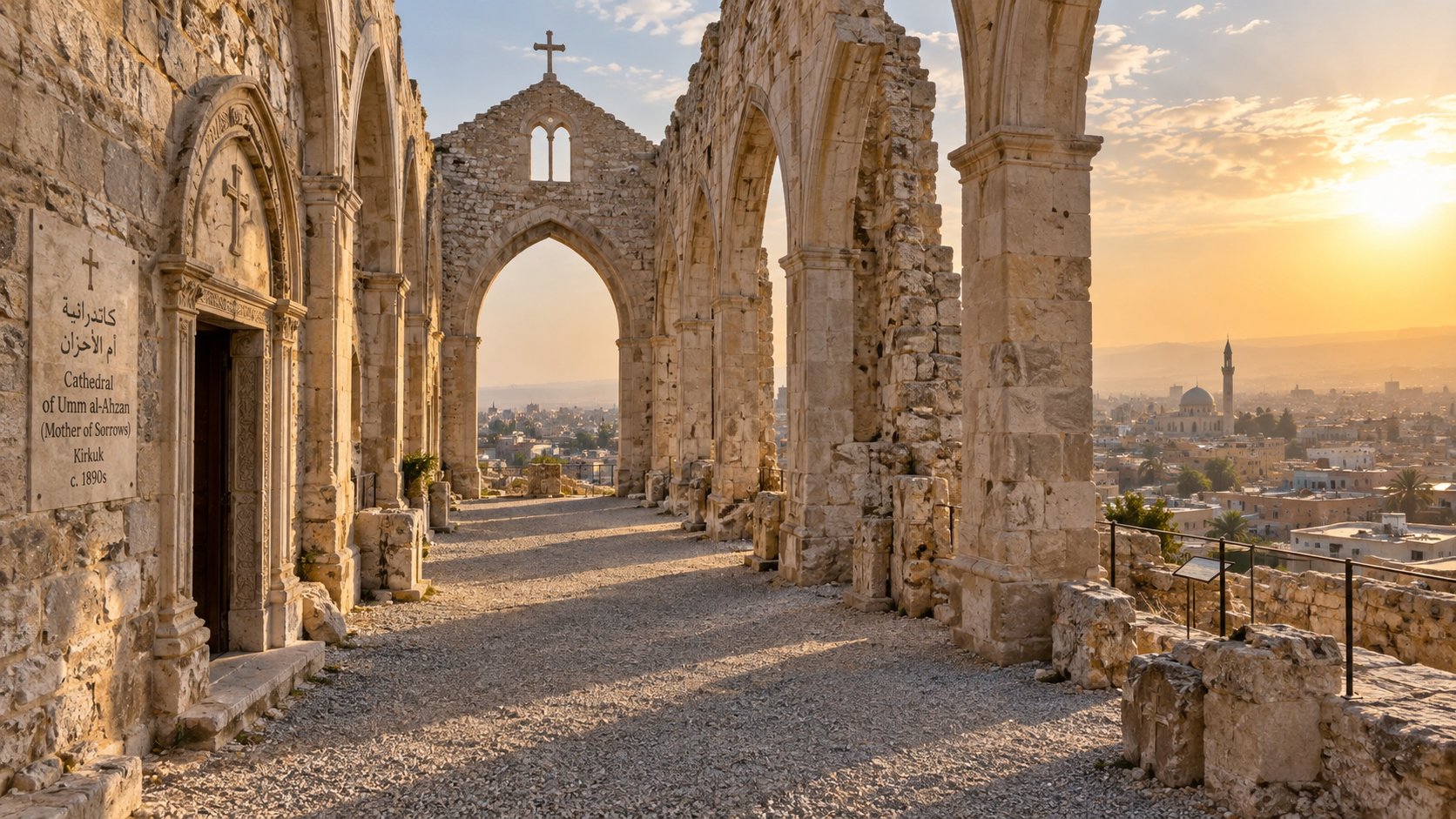
Ruins of Umm al-Ahzan Cathedral
On the eastern flank of the tell (35°28'14"N, 44°23'46"E) stand the roofless stone arcades of Umm al-Ahzan (Mother of Sorrows), a nineteenth-century Chaldean Catholic cathedral consecrated in 1862 under Patriarch Joseph VI Audo according to Mesopotamia Heritage. The cathedral was built to serve the growing Christian population residing within the citadel walls.
The structure suffered major roof collapses in the mid-twentieth century due to heavy brick vault loads placed on slender limestone columns, compounded by weathering and poor cement repairs in 1961. Today, its exposed arches, carved stone lintels, and surviving nave walls offer a clear look at nineteenth-century ecclesiastical construction in northern Iraq.
Al-Ariyyan Mosque
Built in 1142 AH (1729 CE) in the historic Hammam quarter, Al-Ariyyan Mosque is notable for its refined stone and gypsum interior. The mosque preserves a stone minbar carved with six-pointed geometric stars and a decorative mihrab painted with floral motifs and inscribed with Quranic verses from Surah Ali 'Imran (3:37).
Historic Courtyard Mansions
A cluster of traditional Ottoman houses survived the clearances on the mound, most notably Dar al-Tayfur (dating to 1152 AH / 1739 CE), Dar Abdullah Effendi Yaqoubi, and Bayt al-Aris. These residences demonstrate distinctive northern Mesopotamian domestic architecture:
- Central courtyards paved with local river pebbles and limestone slabs.
- Carved local alabaster stone (al-farsh al-kirkuki) used for doorway arches and structural columns.
- Deep shade iwans opening onto the central court for summer cooling.
- Upper-story rooms with carved plaster wall niches (chini-khana) designed to hold imported porcelain and tea sets.
- Projecting wooden window balconies (shenashil) looking out over the citadel paths.
The 1997 Clearances and Modern Conservation
In 1997 and 1998, the former Ba'athist government initiated a widespread demolition campaign on the tell under the direction of General Iyad Futayyih. Citing archaeological restoration and park development plans, state authorities forcibly evicted several hundred families, predominantly Turkmen and Chaldean residents, and bulldozed approximately 800 historic residential buildings.
Only isolated public monuments and a handful of aristocratic houses were left standing, transforming what was once an inhabited historic town into an open, partly ruined archaeological park. Subsequent repair projects between 1998 and 2003 used incompatible modern cement that accelerated moisture damage in historic masonry, an issue highlighted by Oxford University's archaeological assessment.
In recent years, the Iraqi State Board of Antiquities and Heritage (SBAH) and local Kirkuk heritage groups have prioritized stabilizing the citadel's perimeter slopes, securing the remaining Ottoman houses, and preserving the standing monuments against erosion and weathering, as reported by Shafaq News.
What Visitors Can Currently Access
The Kirkuk Citadel is accessible to independent travelers and guided visitors. Because the site is an open archaeological mound rather than an enclosed ticketed museum, the experience centers on self-guided walking among the ruins and active monuments.
- Citadel Perimeter and Views: Visitors can walk the edge of the tell for 360-degree views over downtown Kirkuk, the seasonal Khasa riverbed, the Ottoman-era Qaysariyya Market, and the modern bridge crossings.
- Prophet Daniel Mosque: The mosque is open daily to respectful visitors. Local caretakers manage the prayer hall, and visitors are welcome to view the three historic tombs inside outside of prayer times.
- Gök Kümbet (Blue Dome): The exterior of the octagonal tomb is visible within its walled courtyard near the northern gate.
- Umm al-Ahzan Ruins: The standing arches of the Chaldean cathedral are open to view from the plateau footpaths. Visitors should watch their footing around loose rubble and crumbling stone walls.
- Walking the Archaeological Tell: Broad gravel tracks run across the plateau between the standing monuments, making it straightforward to navigate the entire 42-hectare site on foot in 60 to 90 minutes.
Practical Visitor Details
Getting There
The citadel sits immediately adjacent to the old city center of Kirkuk.
- From within Kirkuk: A local taxi ride from central commercial districts like Atlas Street or Baghdad Road takes five to ten minutes and costs around 3,000 to 5,000 IQD ($2 to $4 USD).
- On Foot: You can walk directly up to the citadel from the historic Qaysariyya Bazaar across the Khasa River pedestrian crossing. Paved access ramps lead up the eastern and southern flanks of the mound.
- Intercity Connections: Kirkuk is easily reached by road from Erbil (about 1.5 to 2 hours drive south via Highway 2) or Sulaymaniyah (roughly 2 hours west via Chamchamal). Shared taxis from Erbil's Kirkuk Garage cost approximately 10,000 to 15,000 IQD per seat.
Entry and Hours
- Admission: Access to the citadel mound and its mosques is currently free of charge.
- Hours: The mound is open during daylight hours, generally from 8:00 AM until sunset. Visiting during early morning or late afternoon provides the best lighting for photography and cooler temperatures.
- Checkpoints: Local police and heritage protection officers maintain small posts near the main access road on the mound. Foreign visitors may be asked to present their passport and Iraqi visa.
Practical Tips
- Footwear: Wear sturdy walking shoes with good grip. The plateau features uneven ground, loose gravel, exposed brick foundations, and steep edges without safety railings.
- Dress Code: Dress modestly with shoulders and knees covered when entering Prophet Daniel Mosque or Ulu Camii. Women should carry a headscarf for mosque visits.
- Weather: Summers in Kirkuk are extremely hot, with afternoon temperatures frequently exceeding 42°C (108°F) between June and August. The best months to visit are October through April, when daytime weather is mild and clear.
- Combining Visits: Pair your walk around the citadel with a visit to the covered Qaysariyya Market and the Ottoman Qishla barracks located at the foot of the mound.
Sources
- UNESCO World Heritage Centre: "Kirkuk Citadel" (Ref 6522, Tentative List), https://whc.unesco.org/en/tentativelists/6522/, accessed March 2026.
- University of Oxford (School of Archaeology): "The Citadel of Kirkuk: Reconnaissance and assessment of its archaeological heritage" by Dr. Narmeen Ali Muhammadameen, https://podcasts.ox.ac.uk/citadel-kirkuk-reconnaissance-and-assessment-its-archaeological-heritage-arabic, accessed March 2026.
- Mesopotamia Heritage: "The ancient cathedral Om Al Ahzane in the citadel of Kirkuk (and other Christian buildings in the citadel)", https://www.mesopotamiaheritage.org/en/monuments/lancienne-cathedrale-chaldeenne-om-al-ahzane-de-la-citadelle-de-kirkouk-et-autres-anciens-edifices-chretiens-de-la-citadelle/, accessed March 2026.
- The National News: "The ancient citadel of Kirkuk - in pictures", https://www.thenationalnews.com/mena/the-ancient-citadel-of-kirkuk-in-pictures-1.1229491, accessed March 2026.
- Shafaq News: "Kirkuk's Citadel crumbles: Calls grow for urgent action", https://shafaq.com/en/Iraq/Kirkuk-s-Citadel-crumbles-Calls-grow-for-urgent-action, accessed March 2026.
- Shafaq News: "Kirkuk's Green Dome crumbles: Neglect threatens 14th-century icon", https://shafaq.com/en/culture-art/Kirkuk-s-Green-Dome-crumbles-Neglect-threatens-14th-century-icon, accessed March 2026.
- Al-Sabaah Newspaper: "The city of archeology: Kirkuk, a city steeped in history and indicative of civilization", https://alsabaah.iq/59583-.html, accessed March 2026.
❓Frequently Asked Questions
Here are answers to frequently asked questions about the content above
Yes, Kirkuk Citadel is accessible to the public during daylight hours. Visitors can walk the plateau, explore the open ruins, and enter active landmarks like the Mosque of Prophet Daniel and the Great Mosque free of charge.
Local religious tradition holds that the mosque contains the tombs of the biblical Prophet Daniel and two companion figures, Hananiah and Azariah (associated with Shadrach and Abednego). The site has been a shared place of reverence for Jews, Christians, and Muslims for centuries.
The Blue Dome is an octagonal brick mausoleum built in 1361 CE during the Jalayirid Sultanate for Bogdai Khatun, a noblewoman who died while traveling to Mecca. It features decorative brick niches and turquoise tile work.
In 1997 and 1998, the former Ba'athist government forcibly evicted hundreds of Turkmen, Christian, and Kurdish families and demolished around 800 traditional Ottoman-era courtyard houses under the pretext of archaeological clearances, leaving only isolated public monuments and a few mansions standing.
Kirkuk is roughly 90 minutes south of Erbil by private car or shared taxi along Highway 2. From Baghdad, travelers can take shared taxis or private transport northward via Highway 1 in approximately 3 to 4 hours.
Kirkuk Citadel was officially added to the UNESCO World Heritage Tentative List in April 2021 (Ref 6522) due to its four millennia of continuous urban settlement, authentic Mesopotamian tell morphology, and multi-faith architectural heritage.