Explore Qizqapan's cliff-carved columns, reliefs and burial chambers near Sulaymaniyah, with disputed dating and essential access precautions.
Qizqapan rock-cut tomb
Qizqapan is a burial monument carved into a cliff near Zarzi, northwest of Sulaymaniyah in Iraqi Kurdistan. Two stone columns frame its entrance. Above the doorway, two bow-holding figures face one another across an altar. Behind them are three burial chambers, cut into the mountain rather than built from blocks.
The relief work makes it one of the most distinctive archaeological sites in the region, but visiting requires clear eyes about the physical realities. The entrance sits high on a sheer rock face. Published reports describing ladders or stairs reflect past visits, not a promise that access is safe or open today. The site is also not a proven royal tomb. Its exact date and the identities of its occupants remain open questions.
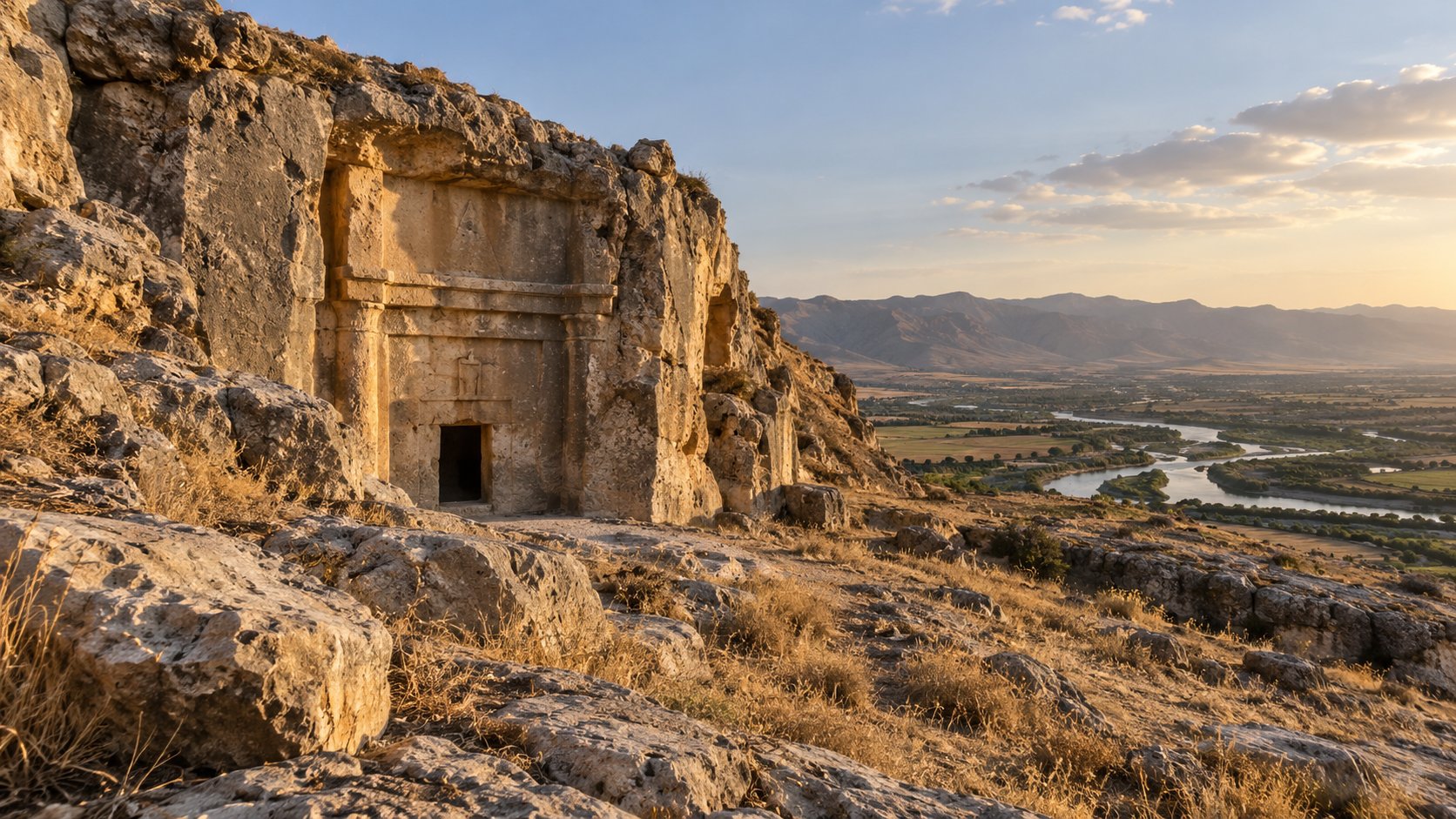
Where Qizqapan is
In an illustrated report for World History Encyclopedia, Osama Shukir Muhammed Amin places Qizqapan near Zarzi village in the Chemi Rezan Valley, roughly 65 kilometres northwest of Sulaymaniyah, near coordinates 35°48'36.09"N, 45°0'23.35"E. Treat that distance as a general orientation rather than a verified driving route or travel time. The site also appears under the spellings Qyzqapan and Ashkawt-i Qizqapan. World History Encyclopedia
Local Kurdish names refer to it as a cave, but Qizqapan was deliberately carved out of the mountain. Local folklore tells of an abducted girl held at the cliff, but those stories belong to local tradition. They do not tell us who commissioned the monument or who was buried inside.
What to look for on the facade
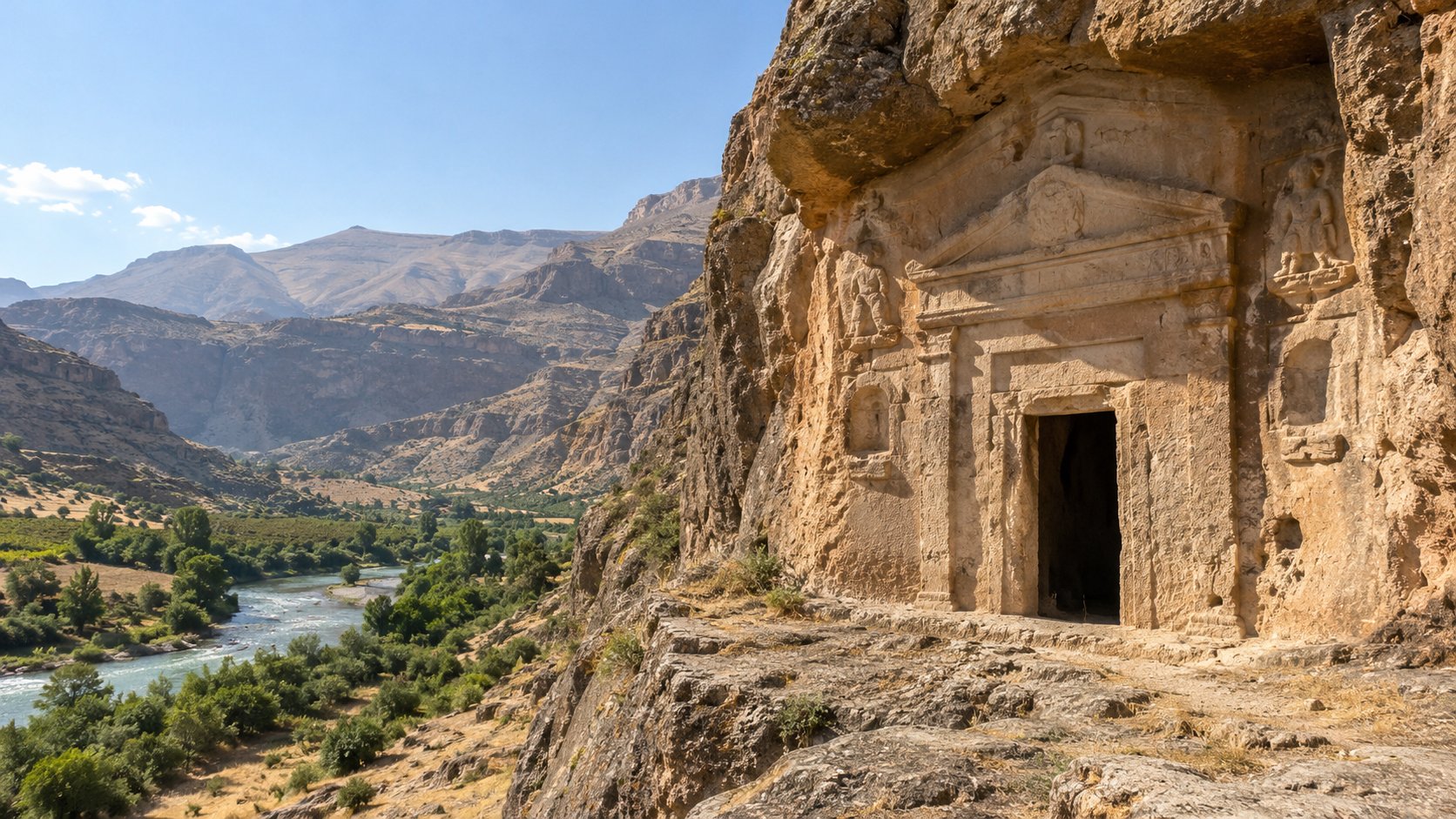
The facade mimics freestanding architecture carved straight into living rock. Two engaged columns frame the entrance, each with a smooth shaft and a large curling capital. Above them, the stone forms projecting eaves that resemble the roof of a wooden building.
The central relief sits directly over the doorway. Two standing figures hold bows, each raising a hand toward a stepped altar between them. The altar carries a rounded top, which Amin identifies as a possible depiction of fire. Both figures wear head coverings typical of Median clothing. That attire gives researchers a point of comparison with Persian and Median reliefs elsewhere, but costume styles lasted across centuries and cannot fix a firm date.
Three round emblems sit across the upper facade above the central scene. You can make out a radiating solar disk, a human figure set within a crescent, and a winged figure. Their exact religious and symbolic meanings remain unsettled. Amin notes competing theories rather than a single identification. Rather than trying to match each emblem to a specific deity, it is better to take in the carving as a blend of regional traditions. Illustrated descriptions and close-up photographs
Inside the burial chambers
A roughly square doorway opens from the portico into the central room. Passages on either side lead into two flanking chambers. Each room has a rectangular burial trough hollowed out of the stone floor, positioned along a wall or tucked into a corner.
Amin notes raised stone rims that once held covers, but the cavities are empty today and the lids are long gone. He found no ancient inscriptions or carved reliefs inside the chambers. His account provides a valuable record of the layout, but reading about the interior is not confirmation that travelers can step inside today. World History Encyclopedia
The absence of an inscription is significant. Without a name carved into the rock, any claim about who lay in these stone troughs remains an educated guess. The chambers show how regional builders cut rock tombs, but they leave the personal history behind them blank.
Is it the tomb of Cyaxares?
Calling Qizqapan the tomb of Cyaxares is an old hypothesis, not an established fact. Guidebooks, road signs, and casual tour itineraries often repeat the name, but no archaeological evidence connects the site to the seventh-century BCE Median king.
The disagreement reaches far beyond the identity of the occupant. In a 2021 study in the journal IRAQ, archaeologist Iraj Rezaei reviews proposed dates spanning the Median, Achaemenid, Seleucid, and Parthian periods. His analysis highlights that none of these proposals commands majority support among specialists.
Rezaei makes a case for the fourth century BCE, during the transition between the late Achaemenid and early Seleucid periods. He draws a firm line between Median artistic motifs and the historical Median empire. Artistic styles and traditional dress outlasted the fall of the Medes by centuries. While Rezaei presents a compelling framework, it remains one scholarly perspective among several. Cambridge University Press, IRAQ
For visitors, the takeaway is straightforward. Median-style clothing and Iranian religious motifs on the cliff face do not prove that an ancient king was buried here.
Approach and physical access
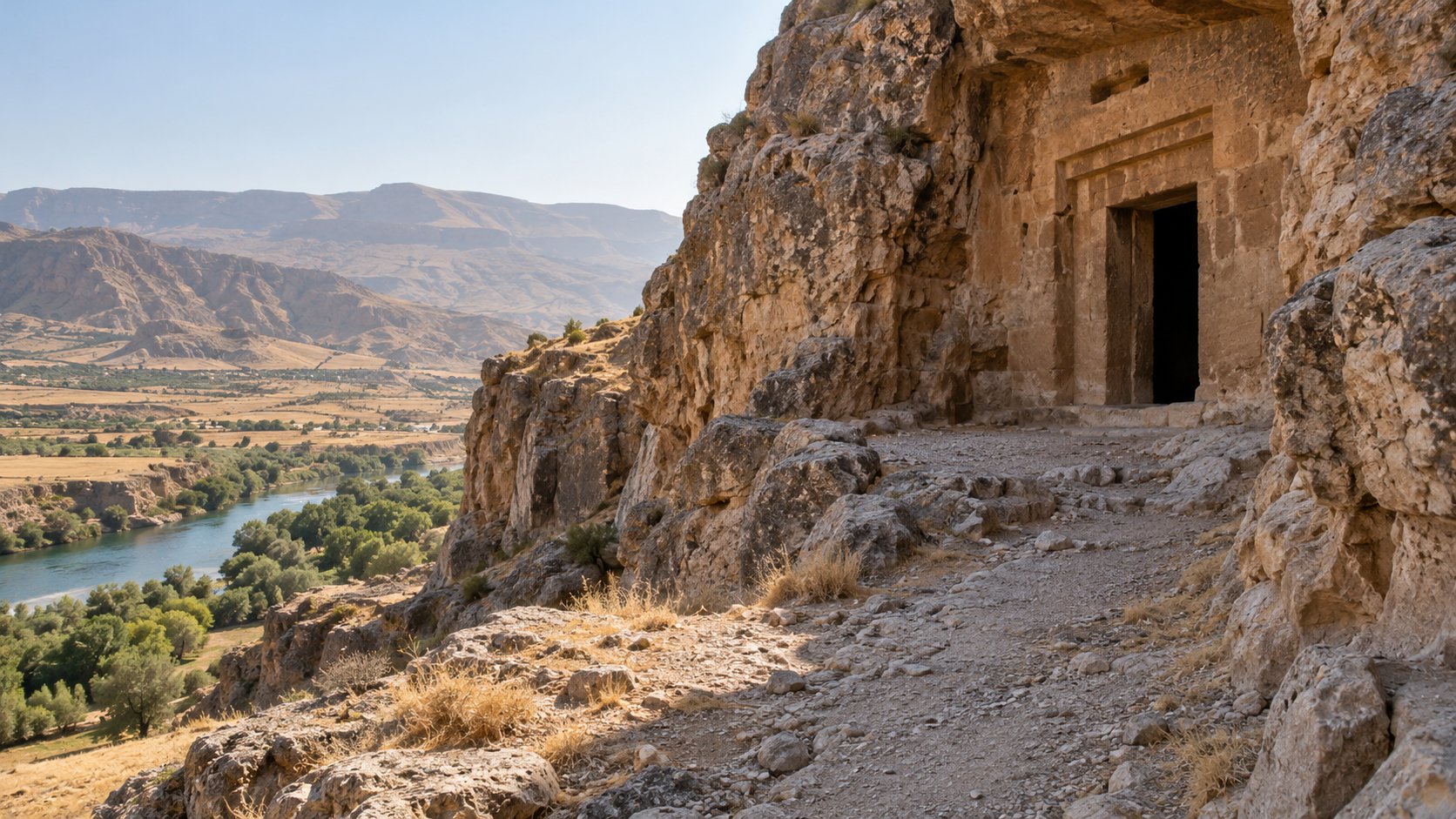
The entrance opens roughly eight metres above the valley floor. Amin recorded that an iron ladder installed during earlier conservation work was replaced by a larger double ladder around 2012. His report appeared in 2018, and it cannot vouch for the condition, stability, or presence of that ladder today. Published access history
No recent field check confirmed current road conditions, parking spots, or ladder safety for this guide. Before heading out from Sulaymaniyah, ask a trusted local guide to verify arrangements with the Sulaymaniyah antiquities directorate or museum staff. Check these specifics:
- Which approach road is clear, especially after heavy rain.
- Whether the site is open to travelers, whether an entry fee applies, and whether staff permit climbing into the chambers.
- Whether the ladder and approach steps are structurally sound and authorized for public use.
- Whether photography, tripods, or aerial drones require prior permits.
- Whether on-site staff, shade, drinking water, or toilets exist.
Assume the site has zero amenities. Bring plenty of drinking water, wear sturdy shoes with reliable grip, and book your return ride before leaving Sulaymaniyah.
This is not an easy family excursion or an accessible tourist stop. Reaching the tomb requires scaling a tall, exposed ladder above rough ground. Anyone uncomfortable with steep heights or narrow footholds should view the monument from below. Never climb a damaged, rusted, or blocked ladder, and do not scramble up the bare rock face if the ladder is removed. The view from the base of the cliff still gives you a clear look at the facade.
Visit without adding to the damage
Amin documented paint, modern graffiti, and bullet strikes across the facade, along with conservation work launched by the Sulaymaniyah antiquities directorate in 2002. Past neglect is never a reason to treat the rock casually. Conservation account
Keep your hands off the stone. Never trace the carvings with fingers, wet the relief for photographs, or apply chalk to highlight details. Keep backpacks and boots away from carved rock. If you do reach the interior, do not stand inside the burial cavities or disturb loose stones. Respect all boundary markers, warning signs, and local instructions.
If you want to inspect the architectural details without the climb, visit the Sulaymaniyah Museum. The museum installed a full-scale replica of the Qizqapan facade, letting you examine the columns, capitals, and relief figures at eye level. Check current opening hours and gallery access before visiting.
Frequently asked questions
Sources
- World History Encyclopedia. Osama Shukir Muhammed Amin, "The Rock-Cut Tombs of Qizqapan, Iraqi Kurdistan: Median or Achaemenid?" Published 26 January 2018. https://www.worldhistory.org/article/1181/the-rock-cut-tombs-of-qizqapan-iraqi-kurdistan-med/ . Accessed 24 October 2026.
- Cambridge University Press, IRAQ, volume 83. Iraj Rezaei, "Qizqapan: A Rock-Cut Tomb from the Median, Achaemenid, Seleucid or Parthian Period?" Published online 20 August 2021. Public abstract consulted. https://www.cambridge.org/core/journals/iraq/article/abs/qizqapan-a-rockcut-tomb-from-the-median-achaemenid-seleucid-or-parthian-period/E88AC31555D04C8A6D6481461AC073E8 . Accessed 24 October 2026.
❓Frequently Asked Questions
Here are answers to frequently asked questions about the content above
The tomb is carved into a cliff near Zarzi village in the Chemi Rezan Valley, northwest of Sulaymaniyah in Iraqi Kurdistan. Published accounts place it roughly 65 kilometres from the city, though you should treat that figure as a general guide rather than a verified road distance.
No evidence confirms that attribution. The tomb contains no inscriptions naming Cyaxares or any other ruler. While popular accounts and guidebooks often repeat the name, archaeologists consider the link unproven.
Scholars debate the date, with proposals spanning the Median, Achaemenid, Seleucid, and Parthian periods. A 2021 study by Iraj Rezaei argues for the fourth century BCE, during the late Achaemenid or early Seleucid era, but specialists have not reached a consensus.
The cliff facade has two rock-cut columns, a carved relief of two bow-holding figures beside an altar, and three upper emblems. Behind the entrance lie three connected chambers with burial troughs cut into the stone floor.
No. The entrance sits roughly eight metres up a cliff and historically required climbing an exterior ladder. The site has no paved paths or safety barriers, making it unsuitable for strollers, wheelchairs, or anyone uneasy with heights.
Check with a local guide or antiquities officials in Sulaymaniyah about road conditions, site access, and ladder safety before traveling. Confirm photography rules as well, and assume the location provides no toilets, drinking water, or shade.