Civic heart of Baghdad featuring Nasb al-Hurriyah, Jawad Saleem and Rifat Chadirji's monumental bronze relief commemorating Iraq's modern history.
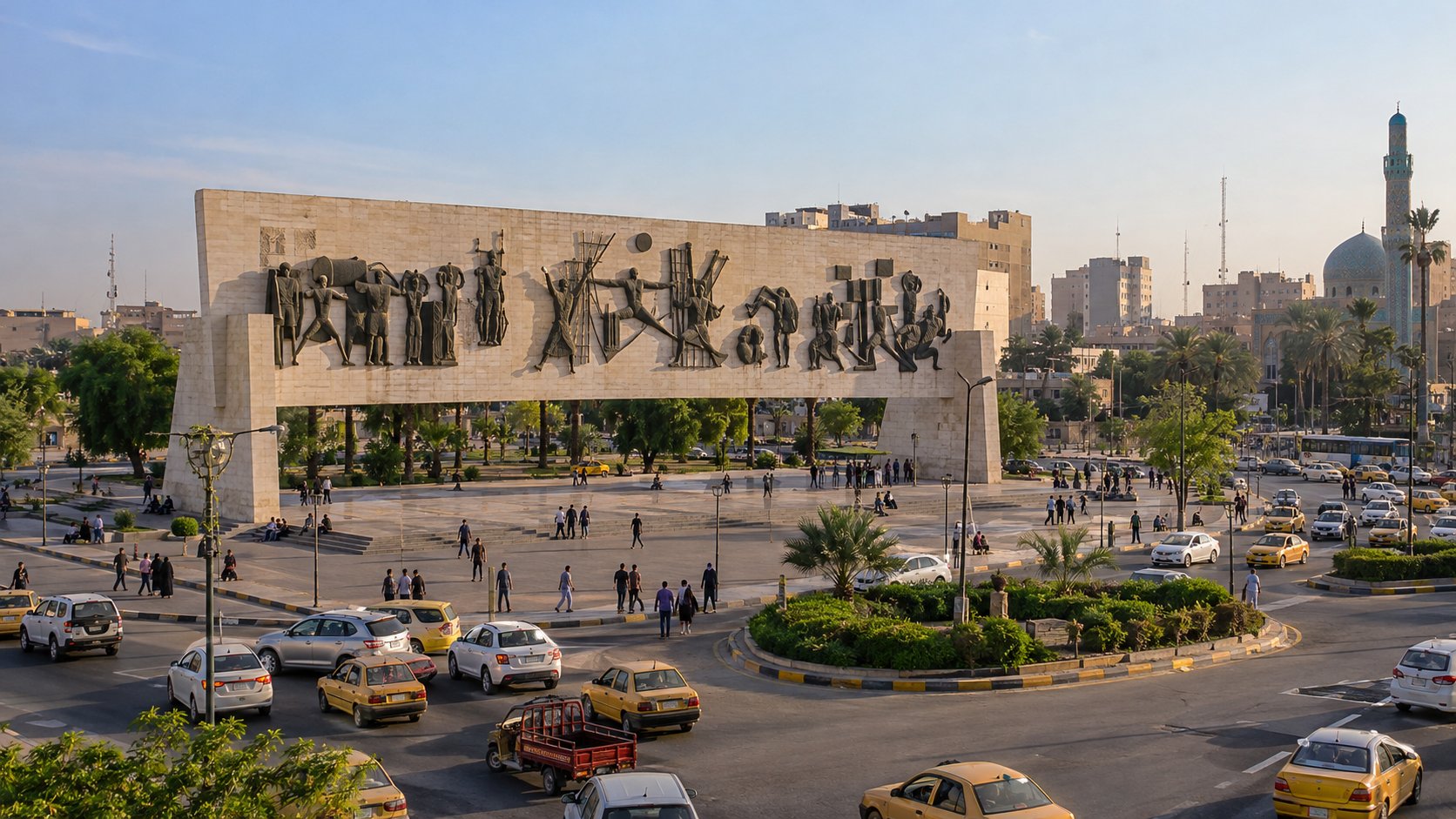
Tahrir Square (Sahat al-Tahrir), or Liberation Square, is the civic heart of Baghdad. Situated in the Al-Rusafa district on the eastern bank of the Tigris River, this large public plaza marks where Al-Sa'doun Street converges before the approach to Al-Jumhuriya Bridge. Anchoring the eastern edge of the square stands Iraq's most prominent 20th-century landmark: the bronze relief titled Nasb al-Hurriyah (The Freedom Monument). Conceived through a collaboration between sculptor Jawad Saleem and architect Rifat Chadirji, the monument reflects modern Iraqi nationhood while drawing direct inspiration from ancient Mesopotamian art.
Historical Origins and the 1958 Revolution
The grounds of Liberation Square were first laid out in 1937 under the Hashemite monarchy as Queen Alia Square (Sahat al-Malika Alia). The site took on new political weight following the 14 July Revolution of 1958, when a coup led by Brigadier General Abd al-Karim Qasim overthrew the monarchy and established the Republic of Iraq.
To mark this political transition with a national monument, Qasim's government commissioned Rifat Chadirji, then the country's leading modernist architect, and Jawad Saleem, founder of the Baghdad Modern Art Group (Jama'et Baghdad lil Fen al-Hadith). While Qasim sought an emblem of the new regime and asked for his own likeness to appear on the frieze, Saleem refused. Instead, he designed a humanist work dedicated to the struggles and aspirations of ordinary Iraqi citizens.
Architectural Vision and Collaboration
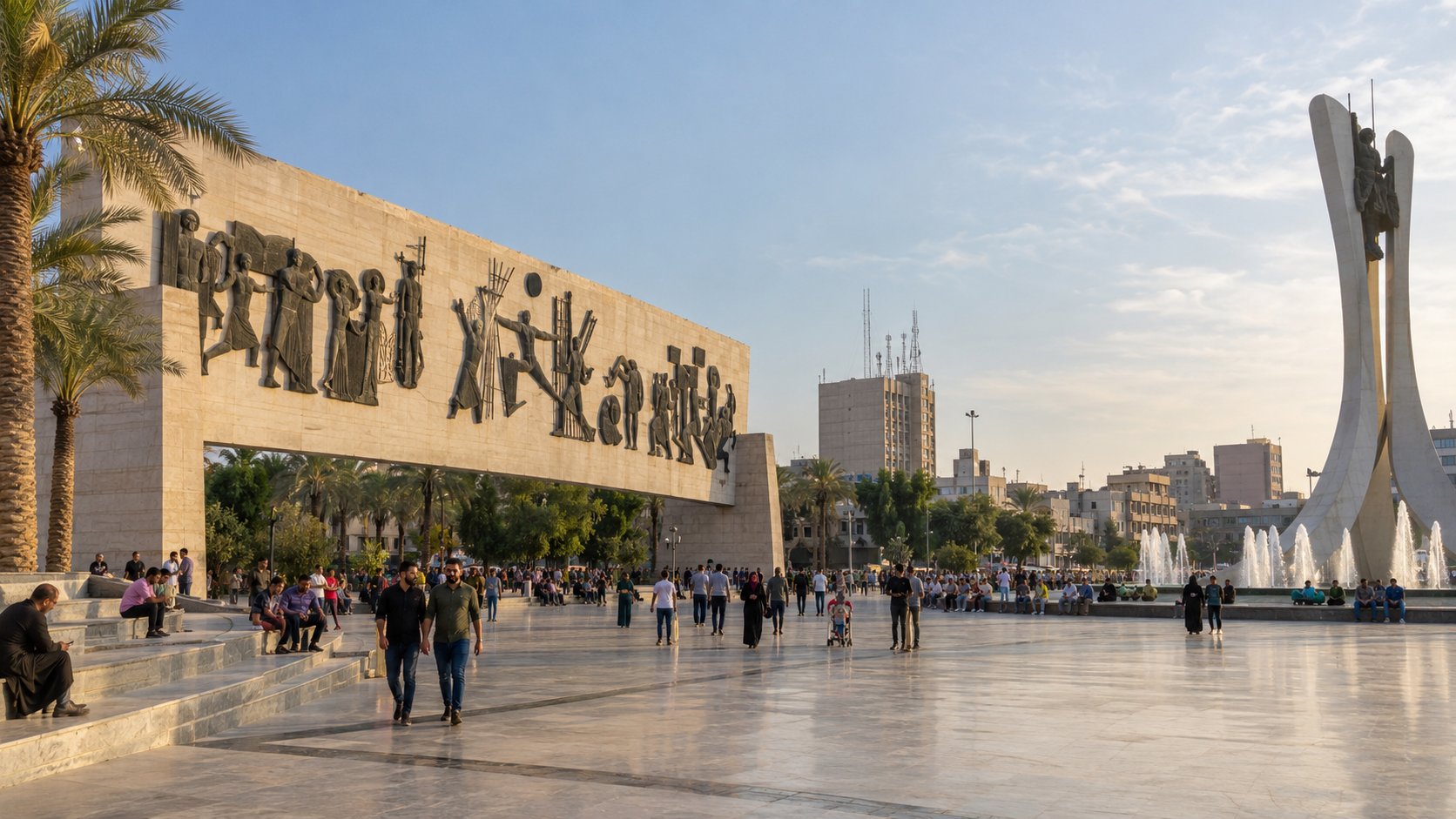
The design of the Freedom Monument developed through close exchanges between Saleem and Chadirji. Saleem originally planned to mount the bronze frieze at street level so pedestrians could walk alongside and touch the figures. Chadirji countered that Baghdad's wide street grid and heavy traffic required an elevated format to make the work visible across the plaza and the river approach.
Chadirji designed a rectangular pylon clad in cream travertine stone, standing 10 meters high, 50 meters wide, and raised 6 meters off the ground. Supported by twin piers, the slab functions like an open horizontal banner framing Saleem's bronze bas-reliefs. The structure stands between the traffic circle and the lawns of Al-Umma Garden (Hadiqat al-Umma), which also features a ceramic mosaic by painter Faiq Hassan and Mohammed Ghani Hikmat's Motherhood statue.
Saleem sculpted the compositions in Florence, Italy, working in foundry conditions under severe physical strain. He suffered a fatal heart attack in Baghdad in January 1961 at age 41, before the monument could be unveiled. Final supervision of the bronze casting and assembly was completed by his wife, artist Lorna Saleem, alongside sculptor Mohammed Ghani Hikmat. The monument opened to the public later that year.
Decoding the Bronze Epic: Istilham al-Turath
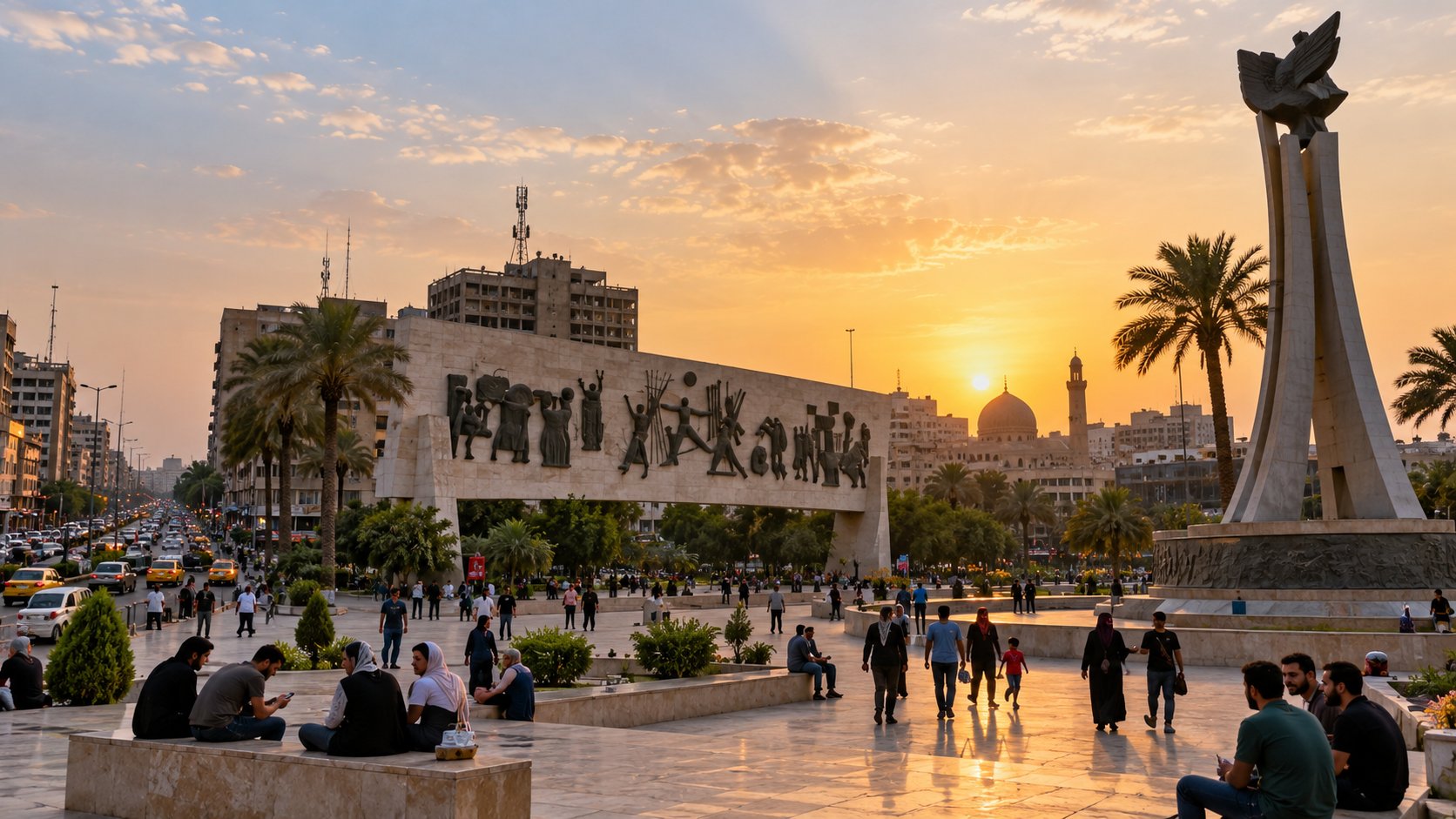
Nasb al-Hurriyah consists of 14 bronze groupings featuring 25 figures, an enraged bull, and a rearing horse. Spanning 50 meters, the relief is organized like a line of classical Arabic script, reading from right to left across three distinct scenes:
- Struggle and Subjugation (Right): The opening section depicts hardships under foreign dominance and poverty. Figures express grief and resolve—a restrained bull symbolizes untapped power, a mourning mother cradles a child, and an impoverished worker bears a heavy load.
- The Revolutionary Break (Center): The narrative peaks in the center, where an insurgent worker breaks through iron prison bars, shattering chains to claim freedom. A fallen martyr lies beneath, while a horse charges forward, representing popular momentum.
- Peace, Labor, and Rebirth (Left): The sequence closes with reconstruction and civic stability. Women carry sheaves of wheat and olive branches, a laborer holds an industrial gear, and families stand together.
Saleem built this narrative on istilham al-turath (drawing inspiration from heritage), combining modernist abstraction with ancient Mesopotamian relief traditions. The shallow depth and elongated figures reference Assyrian and Babylonian stone carvings, while decorative patterns reflect 13th-century Abbasid manuscripts illustrated by Yahya al-Wasiti.
Center of Modern Civic Life
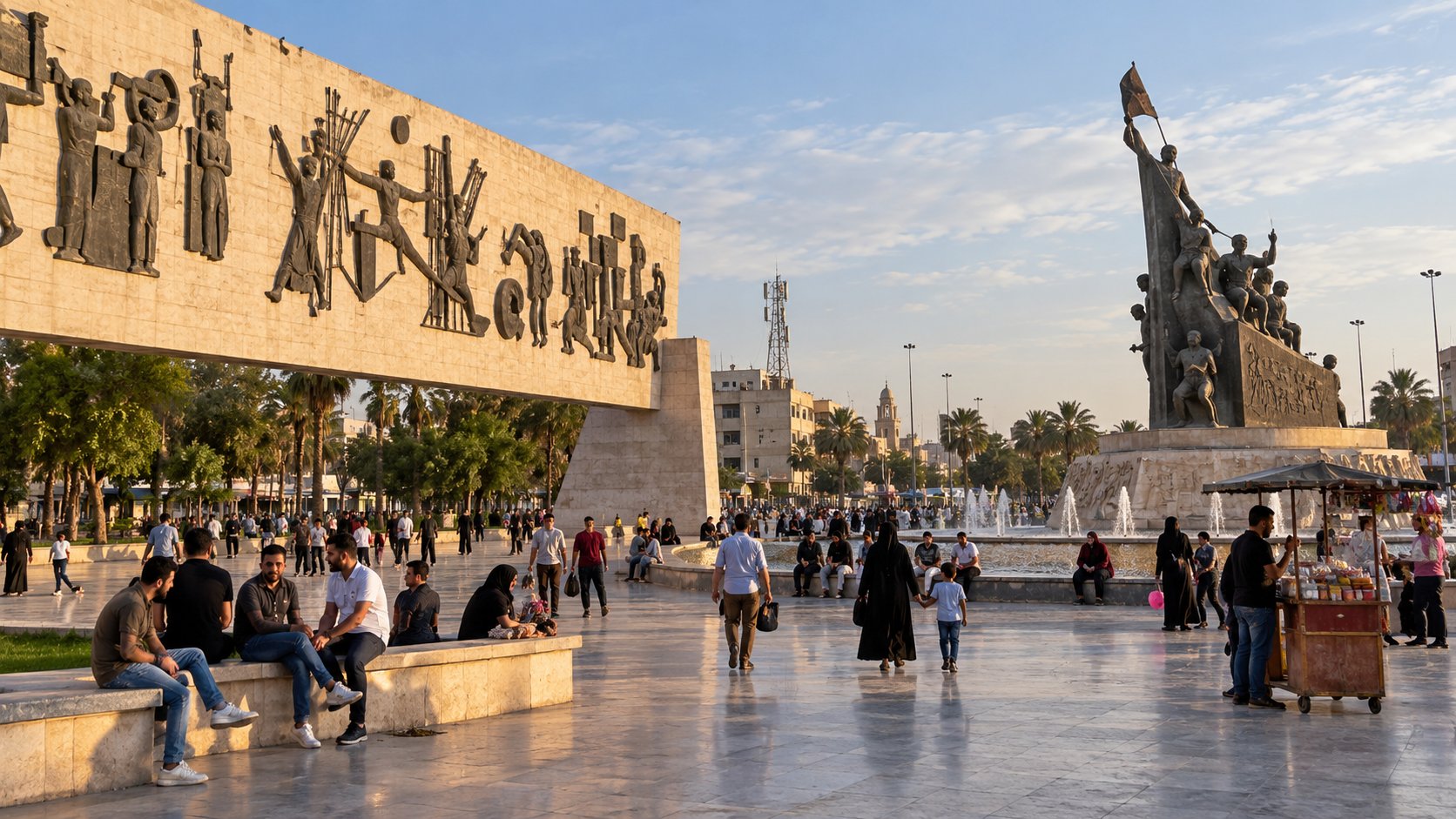
Over subsequent decades, Tahrir Square remained Baghdad's main public gathering space. It served as the site for military parades, state ceremonies, and public demonstrations under successive governments. The monument has also appeared on Iraqi currency, including the 250-dinar and 10,000-dinar banknotes.
In October 2019, Tahrir Square became the center of the nationwide Tishreen protest movement. Demonstrators gathered to demand institutional accountability, job creation, and reliable basic services. Across from the square, an abandoned 14-story building known as the Turkish Restaurant served as an observation post, dubbed "Mount Uhud" by demonstrators. Volunteer clinics, communal kitchens, and three-wheeled tuk-tuks turned the square into an active community base, with Saleem's Nasb al-Hurriyah acting as the movement's primary visual symbol.
Visiting Tahrir Square: Practical Information
- Location: Bab al-Sharqi area, Rusafa district, Baghdad. Situated at the eastern end of Al-Jumhuriya Bridge.
- Accessibility: Tahrir Square is an open public space and free to visit at any time.
- Best Viewing Times: Early morning and late afternoon provide low-angle light that highlights the bronze relief textures. Evenings bring local crowds to neighboring Al-Umma Garden.
- Nearby Sights: Walk into Al-Umma Garden to view Faiq Hassan's tile mural, cross Al-Jumhuriya Bridge toward the Tigris embankment, or visit the shops and street markets along Al-Sa'doun Street and Bab al-Sharqi.
- Visitor Tips: Dress modestly when exploring central Baghdad. Watch for fast-moving traffic when crossing roads around the roundabout. Photography of the monument is permitted; avoid pointing cameras directly at nearby security checkpoints.
Sources
- Wikipedia: "Nasb al-Hurriyah" — Detailed overview of the monument's dimensions, materials, history, and Jawad Saleem's artistic commission (accessed 2025).
- Wikipedia: "Liberation Square, Baghdad" — Urban history of Tahrir Square, Al-Umma Garden, surrounding landmarks, and the 2019 protest movement (accessed 2025).
- Wikipedia: "Jawad Saleem" — Biography of Jawad Saleem, the Baghdad Modern Art Group, and the synthesis of Mesopotamian heritage with modernism (accessed 2025).
- Wikipedia: "Rifat Chadirji" — Architectural philosophy of international regionalism and civic commissions across Baghdad (accessed 2025).
- Wikipedia: "Mohammed Ghani Hikmat" — Historical account of bronze casting for Nasb al-Hurriyah and the monument's completion following Saleem's death (accessed 2025).
❓Frequently Asked Questions
Here are answers to frequently asked questions about the content above
The Freedom Monument (Nasb al-Hurriyah) is a monumental public artwork in Baghdad's Tahrir Square, featuring 14 bronze bas-relief groupings on a 50-meter travertine slab designed by sculptor Jawad Saleem and architect Rifat Chadirji to commemorate Iraq's 1958 republican revolution.
The monument was designed by Iraqi sculptor Jawad Saleem in collaboration with architect Rifat Chadirji. Following Saleem's unexpected death in January 1961, the bronze casting and final installation were completed by Lorna Saleem and sculptor Mohammed Ghani Hikmat.
The monument is designed to be read from right to left like a line of Arabic verse. It begins on the right with scenes of oppression and struggle, transitions into the central revolutionary breakthrough of breaking prison bars, and ends on the left with images of peace, agriculture, and modern prosperity.
Tahrir Square is situated in the Bab al-Sharqi area of the Al-Rusafa district on the eastern side of the Tigris River, positioned at the junction of Al-Sa'doun Street and the approach to Al-Jumhuriya Bridge.
Tahrir Square served as the central staging ground for Iraq's nationwide October 2019 Tishreen protests, where citizens rallied against corruption and poor public services, turning the square and the adjacent Turkish Restaurant tower into icons of grassroots civic action.
Yes, Tahrir Square is an open public plaza accessible at any time without admission fees. Visitors can view the monument and adjacent Al-Umma Garden, while following local guidelines and remaining respectful around nearby traffic and security personnel.