Built entirely from giant marsh reeds without nails or wood, the Iraqi mudhif is a five-thousand-year-old architectural marvel. Discover the engineering behind these vaulted tribal halls, the time-honored hospitality customs of Southern Iraq, and how travelers can experience an overnight stay in the Mesopotamian Marshes.
The Traditional Iraqi Mudhif: Reed Architecture, Hospitality Etiquette, and Marsh Stays
Excerpt: Built entirely from giant marsh reeds without nails or wood, the Iraqi mudhif is a five-thousand-year-old architectural marvel. Discover the engineering behind these vaulted tribal halls, the time-honored hospitality customs of Southern Iraq, and how travelers can experience an overnight stay in the Mesopotamian Marshes.
Meta Description: Explore the traditional Iraqi mudhif, from ancient Sumerian reed engineering and tribal guest etiquette to planning an authentic overnight stay in the Ahwar marshes.
What is an Iraqi mudhif?
A mudhif is a large, freestanding barrel-vaulted hall built entirely from giant reeds harvested from the waterways of southern Iraq. According to historical records cataloged by Wikipedia's Mudhif documentation, these structures have served as communal halls, tribal council rooms, and guest quarters for the Marsh Arabs (the Ma'dan or Ahwari people) for over five millennia.
Depictions of identical arched reed buildings appear on Sumerian cylinder seals dating to roughly 3300 BCE, including the Uruk Trough preserved at the British Museum, as documented by researcher Dr. Mary Shepperson in the Journal of Material Cultures in the Muslim World. In December 2023, mudhif construction gained formal global recognition when UNESCO inscribed the traditional craft skills and arts of Al-Mudhif building on the Representative List of the Intangible Cultural Heritage of Humanity.
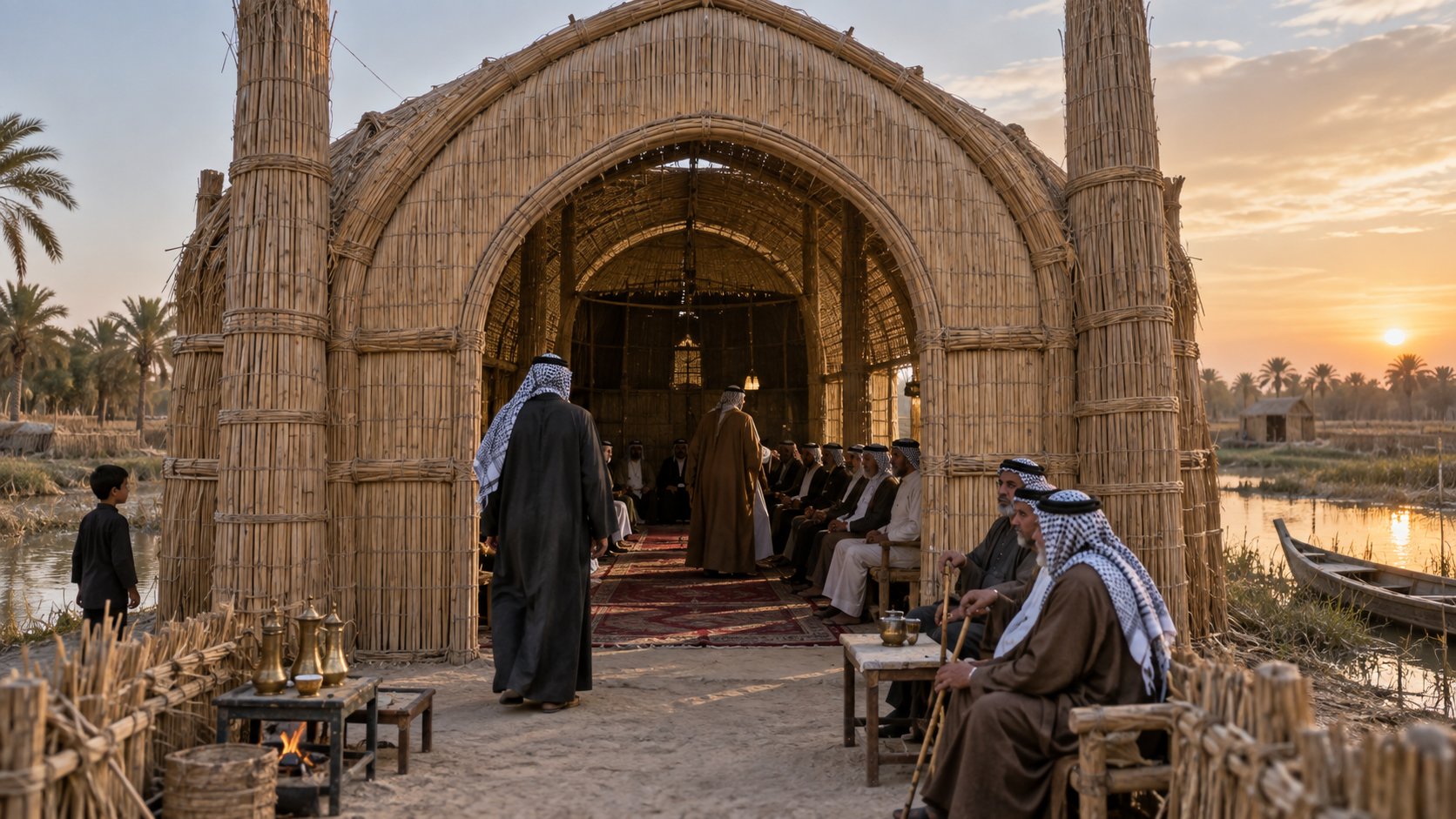
In marsh communities, a mudhif belongs to a local sheikh (shaykh) and serves as the social anchor of the clan. It hosts visiting travelers, weddings, funerals, poetry recitations, and tribal councils (fasl) where elders resolve local disputes. The entrance to a traditional mudhif always faces Mecca, preserving a spiritual alignment alongside its civic role.
How do Marsh Arabs build a reed mudhif without nails?
Traditional mudhif construction is among the oldest vernacular engineering traditions still practiced. Marsh builders use no nails, timber framing, or metal brackets. Instead, they rely entirely on Phragmites australis (locally called qasab or ihdri), a thick perennial giant reed that grows abundantly across the Tigris and Euphrates delta, as recorded by the ArCHIAM Research Centre.
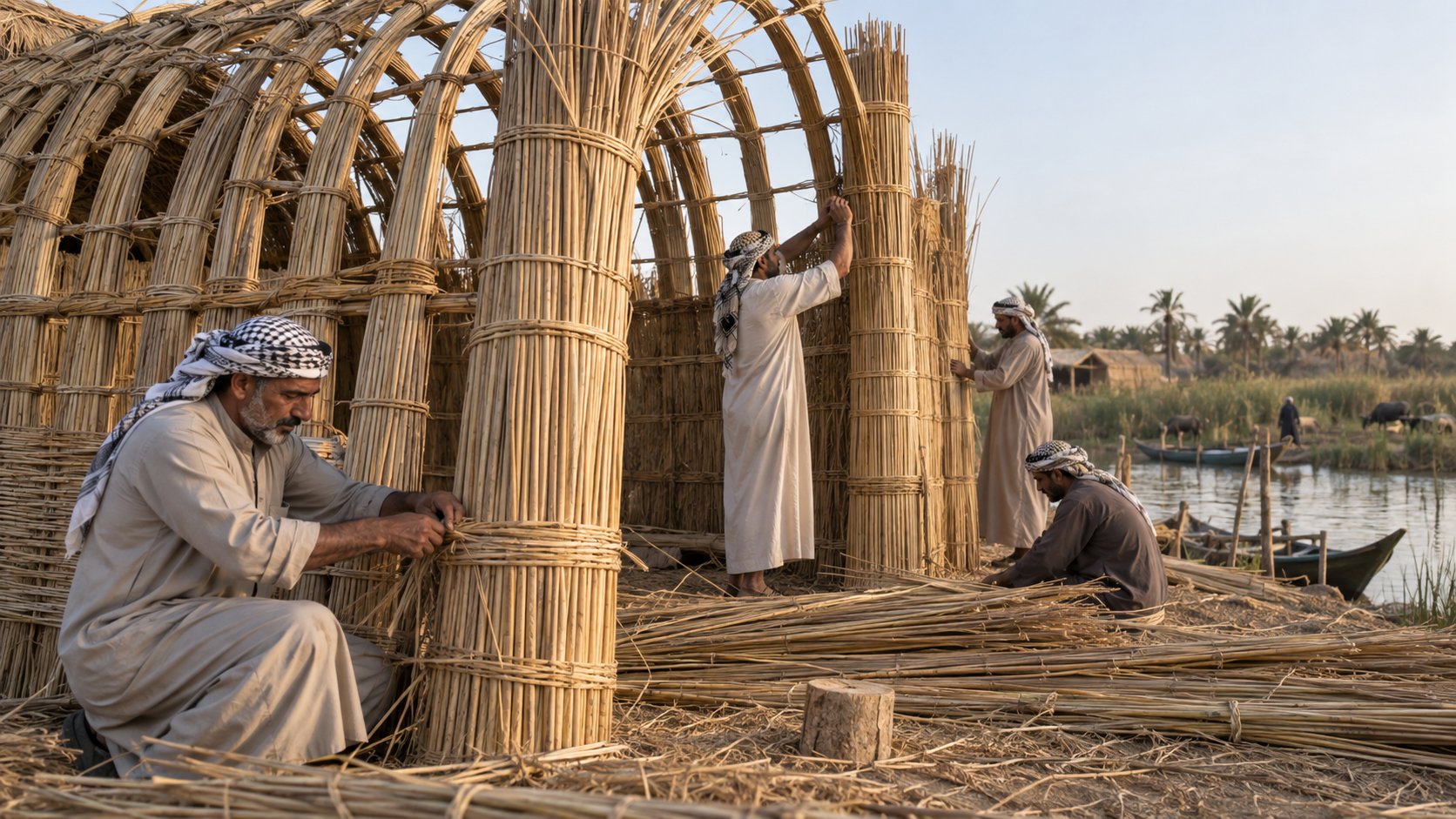
The building process begins by digging paired rows of holes roughly one meter deep into dry ground or compacted mud platforms (tuhul). Builders assemble hundreds of dried reeds into thick, flexible columns up to ten meters long. These bundles are planted into the holes at opposing angles, bent toward the center under tension, and lashed together at the apex with twisted reed cordage to create massive parabolic arches.
       / \             <-- Parabolic reed arches lashed at apex
     /     \
    |       |          <-- Interlaced reed latticework (mshebbech)
   /|       |\         <-- Bundled reed columns planted 1m deep
=====================  <-- Raised platform or ground foundation
Once the arches stand, builders connect them with horizontal reed girders (hutta) for structural rigidity. The exterior walls feature woven lattice screens called mshebbech, which let river breezes pass through while keeping the interior shaded and cool during high summer heat. Overlapping mats of split reeds (bariyah) cover the curved roof, shedding rain and providing natural insulation. Reeds naturally contain high concentrations of silica, which repels insects, sheds moisture, and resists decay. Because reeds degrade under weather and damp ground, a mudhif lasts between ten and fifteen years before the community rebuilds it, as detailed in Grokipedia's Mudhif Architecture overview.
Tribal hospitality inside the mudhif: rules and etiquette
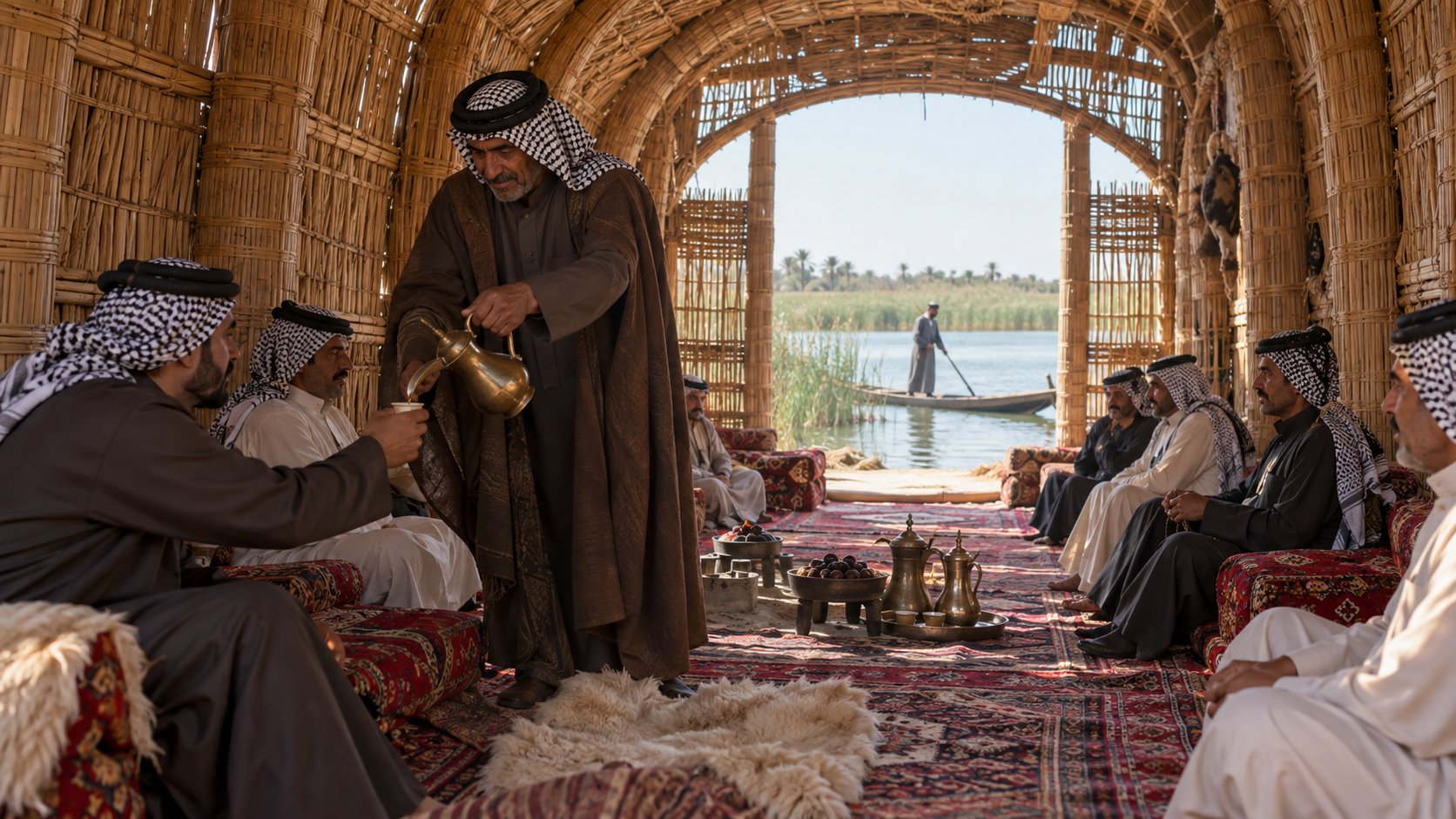
The mudhif operates under established codes of Arab hospitality (karam). In southern Iraq, welcoming a guest is a customary obligation. Historically, any traveler could enter a mudhif and receive food, lodging, and protection for three days without being asked their name, origin, or purpose.
Visiting an active mudhif today requires respect for local cultural norms. When visiting a mudhif in towns like Chibayish or nearby rural settlements, following basic etiquette ensures a smooth, respectful welcome:
- Footwear at the threshold: Take off your shoes before stepping onto the reed floor. Mudhif floors are covered with handwoven rugs, wool mats, and sitting cushions.
- Greeting the room: Greet the room with the standard greeting, Salam Alaykum (peace be upon you). The assembly responds in unison, Wa Alaykum As-Salam. Shake hands with the host and elders using your right hand.
- Seating hierarchy: Seating follows a clear social order. The sheikh and honored guests sit at the far end opposite the door, known as the sadr al-mudhif. Newer arrivals and younger men sit closer to the entryway (bab al-mudhif). Wait for the host or guide to motion you toward a cushion rather than picking a seat randomly.
- Sitting posture: Sit cross-legged or with your legs tucked beside you. Never stretch your legs out so that the soles of your shoes or feet point directly at someone, as this is considered disrespectful in Iraqi tribal customs.
The Gahwa coffee ritual: customs and unspoken signs
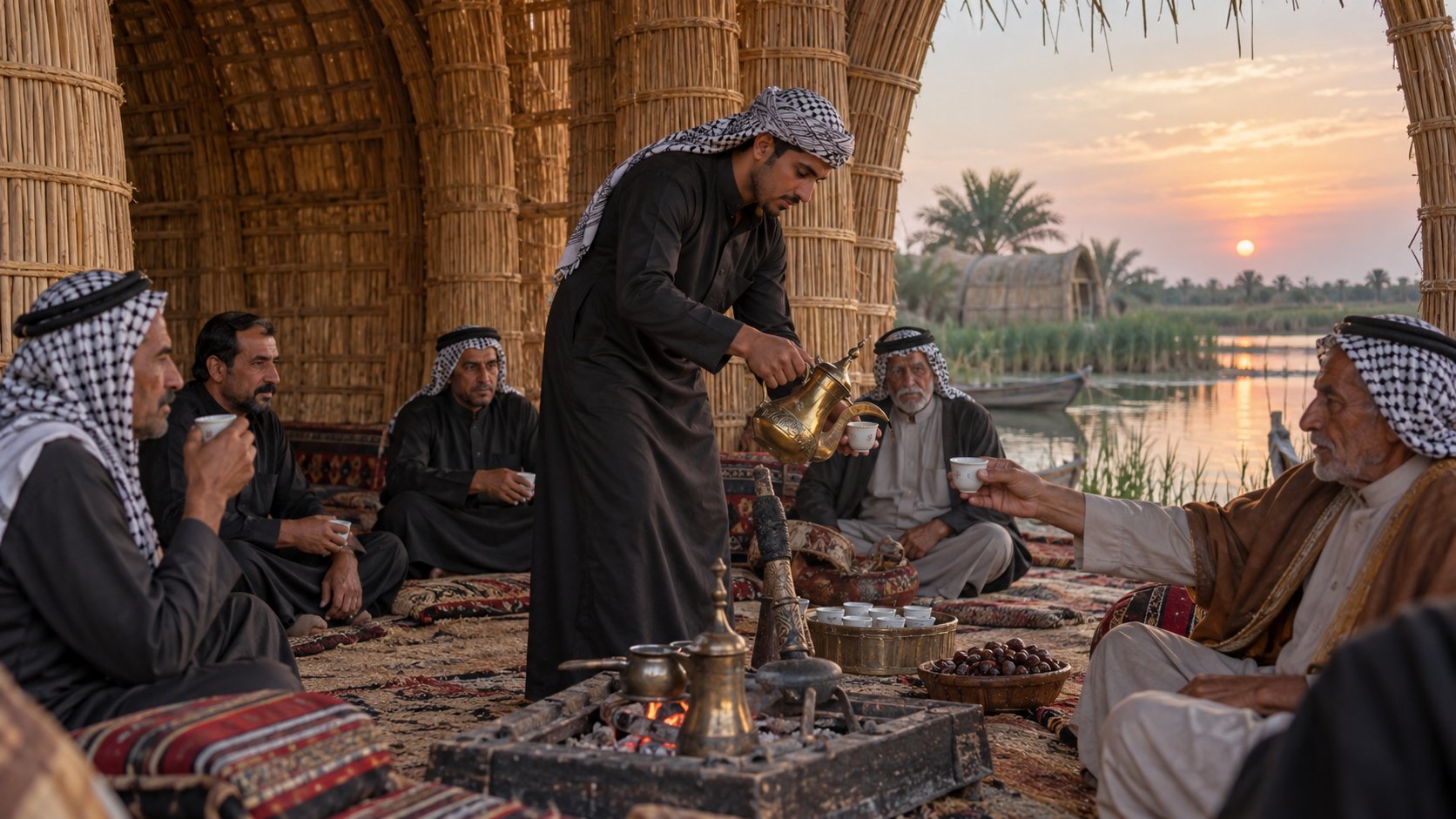
Coffee is the centerpiece of mudhif hospitality. The moment guests settle onto cushions, the coffee maker (gahwachi) prepares fresh Arabic coffee (gahwa) over a dedicated hearth. The coffee is roasted, freshly ground with cardamom, and brewed unsweetened in heavy brass pots called dallah.
The host or server holds the dallah in their left hand and presents a tiny handleless ceramic cup (finjan) with their right hand. Accepting and returning the cup requires specific customs:
- Use your right hand only: Always take the finjan and return it using your right hand.
- Drink in small sips: The cup is filled only one-third full so it remains easy to hold without burning your fingers. Drink the concentrated, aromatic cardamom brew in two or three small sips.
- The cup shake (hazz al-finjan): If you finish and want another cup, hand the finjan straight back. If you have had enough, gently tilt and shake your wrist side to side two or three times before handing the cup back to the server. This subtle gesture signals that you are satisfied without saying a word.
- Three customary cups: In Bedouin and Marsh Arab tradition, guests may drink up to three cups: the cup of hospitality (finjan al-dayf), the cup of pleasure (finjan al-kayf), and the cup of the sword (finjan al-sayf), which historically sealed tribal loyalty and alliance.
Planning an overnight stay in the Mesopotamian Marshes
For travelers seeking firsthand immersion, staying overnight in a reed mudhif offers direct contact with Marsh Arab life. Iraqi marsh tourism centers around Chibayish (Al-Chibayish), in Dhi Qar governorate between Nasiriyah and Basra, as highlighted by Meer Magazine's marshland history.
Ecotourism initiatives supported by local groups like Nature Iraq offer traditional mudhifs set up for visitors, as documented in the Ahwar of Southern Iraq World Heritage overview.
What to expect during a mudhif stay
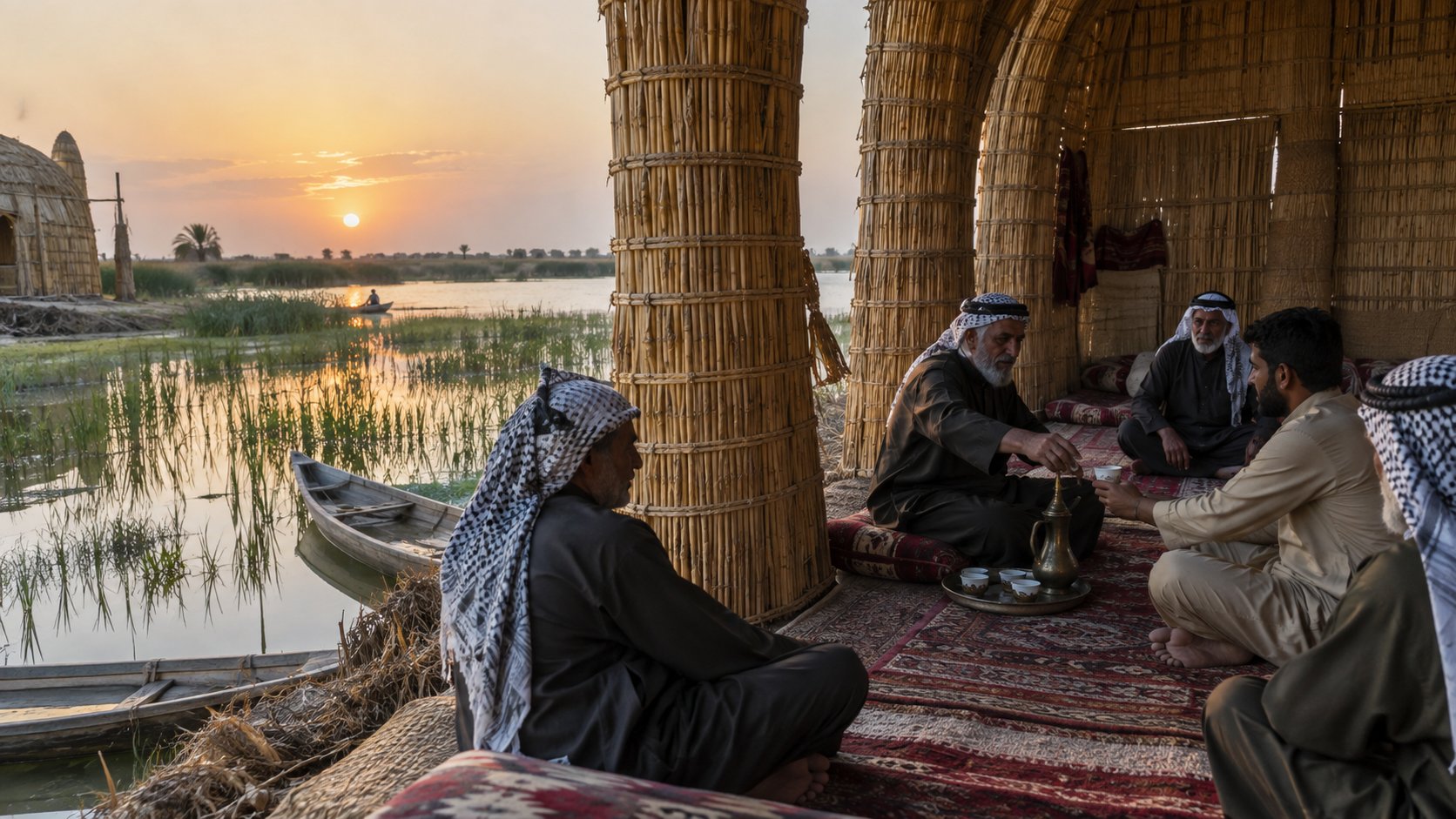
Sleeping in a mudhif is communal, quiet, and simple. You sleep on thick cotton or wool mattresses laid directly over carpets on the reed floor, with blankets and mosquito netting. At night, river breezes pass through the reed screens, accompanied by the calls of marsh frogs and migrating waterfowl.
Local hosts prepare meals on site. Breakfast usually features fresh khubz tanoor (clay-oven flatbread) with buffalo clotted cream (geymar or qaymar) and date syrup (dibs). Dinner centers on masgouf, seasoned freshwater carp impaled on wooden stakes and slow-roasted beside open fruitwood or reed embers, served with rice, pickles, and hot Iraqi black tea (chai).
During the day, boatmen guide travelers through open lagoons in slender traditional canoes (mashhoof) or small motorized skiffs. You navigate through reed corridors, pass semi-wild water buffalo cooling in the water, and visit artificial floating reed islands (chibasha) where families keep homesteads.
Practical advice for visiting the Marshes
To ensure a smooth trip to southern Iraq, keep these travel logistics and cultural considerations in mind:
- Best time to travel: The optimal season runs from November through March. Winter and early spring bring mild daytime temperatures ranging from 15°C to 24°C (59°F to 75°F). Avoid the summer months between June and September, when temperatures regularly exceed 45°C (113°F).
- Getting there: Most international visitors arrive via Basra International Airport or Baghdad International Airport. From Baghdad, travelers usually drive south past Babylon and Ur (near Nasiriyah) before entering Chibayish. From Basra, Chibayish is roughly a two-hour drive northwest along well-paved highways.
- Local guides: Independent navigation inside the vast marsh channels is nearly impossible. Always arrange your boat excursions and mudhif stays through reputable Iraqi tour operators or licensed local marsh guides based in Chibayish.
- Dress code and modesty: Southern Iraq is socially conservative. Men should wear long pants and short- or long-sleeved shirts (avoid tank tops or short athletic shorts). Women should wear loose, opaque clothing that covers shoulders, arms, and legs. Carrying a light headscarf is recommended for entering villages and family homes.
- Photography etiquette: Always ask permission before photographing local residents, particularly women, children, and buffalo herders. Most local men and boat drivers are happy to be photographed once you ask.
Sources
- UNESCO Intangible Cultural Heritage — Traditional craft skills and arts of Al-Mudhif building — Accessed March 14, 2026.
- ArCHIAM Centre, University of Liverpool & Nature Iraq — Documenting the Endangered Reed Architecture of the Iraqi Marshes — Accessed March 14, 2026.
- Journal of Material Cultures in the Muslim World, Brill — Modern Mudhifs: an Ancient Architectural Tradition in a State of Rapid Change by Dr. Mary Shepperson — Accessed March 14, 2026.
- Wikipedia — Mudhif — Accessed March 14, 2026.
- Wikipedia — Ahwar of Southern Iraq — Accessed March 14, 2026.
- Wikipedia — Marsh Arabs — Accessed March 14, 2026.
- Grokipedia — Mudhif Architecture and History — Accessed March 14, 2026.
- Meer Culture Magazine — The Marshes and "Marshmen" of Southern Iraq by Madison Leeson — Accessed March 14, 2026.
❓Frequently Asked Questions
Here are answers to frequently asked questions about the content above
A traditional mudhif is built entirely from giant marsh reeds (Phragmites australis) and woven reed mats, without using nails, timber beams, or metal fasteners.
The primary area for visiting and staying overnight in a mudhif is Chibayish (Al-Chibayish) in Dhi Qar governorate, situated within the Mesopotamian Marshes between Nasiriyah and Basra.
Wear conservative, loose-fitting clothing that covers your shoulders and knees. You must also remove your shoes before stepping inside onto the carpeted reed floor.
Hold the small cup (finjan) in your right hand and gently shake your wrist side to side two or three times before handing it back to your host.
The best season is from November through March, when daytime temperatures are pleasant and mild, avoiding the extreme heat of southern Iraqi summers.
Yes, UNESCO inscribed the traditional craft skills and arts of Al-Mudhif building on the Representative List of the Intangible Cultural Heritage of Humanity in December 2023.