Explore the history of ancient Kalhu, destruction and conservation at Nimrud, and why visitor access must be confirmed directly with Iraqi antiquities authorities.
Nimrud: ancient Kalhu and visiting considerations
Nimrud, ancient Kalhu, lies 30 kilometers south of Mosul in northern Iraq on the east bank of the Tigris. In the ninth century BCE, it was the capital of the Neo-Assyrian Empire. Today, the site reflects both ancient imperial scale and modern devastation, alongside ongoing rescue archaeology by Iraqi specialists and international partners.
Current visitor access has not been verified directly with Iraq's State Board of Antiquities and Heritage. This article does not confirm that a visit can currently be arranged. Do not treat research activity, restoration announcements, or a tour operator's itinerary as permission to enter.
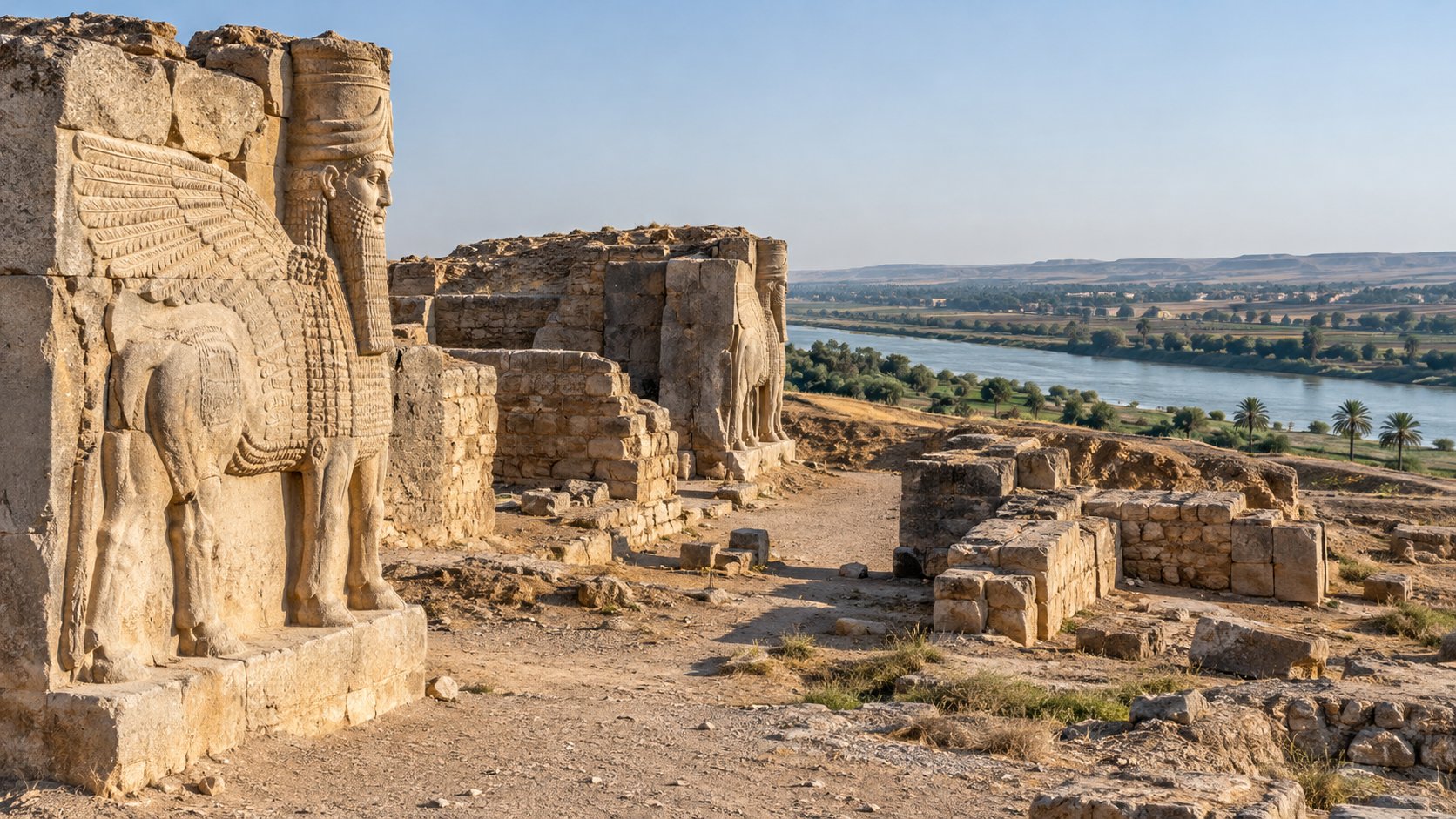
Kalhu, an Assyrian capital
Ashurnasirpal II, who ruled from 883 to 859 BCE, made Nimrud the capital of the Neo-Assyrian state and built its Northwest Palace. The Assyrians knew the city as Kalhu, and it appears in the Bible as Calah. These names refer to the same archaeological site, according to the Penn Museum's account of its Nimrud research.
At its ninth-century BCE peak, mudbrick city walls enclosed more than 900 acres. Within this perimeter stood royal palaces, temples, domestic quarters, and a stepped mudbrick ziggurat. While King Ashurnasirpal II established the Northwest Palace, the site has deeper roots. Archaeological deposits extend back to the late fourth millennium BCE, as detailed during a 2024 joint event organised by the Academic Research Institute in Iraq and the State Board of Antiquities and Heritage.
The site covers an entire urban landscape, not just a single royal residence. Religious institutions, storehouses, and administration buildings supported royal governance across the capital.
Nimrud is not Birs Nimrud
Travelers frequently confuse Nimrud with Birs Nimrud. They are separate sites in different provinces of Iraq. Nimrud, ancient Kalhu, is an Assyrian capital in Nineveh Governorate south of Mosul. Birs Nimrud is the local name for Borsippa, an ancient Babylonian city in Babylon Governorate southwest of Hillah and Babylon.
The Borsippa reference entry identifies that southern site and its ruined ziggurat dedicated to the god Nabu. Confusing the two leads to faulty itineraries. Photographs that show Borsippa's tall, jagged tower ruin do not represent Nimrud's topography or current conditions.
Destruction changed what remains
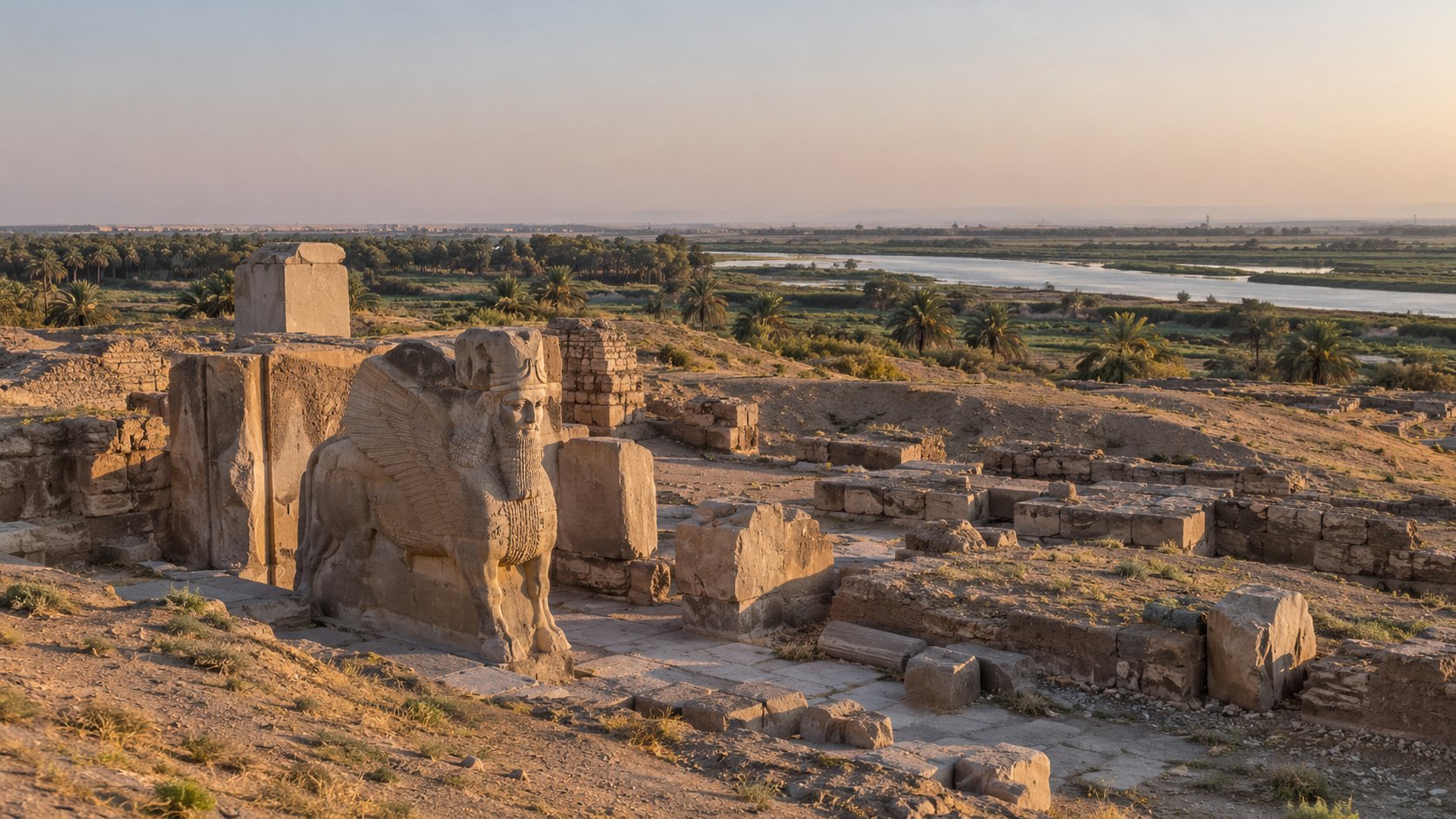
Historic photographs of Nimrud need dates and captions. Older pictures showing relief-lined corridors and colossal winged bulls guarding palace gates do not show what a visitor would find today.
In April 2015, UNESCO documented destruction at the Northwest Palace. Militants attacked stone reliefs and colossal sculptures with bulldozers, jackhammers, and explosives, leveling the northwestern quarters of Ashurnasirpal II's palace. Penn Museum also identifies the Ninurta Temple and its ziggurat among the monuments severely damaged during that period.
Visitors should not expect intact galleries or walk-through palace rooms. At the same time, substantial archaeological material remains across the mound. Buried foundations, stratified deposits, and collapsed architectural elements survived the onslaught. Archaeologists continue to record and stabilize these remains, but surviving stone does not mean the site is open to the public.
What recent archaeology has recovered
Recent excavations reveal major discoveries beneath the damaged surfaces. A joint team from Iraq's State Board of Antiquities and Heritage and the University of Pennsylvania excavated at the Ninurta Temple complex through late 2024. As detailed in the Penn Museum's excavation report, the team uncovered two shrines that had remained buried since antiquity.
Inside the larger shrine, excavators found a stone cult platform with a cuneiform inscription provisionally attributed to Ashurnasirpal II. The team also discovered a stone monument dated to 797 BCE recording a royal land grant to an Assyrian governor, clay tablets documenting silver loans, carved ivories, jewelry, and sculpture fragments.
The site experienced two separate destructions. Nimrud burned during the collapse of the Assyrian Empire between 614 and 612 BCE. When the Ninurta Temple collapsed in that ancient fire, falling mudbrick sealed the lower shrines and shielded them from looters. That collapse protected the artifacts until modern excavations uncovered them. The modern attacks in 2015 damaged exposed upper structures thousands of years later. All artifacts recovered during recent excavations remain in Iraq under national custody; none are displayed on site.
Conservation comes before a visitor itinerary
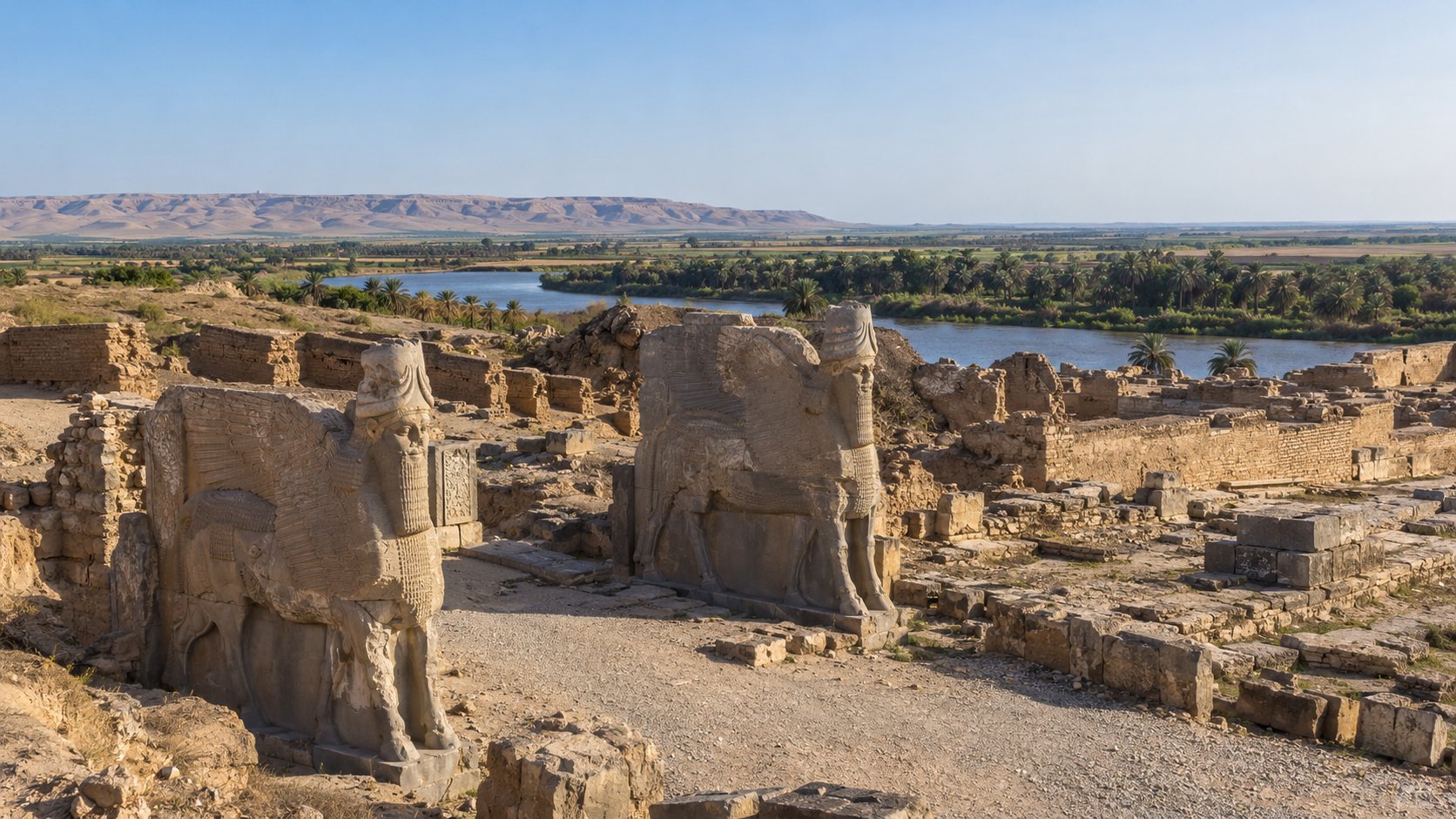
Site stabilization and structural conservation take priority over tourism. In September 2024, the Academic Research Institute in Iraq and Iraq's State Board of Antiquities and Heritage brought together archaeologists, officials, and conservators to plan a coordinated recovery strategy. Their event announcement described making the site accessible again as a long-term goal.
Penn's December 2024 report similarly noted future tourism as an objective. Neither statement indicates present public admission. An active excavation permit for an authorized research team does not mean regular travelers can enter.
Can a visit currently be arranged?
Current visitor access has not been verified directly with Iraqi antiquities authorities. Institutional reports explain recovery work, but they do not confirm public visiting permissions. No opening hours, ticket prices, or accessible palace interiors exist at this time.
Never assume a driver or guide can grant entry. Anyone considering a trip must request formal permission from Iraq's State Board of Antiquities and Heritage, or from the Nineveh Antiquities Directorate acting under it. If a tour operator claims to arrange access, ask for written confirmation from the antiquities authority itself before traveling.
A permission request should verify:
- Whether visitor entry is permitted on the requested date.
- What written clearances and identity documents are required.
- Which sectors of the mound visitors may enter, and whether an official escort must accompany them.
- What restrictions apply to photography and movement around active conservation areas.
Until you obtain written authorization, leave Nimrud off your travel schedule. Permission to enter an archaeological site also does not replace a security assessment of regional highway checkpoints between Erbil, Mosul, and southern Nineveh.
If authorities grant access, follow instructions from site guards and staff. Walk only on approved paths. Do not climb mudbrick walls, walk across trenches, touch carved stone surfaces, or pick up pottery fragments. Dislodging a single brick or stone can disturb archaeological evidence that conservators still need to record.
Frequently asked questions
Sources
Access-date note: The sources below were fetched during this research session. The research environment did not supply a verifiable calendar date, so no access date has been invented.
- Penn Museum. "Restoring At-Risk Assyrian Cultural Heritage: Archaeologists Recover Remarkably Preserved Shrines from a Temple in Iraq." Published 20 December 2024. https://www.penn.museum/about/press-room/press-releases/restoring-at-risk-assyrian-cultural-heritage-archaeologists-recover-remarkably-preserved-shrines-from-a-temple-in-iraq. Access date: unavailable in this research session.
- The Academic Research Institute in Iraq, joint event with Iraq's State Board of Antiquities and Heritage. "A Future for Nimrud: Where are we today?" Event dated 16 September 2024. https://www.tarii.org/events/2024/9/16/a-future-for-nimrud-where-are-we-today. Access date: unavailable in this research session.
- UNESCO World Heritage Centre. "UNESCO Director-General condemns destruction at Nimrud." Published 13 April 2015. https://whc.unesco.org/en/news/1260. Access date: unavailable in this research session.
- Wikipedia contributors. "Borsippa." Used only to distinguish Borsippa from Kalhu, not to establish visitor access. https://en.wikipedia.org/wiki/Borsippa. Access date: unavailable in this research session.
❓Frequently Asked Questions
Here are answers to frequently asked questions about the content above
The Assyrians called the city Kalhu. It also appears in the Bible as Calah. King Ashurnasirpal II established it as the Neo-Assyrian royal capital in the ninth century BCE.
No. Nimrud, ancient Kalhu, lies south of Mosul in Nineveh Governorate. Birs Nimrud is the local name for Borsippa, an ancient Babylonian city southwest of Hillah in Babylon Governorate.
No. In 2015, deliberate destruction demolished large sections of the Northwest Palace and surrounding monuments. While foundations and fragmented elements remain, there are no intact relief-lined palace rooms open to visitors.
In late 2024, a joint team from the State Board of Antiquities and Heritage and the University of Pennsylvania recovered two ancient shrines at the Ninurta Temple. Finds included an inscribed stone cult platform, a 797 BCE land-grant monument, cuneiform tablets, and carved ivories. All artifacts remain in Iraqi custody and are not on public display at the site.
Public access is not confirmed. The site remains an active archaeological recovery and conservation zone. Travelers must verify permission in advance directly with Iraq's State Board of Antiquities and Heritage or the Nineveh Antiquities Directorate rather than relying on tour itineraries.
No regular opening hours or ticket prices exist. The site does not operate as an open tourist attraction. Any entry requires advance authorization from Iraqi antiquities authorities specifying permitted areas, escort terms, and security clearance.